
Understanding Korean restaurant ratings is the secret weapon for anyone walking down a bustling street in Myeongdong or Seongsu-dong, Seoul. You see a queue outside a restaurant, but you are not sure if it’s worth the wait. Savvy Seoul diners look beyond social media trends. In Korea, experienced diners often rely on trusted restaurant guides before deciding whether a place is truly worth the wait.
When a Korean local sees a line, they don’t immediately join it. Instead, they check the door. They are looking for two specific seals of approval: the red global mark and the blue local ribbon. These two stickers are the gold standard of dining in Korea.
Here is your ultimate guide to decoding Michelin and Blue Ribbon Survey labels so you can eat like a verified Seoul insider.
🟥 The Global Powerhouse: Michelin Guide Seoul
You already know the famous little red book. When the Michelin Guide launched its Seoul edition in 2016, it brought global scrutiny to Korean cuisine. If you see this red sticker on a door, you know the restaurant meets an exceptional international benchmark.
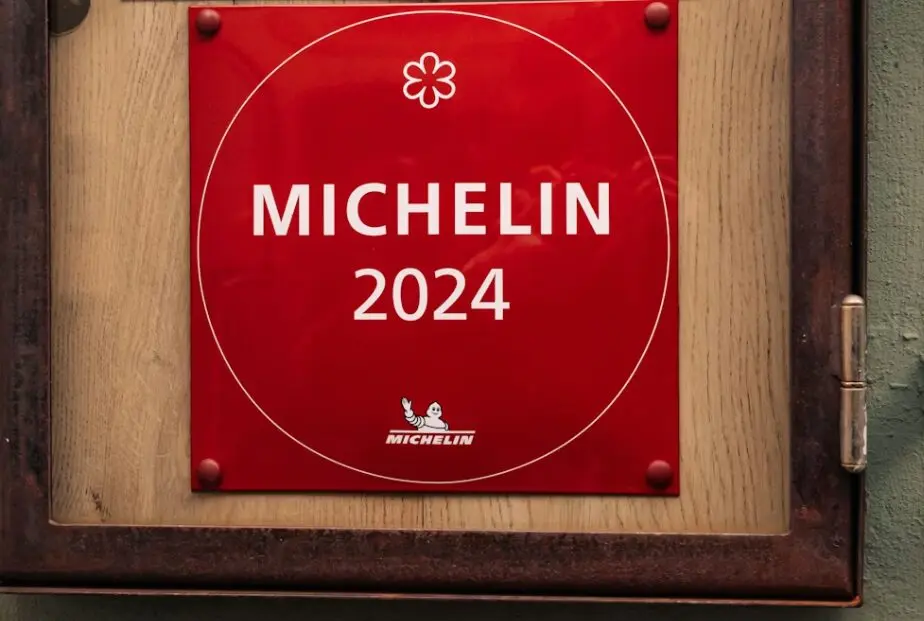
Here are the specific marks you need to know:
Michelin Stars (One, Two, Three)
The pinnacle of culinary achievement. In Seoul, starred restaurants like Jungsik (2 stars) or Onjium (1 star) represent highly refined, often innovative New Korean fine dining. They require reservations months in advance and represent a premium investment.
Michelin Bib Gourmand
Among various Korean restaurant ratings, the Michelin Bib Gourmand is the one travelers trust most.
This is the sweet spot for travelers. The Bib Gourmand denotes restaurants offering exceptionally good food at a moderate price (usually under 45,000 KRW for a complete meal). These are often legendary, traditional spots like Myeongdong Kyoja that provide a deeply authentic and accessible taste of Korea.
Michelin Green Star
This mark is awarded to restaurants like A Flower Blossom on the Rice for their outstanding commitment to sustainable and organic practices. If you see this, you are dining with a conscience.
This is a rare and honorable category in Korean restaurant ratings.
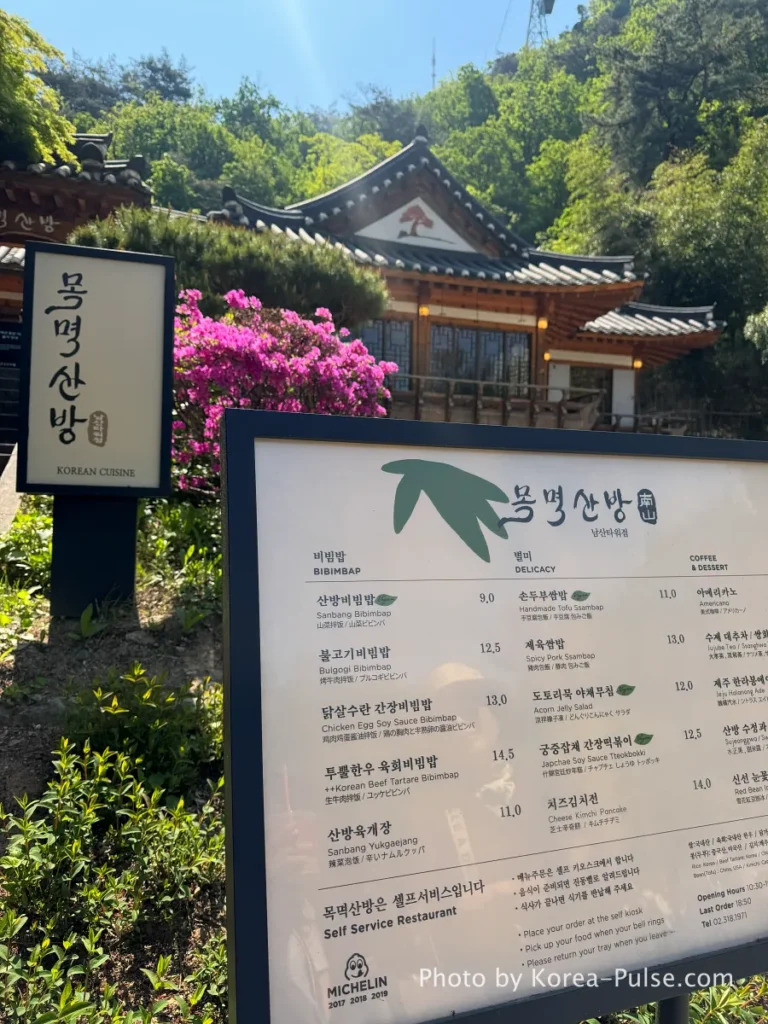
When discussing Korean restaurant ratings, the Michelin Guide is undoubtedly the most recognized global benchmark.
🟦 The Local Authority: Blue Ribbon Survey
However, to truly understand the local landscape, you must look at Korean restaurant ratings from a domestic perspective, which is where the Blue Ribbon Survey excels.
Now let’s look at the local side of Korean restaurant ratings.
While Michelin is global, the Blue Ribbon Survey is one of Korea’s most respected local restaurant guides. Established in 2005, it was Korea’s very first premier restaurant evaluation guide. Think of it as a guide tailored specifically for the Korean palate. Western guides often miss the subtlety of Korean flavors, but Blue Ribbon understands them perfectly.
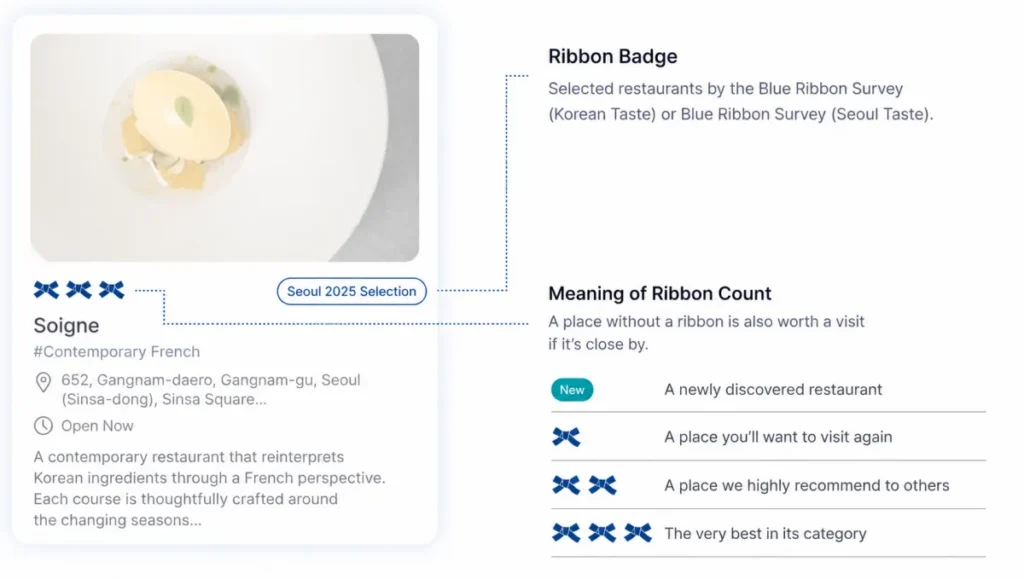
Here is how the local system works:
One Blue Ribbon
This is a high honor. It means the restaurant is a notable neighborhood favorite where you would happily return.
Two Blue Ribbons
This restaurant is excellent. It is highly respected by locals and is a place you would actively recommend to friends visiting from out of town.
Three Blue Ribbons
The absolute pinnacle of local dining. This category is extremely exclusive. When a restaurant carries Three Blue Ribbons, you are often looking at a legendary Nopo (heritage shop) like Hadongkwan, which has been a local favorite for 80+ years. If you want the most authentic, local-verified taste of Korea, this is where you go. This is the highest achievement in local Korean restaurant ratings.
🏆 Why Korean Restaurant Ratings Matter in 2026: The Korea Pulse Verified Strategy
Let me be honest with you. When my wife handed me her phone and showed me her naver blog list — five Myeongdong restaurants she’d quietly been compiling for one of our weekend outings — I didn’t just see a list of places to eat.
I saw exactly what Korea Pulse was built to do. My wife’s intuition often aligns perfectly with these professional Korean restaurant ratings, creating a double-verified list you can trust.
She’s Korean. She grew up here. She knows which doors are worth opening not because a guide told her so, but because she’s been eating her way through this city her whole life. That instinct — local, personal, and deeply trustworthy — is what the Blue Ribbon Survey is built to capture.
And when those same restaurants also carry a Michelin mark? That’s when I, the guy who has eaten in forty countries and still sometimes needs the receipts, feel completely confident putting them in front of you.
Here’s how I think about the two:
Michelin is the friend who has eaten everywhere and comes with a passport full of stamps. When they say something is exceptional, they mean it by a global standard. It’s rigorous. It travels. It compares.
Blue Ribbon is my wife. It knows what a proper bowl of gomtang is supposed to taste like at 7am. It knows which grandmother has been kneading dough in the back of that place since before the shopping district was famous. It knows that a restaurant with two dishes on the menu and a line out the door is probably doing something right.
When a restaurant earns the trust of both? That’s the Korea Pulse standard. And those are the only restaurants we’re going to take you to. Seeing these Korean restaurant ratings on the door gives me total confidence.
Before We Head to Myeongdong
Here’s something I want you to carry with you as you explore Seoul’s food scene.
The stickers on the door matter. But so does the steam rising from the pot, the stack of worn plastic trays by the entrance, the handwritten menu that hasn’t changed in twenty years. The most important meal you’ll eat in Korea might not have any certification at all — just a line of locals who know something you’re about to find out.
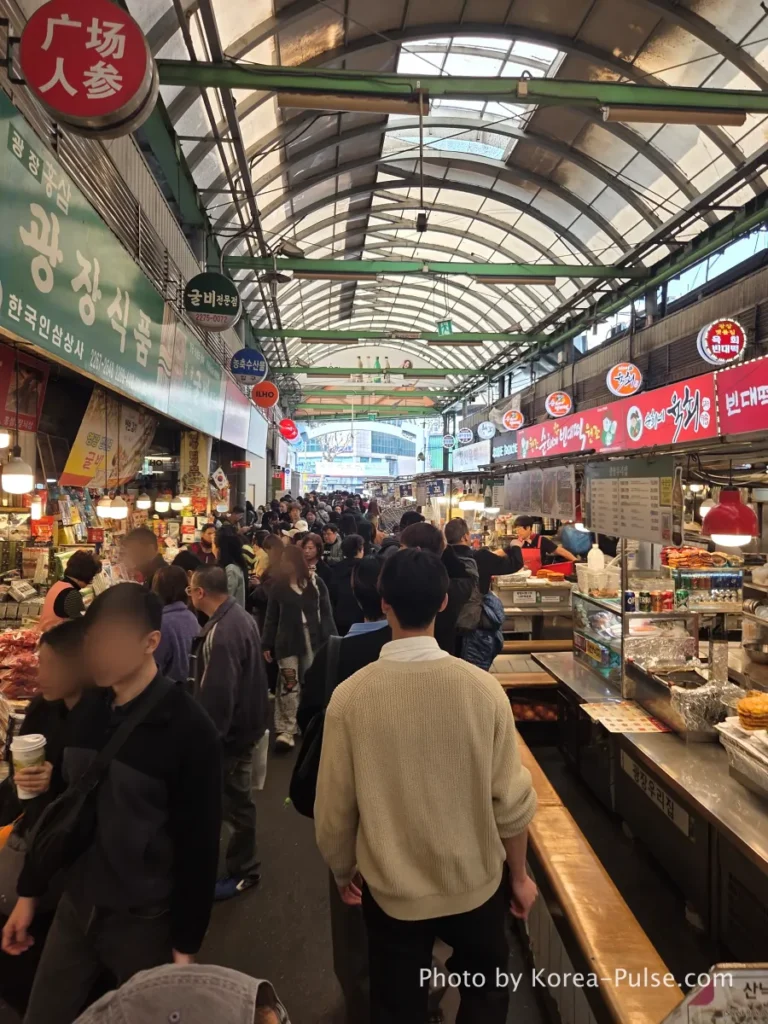
What Michelin and Blue Ribbon give you is a confident starting point. A reason to walk through a particular door without hesitation. The rest — the smell, the warmth, the moment you take your first bite and finally understand why people queue for this — that part is entirely yours.
That’s what eating in Seoul feels like when you know where to look.
And that’s exactly what we’re here for.
Up Next: We’re Opening the Door in Myeongdong
My wife’s list is ready. I’ve done the verification. And next week, we’re heading to Myeongdong — Seoul’s most iconic, most chaotic, and honestly most delicious neighborhood.
We’ll walk past the tourist traps and go straight to the doors that are worth opening: a Michelin Bib Gourmand noodle shop that has outlasted every trend around it, a beef soup institution that has been feeding this city since 1939, and a few spots that most visitors walk right past because they’re too busy looking at the signs.
My wife found them. Korea Pulse verified them. Now we take you there.
The queue is about to make a lot more sense.
All restaurants featured in the Korea Pulse series are verified against current Michelin Guide Seoul and Blue Ribbon Survey listings. No sponsorships. No paid placements. Just the meal.
Verified against the latest 2026 Korean restaurant ratings data.
“While exploring Korean lifestyle, you might also want to check out my guide on Olive Young“ “Looking for a premium beauty experience? Visit idHAIR One Mount“