How to Buy a Seoul Subway Ticket: Step-by-Step Guide for Foreigners (2026)

Series: K-Travel | Post #3 | Previously: Seoul Subway Decoded — Rush Hour, Signage & What to Expect


If you want to buy a Seoul subway ticket without the fuss, this guide is for you.

It’s 6:00 AM. The alarm goes off. Somewhere in Ilsan, a man puts on his shoes, walks to Juyeop station, and taps his phone at 6:32 — mobile transit card, no fumbling, no ticket machine, no deposit to remember. He hasn’t touched a ticket machine in years.

This post is not for him. This post is for you.

The complete, no-panic, step-by-step guide to buy a Seoul subway ticket — single-use, from machine to platform, with everything in between.


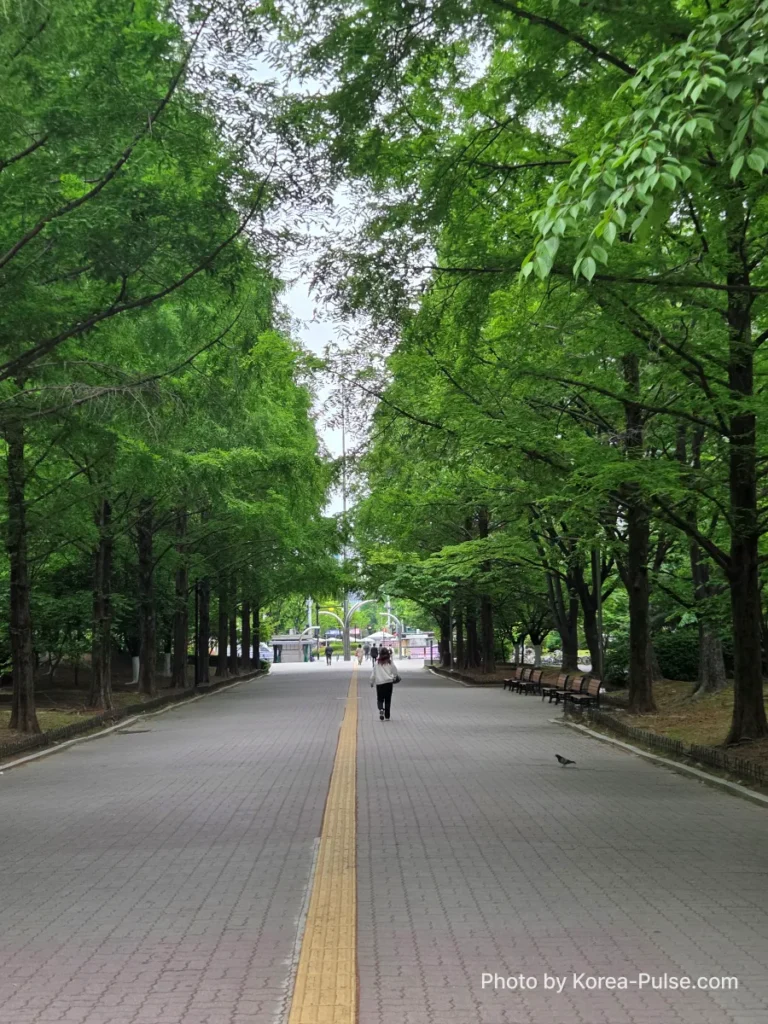
Tree-lined street near Juyeop station on Seoul Metro Line 3 during early morning commute to Seoul
6:23 AM. The city hasn’t caught up with you yet. Five minutes from the station, the air still quiet, the day still yours. Enjoy it — because on the other side of that ticket machine, seven million people are already moving.
Juyeop station entrance on Seoul Metro Line 3 — terminus station and starting point for buying a single journey ticket to Seoul
Juyeop station — the last stop on Line 3, which means it’s the first stop heading into Seoul. The Seoul Metro ticket machine is just inside, to the right of the entrance. And starting at the terminus has one quiet advantage: you’ll always find a seat

Seoul Metro Ticket Machine: Two Types, One Logic

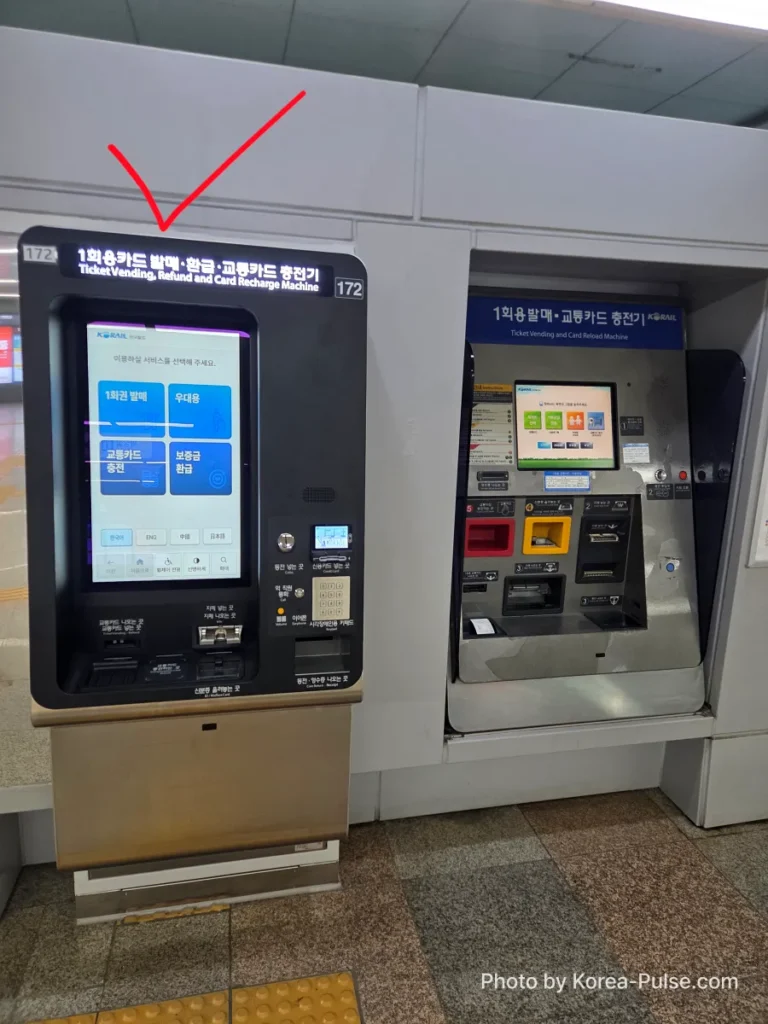
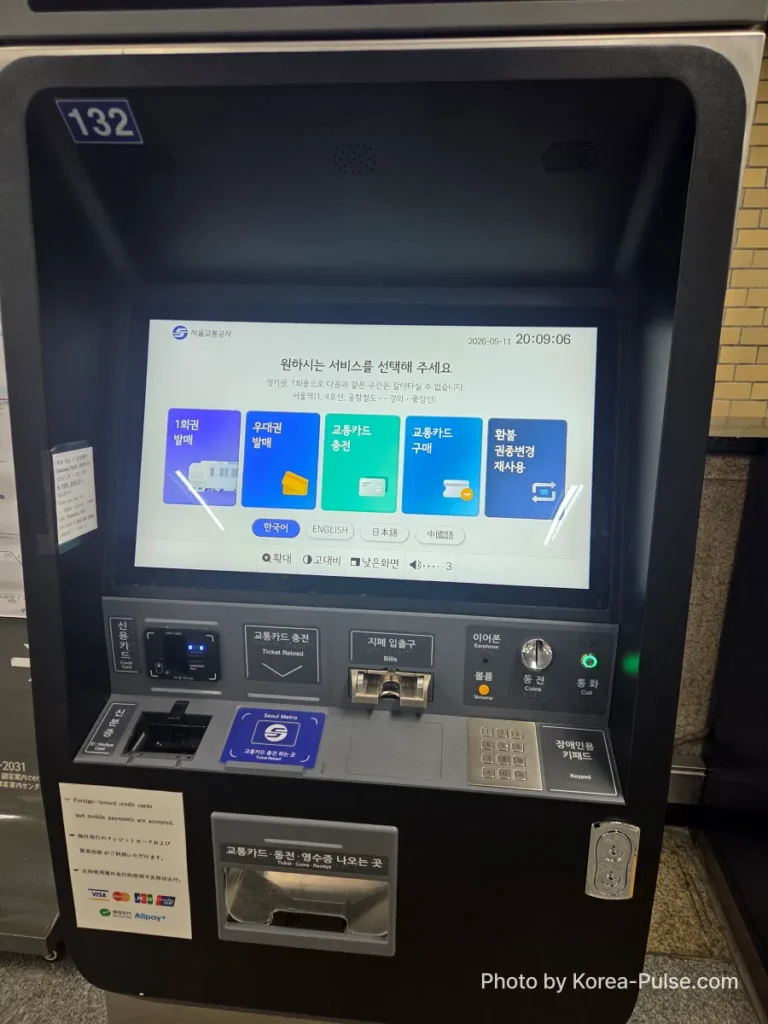
Seoul Metro ticket vending machine positioned near fare gates inside Juyeop station on Line 3 [Buy a Seoul subway ticket]
Walk in, look right. Seoul Metro ticket machines are always placed just before the fare gates — easy to find, no hunting required. This is the vertical screen model, standard on Lines 3 and 4. It looks more serious than it is.

Seoul Metro ticket machines come in two flavours. There’s the vertical screen model — tall, slightly older, more common on Lines 3 and 4. And there’s the wide horizontal screen model — sleeker, newer, more common on Line 2.

They look different enough to cause a moment of doubt. Don’t let them. The logic inside is identical. The buttons are in the same order. The screens ask the same questions. The machine on Line 3 at Juyeop at 6:30 AM and the machine on Line 2 at Euljiro during lunch hour will take you to the same destination through the same steps.

Both accept cash (bills and coins), credit cards, and debit cards. Both give change. Both speak English. Pick whichever one has the shorter queue and proceed with confidence.


How to Buy a Seoul Subway Ticket: Everything You Need to Know

Step 1 — Switch to English and Select Single Journey Ticket
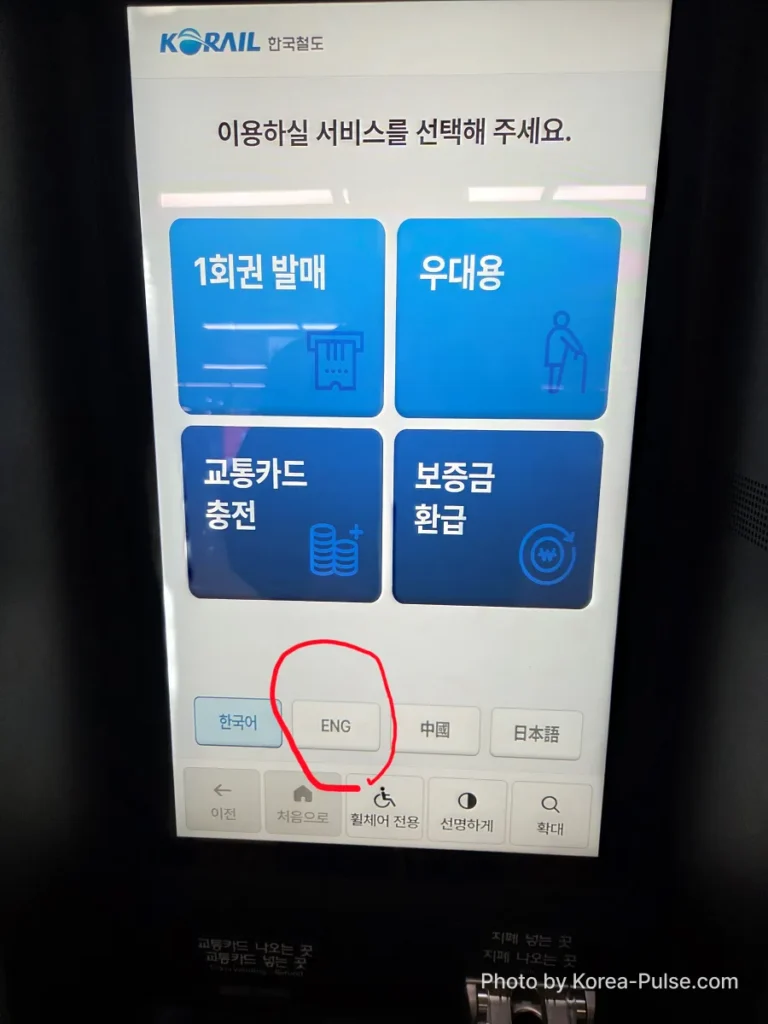
Seoul Metro ticket machine displaying initial screen in Korean — first screen foreigners see when buying a Seoul subway ticket
This is the first screen on the Seoul Metro ticket machine — Korean, all of it. Don’t walk away. The language selector sits at the very bottom: 한국어 / ENGLISH / 日本語 / 中文. One tap and the rest of the process is in English.

The first screen you’ll see is the service selection screen — in Korean. Don’t panic. Look for the language options at the bottom: 한국어 / ENGLISH / 日本語 / 中文. Tap ENGLISH and everything switches. From this point forward, the machine is yours.
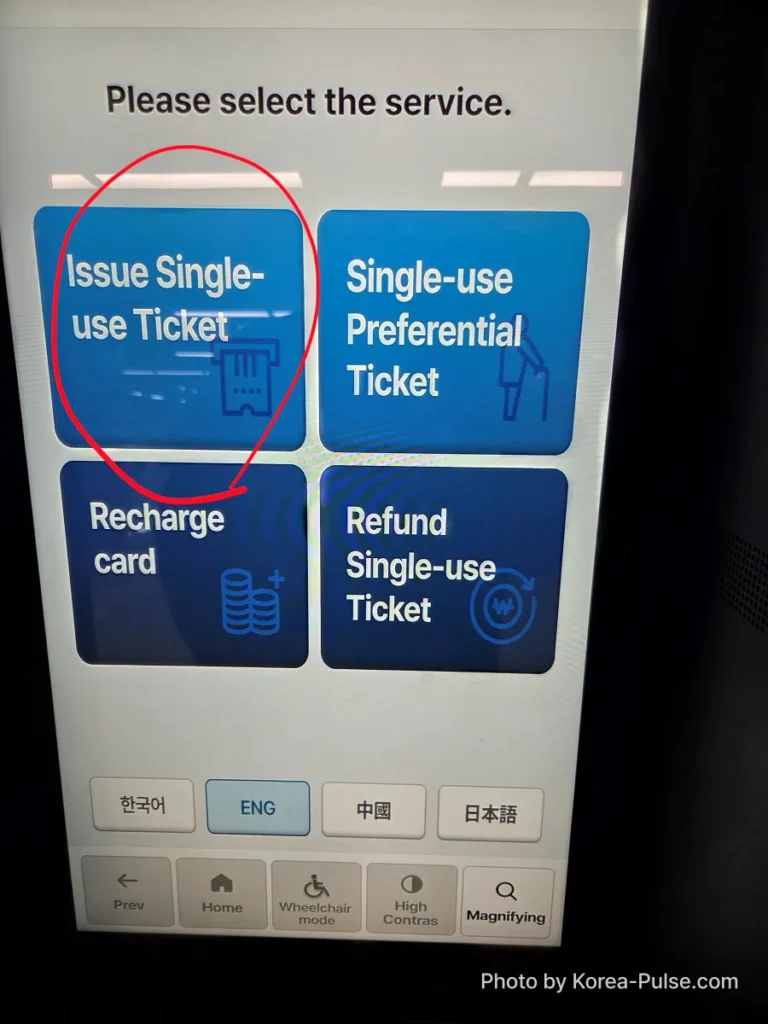
Seoul Metro ticket machine service menu in English showing Single Journey Ticket option — how foreigners buy a Seoul subway ticket
The full service menu, now in English. Five options — but for buying a Seoul metro single journey ticket, tap the first one. Everything else on this screen is for another visit, another day.

Once in English, you’ll see five service options laid out as buttons:

ButtonWhat it’s for
Single Journey Ticket← This is what you want
Free Ticket (Special status)For seniors 65+ and people with disabilities
Reloading the transit cardTop up your T-money card
Purchase transportation cardBuy a new T-money card
Refund / Ticket type change / ReuseReturns and card management

Tap Single Journey Ticket and you’re on your way.

Good to know: See that “Free Ticket (Special status)” button? Seniors aged 65 and over ride Seoul Metro completely free — they just need their Korean ID or welfare card. The machine walks them through it separately. If you’re travelling with an older family member who qualifies, this is the button for them.

Seoul Metro Line 2 horizontal ticket machine showing English service selection menu with Single Journey Ticket clearly labeled  [Buy a Seoul subway ticket]
The same service menu on the Line 2 horizontal machine — wider screen, identical logic. Single Journey Ticket is always the top-left button. Hard to miss on either machine.

Step 2 — Search for Your Destination Station
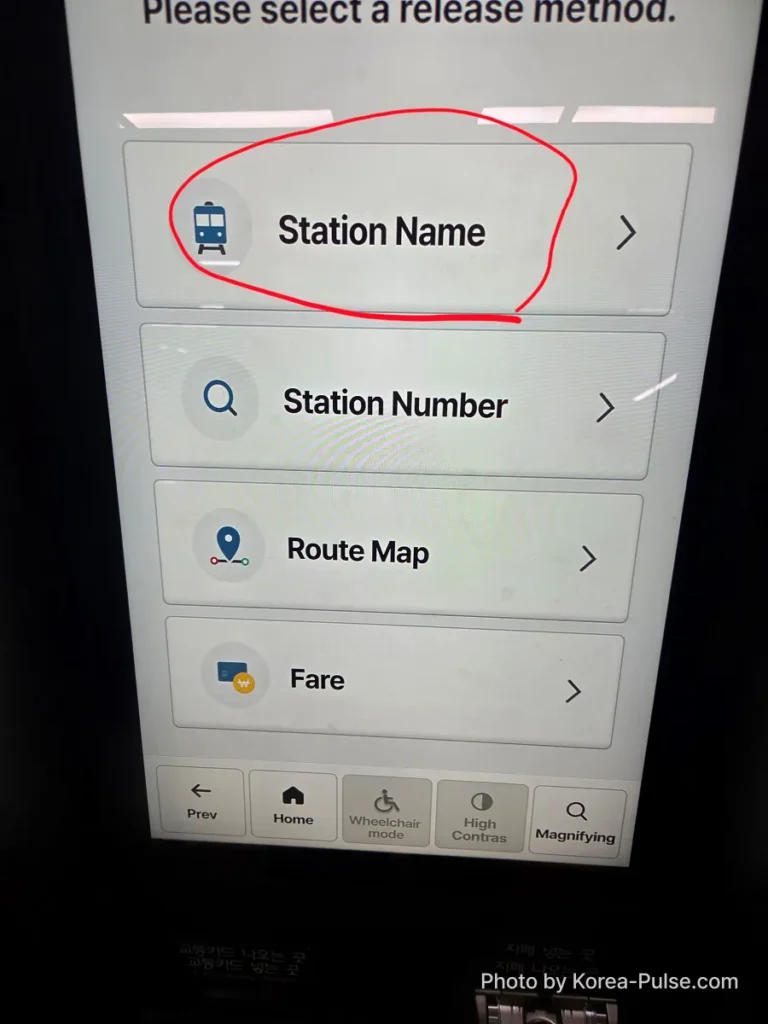
Seoul Metro ticket machine destination search screen with Station Name option highlighted — how to find your stop when buying a Seoul subway ticket
Three ways to search for your Seoul Metro destination — by station name, station number, or route map. Station Name is highlighted here for good reason: it’s the fastest, and the names on the machine match exactly what you see on Naver Map or Google Maps.

The machine asks how you’d like to search. Three options:

  • Station Name — type the name, or browse alphabetically
  • Station Number — every station has a number (e.g., Euljiro 3(sam)-ga is 329 on Line 3)
  • Route Map — browse visually

Station Name is the easiest for most people. Tap it, start typing your destination, and the machine will suggest matching stations.

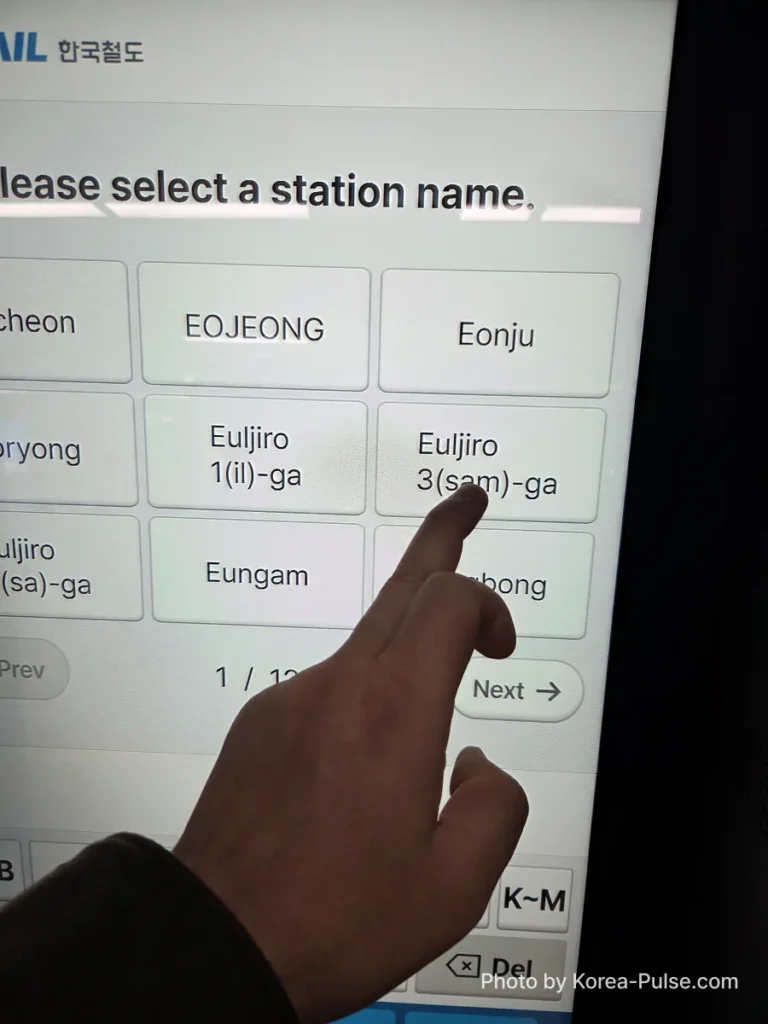
Finger selecting Euljiro 3(sam)-ga on Seoul Metro ticket machine station name grid display  [Buy Seoul subway ticket]
Euljiro 3(sam)-ga — found, tapped, confirmed. Station names on the Seoul Metro ticket machine are romanised identically to every map and transit app. What you searched on your phone is what you type here.

Pro tip: Seoul station names are romanised consistently across maps, apps, and machines. What you see on Naver Map is exactly what you type here.


Step 3 — Choose Number of Tickets and Check the Seoul Metro Fare
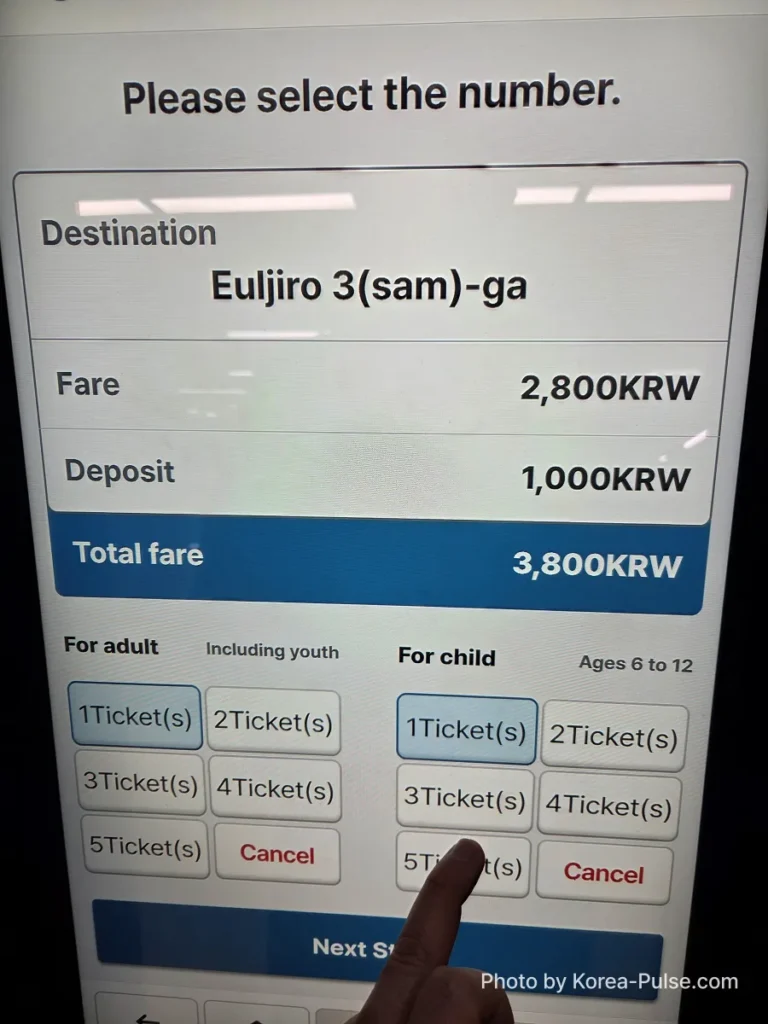
Seoul Metro ticket machine confirmation screen showing destination, Seoul Metro fare, deposit and total before payment  [Buy a Seoul subway ticket]
Destination confirmed, total displayed, no hidden fees. This screen is Seoul Metro’s way of saying: we’ve got nothing to hide. Check it, tap Confirm, and you’re thirty seconds from a ticket.
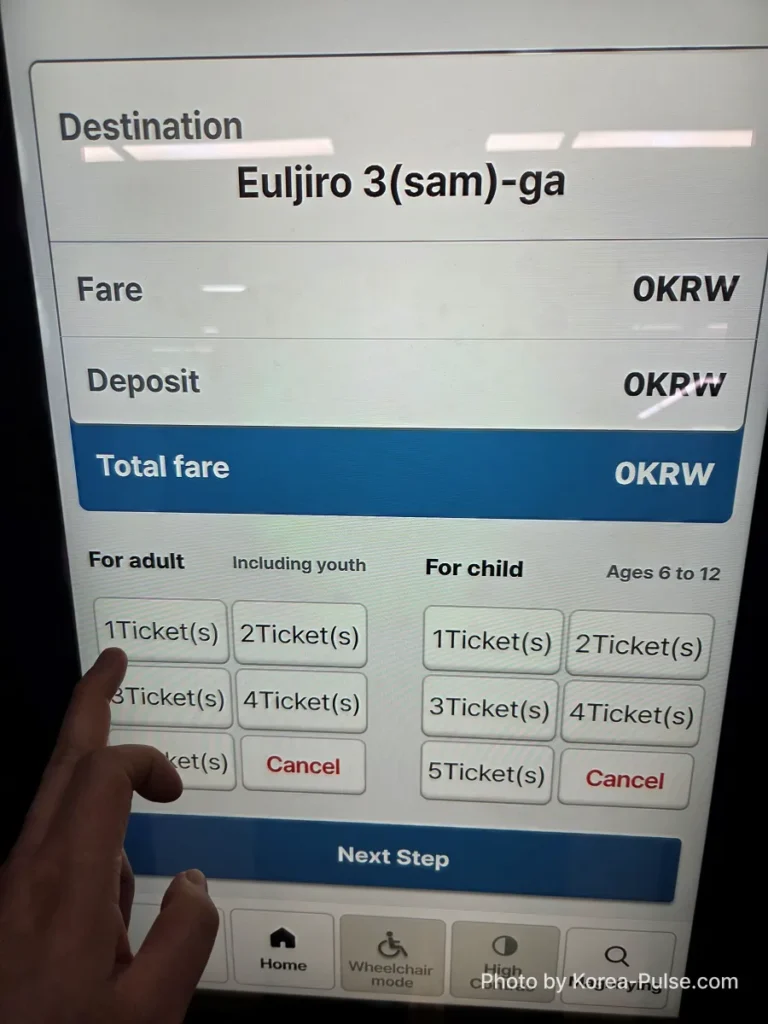
Seoul Metro ticket machine showing fare breakdown for single journey ticket — adult fare, child fare, deposit, and total amount in Korean won
The Seoul Metro fare screen lays it all out before you commit: the actual transit fare, the refundable ₩500 deposit per ticket, and the total. One adult, one child — ₩3,800 including two deposits. No surprises at the gate.

Here’s where the machine shows you the full breakdown:

FareThe actual transit cost
Deposit₩500 per ticket — refundable
Total AmountFare + Deposit

Select 1 Ticket for adult (or however many you need). If you’re travelling with children aged 6–12, the child fare is roughly one-third of the adult fare. Under 6 rides free.

The fare varies by distance — Seoul Metro uses a distance-based system. The base fare (first 10km) is ₩1,550 for adults. Beyond that, it adds ₩100 for every additional 5km. My morning commute from Juyeop to Euljiro 3(sam)-ga — about 30km — comes out to ₩1,950 per adult before the deposit. Less than a cup of coffee. Seoul Metro is generous like that.

Not sure why your total looks higher than expected? Here’s the full breakdown:

DescriptionAdult (19+)Child (6–12)
Base fare (first 10km)₩1,550₩550
Extra distance+₩100 per 5km+₩100 per 5km
Deposit₩500₩500

Real example — Juyeop to Euljiro 3(sam)-ga (approx. 30km):

  • Adult: ₩1,550 base + ₩400 extra distance = ₩1,950
  • Child: ₩550 base + ₩300 extra distance = ₩850
  • Total for 1 adult + 1 child (with 2 deposits): ₩1,950 + ₩850 + ₩1,000 = ₩3,800

Which is exactly what the screen in the photo shows. The machine isn’t overcharging you — Seoul is just bigger than it looks on the map.


Step 4 — Confirm Destination and Total Fare

The machine shows you a summary screen: destination, fare, deposit, total. This is your last chance to check everything before paying. If something looks off, hit Previous. If it’s all correct, tap Next Step.


Step 5 — Pay by Cash or Card (All Major Cards Accepted)
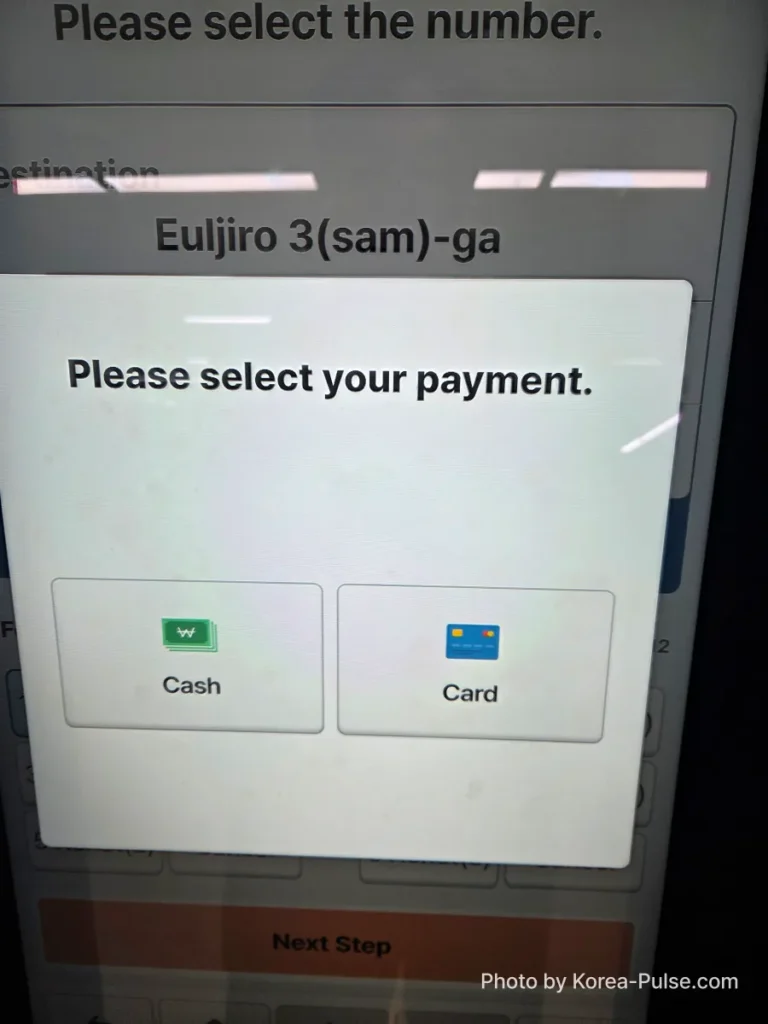
Seoul Metro ticket machine payment screen showing Cash and Card options for buying a single journey subway ticket in Seoul
Cash or card — that’s the whole decision. International Visa and Mastercard work fine. So do bills and coins. From this screen to ticket in hand is about thirty seconds.

It’s time to buy a Seoul subway ticket using your preferred payment method.

Two options: Cash or Card.

  • Card: Tap, insert, or wave — the machine handles contactless, chip, and swipe. International Visa and Mastercard work fine.
  • Cash: Bills and coins accepted. Up to 15 bills and 20 coins per transaction. The machine gives change.
Seoul Metro ticket machine coin insertion slot highlighted with red circle annotation — paying cash for a Seoul subway single journey ticket
The coin slot, circled in red. Bills go in the wide slot to the right; coins go here. Maximum 20 coins per transaction — more than enough. If your total is above ₩10,000, card is faster.

The ticket comes out of the slot at the bottom — small, flat, and easy to overlook. It looks like something you’d throw away. Don’t. It’s your key out of the system, and the ₩500 deposit inside it is quietly waiting to become street food.


Step 6 — Tap Your Ticket at the Gate and Head to the Platform
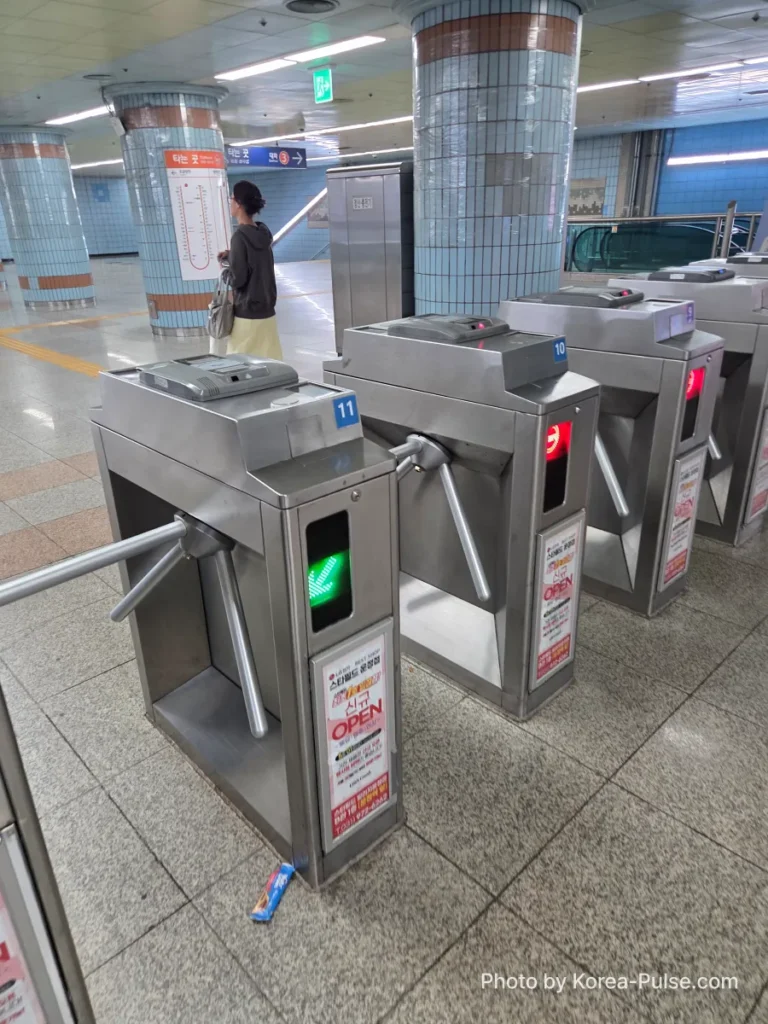
Passenger tapping single journey ticket at Seoul Metro fare gate to enter subway station
Tap the single journey ticket flat on the reader. Green light. Gate opens. It’s the smallest moment of the whole journey — and somehow still satisfying every single time.

Tap the ticket on the reader at the gate — the same way you’d use a transit card anywhere. Green light, gate opens, you’re in. Head down to the platform, follow the signage for your line and direction, and you’re on your way.

Escalator descending to Seoul Metro platform with bilingual Korean and English safety sign reading "Hold onto the handrail"
Down the escalator, ticket in hand, train in a few minutes. Even the safety signs are bilingual — “손잡이를 꼭 잡으세요 / Hold onto the handrail.” Seoul Metro looks after you all the way to the platform.
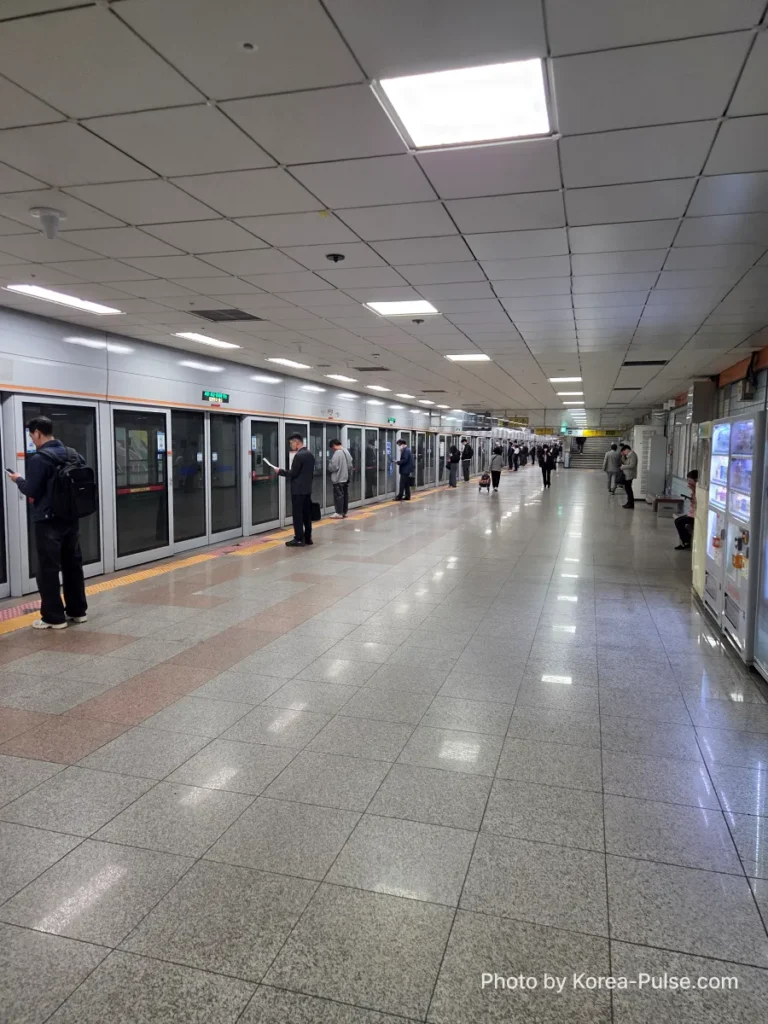
Empty Seoul Metro Line 3 platform at Juyeop station with platform screen doors at 6:30 AM before morning rush hour
Juyeop platform, 6:29 AM. Platform screen doors closed, train incoming, nobody pushing. This is what the Seoul subway looks like before the rest of the city wakes up — and why leaving early is always the right call.

If you’re not sure which platform to take, I covered this in detail in the previous post — the platform signage in Seoul is genuinely excellent and will tell you exactly which direction you need.


Seoul Metro Deposit Refund: How to Get Your ₩500 Back

Two Seoul Metro Deposit Refund Device machines side by side with blue bilingual signage — where to return single journey tickets and collect ₩500 deposit [Buy a Seoul subway ticket]
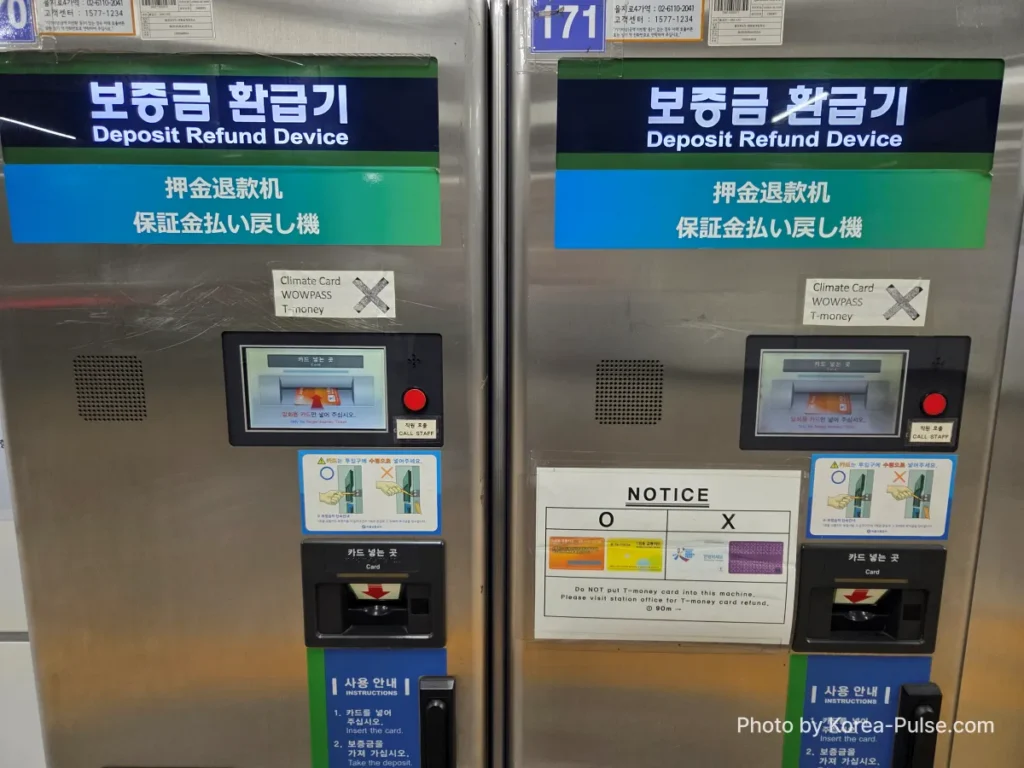
The Deposit Refund Device — blue sign, four languages, always near the exit gates. Left machine for regular single journey tickets; right one for the Climate Card. There’s an O/X diagram on the front to show you which is which. Check it before inserting.

The deposit is refundable. Every station has a Deposit Refund Device (보증금 환급기) — the machines with the bright blue sign, usually sitting right next to the exit gates. Hard to miss. Insert your used single journey ticket into the slot, and out comes a ₩500 coin.

Notice there are often two machines side by side: one for regular single-use tickets, one for the Climate Card. Check the label on the front panel before you insert — the “NOTICE” sticker shows you which card goes where with a simple O/X diagram.

It’s a small amount, but: street tteokbokki starts at ₩3,000, and three refunded deposits get you halfway there. More importantly — please don’t just throw the ticket away. The deposit system exists to keep single-use cards in circulation. Be the responsible tourist.
Seoul Metro Deposit Refund Device screen showing three options — Refund, Change card type, and Reuse of Lost Card — for single journey ticket holders [Buy a Seoul subway ticket]
Three options on the refund machine — Refund, Change card type, Reuse of Lost Card. For most visitors, it’s the first one. Tap it, insert your used ticket, and a ₩500 coin drops out. Small win. Fully deserved.
Seoul Metro machine screen showing instruction to place transit card face-down on reader surface for refund or recharge service
For card-related services — refunds, recharges, card reuse — lay your transit card flat on the reader surface as shown on screen. The machine reads it and handles the rest automatically. No staff required. No Korean needed.

Seoul Subway Ticket Machine in Real Life: Euljiro at Noon

Seoul Metro Line 2 ticket machines and digital information kiosk in Euljiro underground arcade, with beverage vending machines visible nearby
The Euljiro underground arcade at noon — Seoul Metro ticket machines centre, digital information kiosk to the right, and yes, a vending machine on the left for when the commute hits differently. This stretch between Euljiro 4-ga and City Hall is where I see the most foreign visitors every day. And almost always, at least one person frozen in front of a machine — the right one, hopefully.

Every day around noon, I walk from Euljiro 4-ga to City Hall station through the underground arcade. It’s one of Seoul’s underrated pleasures — a long, quietly buzzing underground corridor that connects several stations and smells, inexplicably, like the 1990s.

And at the Line 2 ticket machine area, there is almost always a queue of foreign visitors. Couples with rolling luggage. Backpackers squinting at the screen. Someone’s grandmother being gently guided through the process by someone who clearly just figured it out themselves five minutes ago.

Foreign visitor standing alone at Seoul Metro Line 2 ticket machine in Euljiro underground station — buying a single journey ticket to travel in Seoul
The universal posture of someone buying a subway ticket in a foreign city — weight on one foot, head slightly tilted, one hand extended toward the screen. She’ll figure it out. They always do. But this guide might save her the three minutes of hesitation.
Multiple foreign visitors queuing at Seoul Metro ticket machines in Euljiro underground arcade to buy single journey subway tickets
It’s not just one person. At any hour of the day, there are foreign visitors figuring out how to buy a Seoul subway ticket at these machines — rolling luggage, open maps, the slightly glazed look of someone jet-lagged and trying. The machines can handle it. And now, so can you.

The Line 2 machines here are the wide horizontal screen variety — newer-looking, slightly more intimidating at first glance. But as I said: same logic, same steps, same result. The screen is bigger; the process is identical.

And if the machine itself feels like too much, there’s usually a large digital information kiosk nearby — touchscreen, multilingual, with a full route map and fare calculator built in. No queue. No pressure. Take your time with it, figure out your destination and Seoul Metro fare, then go to the machine already knowing what to do.


Vertical vs Horizontal: Both Seoul Metro Ticket Machines Work the Same Way

Seoul Metro Line 2 wide horizontal screen ticket vending machine — the newer machine type foreigners encounter when buying subway tickets in central Seoul
The Line 2 horizontal ticket machine — wider screen, cleaner interface, same five steps inside. If the vertical machine on Line 3 felt like a vintage kiosk, this one feels like a modern airport terminal. The experience is identical. Only the shape changed.

On my way home, I stopped to try the Line 2 horizontal machine properly — the kind I walk past every day but never actually use, being a mobile transit card person since approximately forever.

Seoul Metro Line 2 horizontal ticket machine displaying English service selection menu — same options as vertical machine for buying a single journey subway ticket
Switch to English, and the horizontal machine shows you the exact same service menu as the vertical one at Juyeop — Single Journey Ticket at the top left, same five options, same logic. The screen is wider. The decision is identical
Seoul Metro Line 2 horizontal ticket machine payment selection screen showing Cash and Card options for buying a Seoul subway single journey ticket
Cash on the left, card on the right — clear, large, easy to read. The coin slot and bill acceptor are right below, labelled with a diagram (maximum 15 bills, 20 coins). Different machine, same payment options, same result: ticket out the bottom.

The interface is cleaner, the touch response is faster, and the payment section is more clearly laid out — Cash on one side, Card on the other, large enough to read without squinting. The coin slot and bill acceptor are clearly labelled with a diagram showing the maximum (15 bills, 20 coins).

Same destination search. Same fare calculation. Same deposit. Same ticket out the bottom.

The machines look different. They are not different. This is a comforting fact about Seoul Metro.


Seoul Metro Ticket Payment Options: Cash, Card, and More

MethodWorks?Notes
Korean credit/debit cardAlways
International Visa/MastercardContactless + chip both work
Cash (bills)Up to 15 bills per transaction
Cash (coins)Up to 20 coins
T-money cardRecharge at machine or convenience store
Mobile payment (Samsung/Apple Pay)At newer gates and machines

Beyond the Single Journey Ticket: Smarter Options for Longer Stays

If you’re staying longer than a day — and honestly, you should be — the single journey ticket has done its job. Time to graduate.

T-money Card — Buy at any GS25, CU, or 7-Eleven for ₩3,000–5,000, then top up as needed. Slightly cheaper per ride than a single journey ticket, no deposit hassle, works on buses and taxis too. It’s a small piece of plastic that quietly makes Seoul feel a little more like home. This is the baseline recommendation for anyone staying two days or more. Official English guide: eng.tmoney.co.kr.

Climate Card (기후동행카드) — Visitor Pass — Unlimited subway and bus rides within Seoul for a flat fee. Available in 1, 2, 3, 5, and 7-day versions starting from ₩5,000 per day. If you’re the kind of traveller who moves through a city rather than sitting in it — multiple neighbourhoods, spontaneous detours, one more stop just to see — this card is built for you. More info: english.seoul.go.kr.

WOWPASS — An all-in-one card for foreign visitors combining currency exchange, transit, and general payments. One card, less pocket chaos. You’ll see the kiosks in Euljiro and at major stations. More at wowpass.io.

Contactless credit card at the gate — In 2026, most Seoul subway gates accept international contactless cards directly. Tap your Visa or Mastercard at the gate reader and skip the machine entirely. No ticket, no deposit, no queue. Just tap and go — the way the locals wish everyone could.

🔗 External links: Seoul Metro official site (English) | T-money English guide | VisitKorea — Transportation Cards | Climate Card info | Naver Map — transit routing


The Full Commute: From Juyeop Station to Seoul, Step by Step

Let me put the whole thing together the way it actually happened.

6:23 AM. Out the door in Ilsan, green canopy overhead, city not yet awake. Five-minute walk to Juyeop station — the first stop on Line 3, which means I always get a seat. Small luxury. Non-negotiable.

Down the escalator. Seoul Metro ticket machine on the right. Language set to English, destination Euljiro 3(sam)-ga, one adult single journey ticket, card tapped. Total: ₩2,150 (₩1,650 fare + ₩500 deposit). Ticket out the bottom. Gate open. Escalator down.

6:33 AM. Train in four minutes. Right on schedule.

This is the commute. This is the system. And now, so help me, it can be yours too.

Now that you know how to buy a Seoul subway ticket like a local, where will your first stop be?


Up Next on K-Travel

The underground corridor between Euljiro 4-ga and City Hall station is one of Seoul’s most overlooked daily experiences — and one of the best places to understand how this city actually moves. Next post: the Euljiro underground arcade, and what it feels like to walk it every single day.

🔗 Internal links: ← Seoul Subway Decoded: Rush Hour, Signage & What to Expect | K-Travel Series continues →


korea-pulse.com | K-Travel Series #3

Leave a Comment