
Category: K-Screen | Related: Perfect Crown (2026): Why This K-Drama is #1 on Disney+
Episode 9 of We Are All Trying Here made me smile in a way I hadn’t expected.
Not the giddy, plot-twist kind of smile. The other kind — the quiet, involuntary one that rises from somewhere deeper when a story does something genuinely true about being human. The last time a Korean drama made me smile like that was My Mister. Same writer. Same feeling. Different wound.
I almost didn’t make it to episode 9. And I suspect a lot of you didn’t either.
This is my honest account of why you should go back and complete We Are All Trying Here.
Drama Profile
| Title | We Are All Trying Here (모두가 자신의 무가치함과 싸우고 있다) |
| Also known as | Mojamussa (모자무싸) |
| Network / Platform | JTBC / Netflix |
| Episodes | 12 |
| Aired | April 18 – May 24, 2026 (Saturdays & Sundays) |
| Screenwriter | Park Hae-young (My Mister, My Liberation Notes, Another Miss Oh) |
| Director | Cha Young-hoon (When the Camellia Blooms, Welcome to Samdal-ri) |
| Main Cast | Koo Kyo-hwan, Go Youn-jung, Oh Jung-se, Kang Mal-geum, Park Hae-joon, Bae Jong-ok, Han Sun-hwa, Choi Won-young |
| Rating | 15+ |
| Where to watch | Netflix |
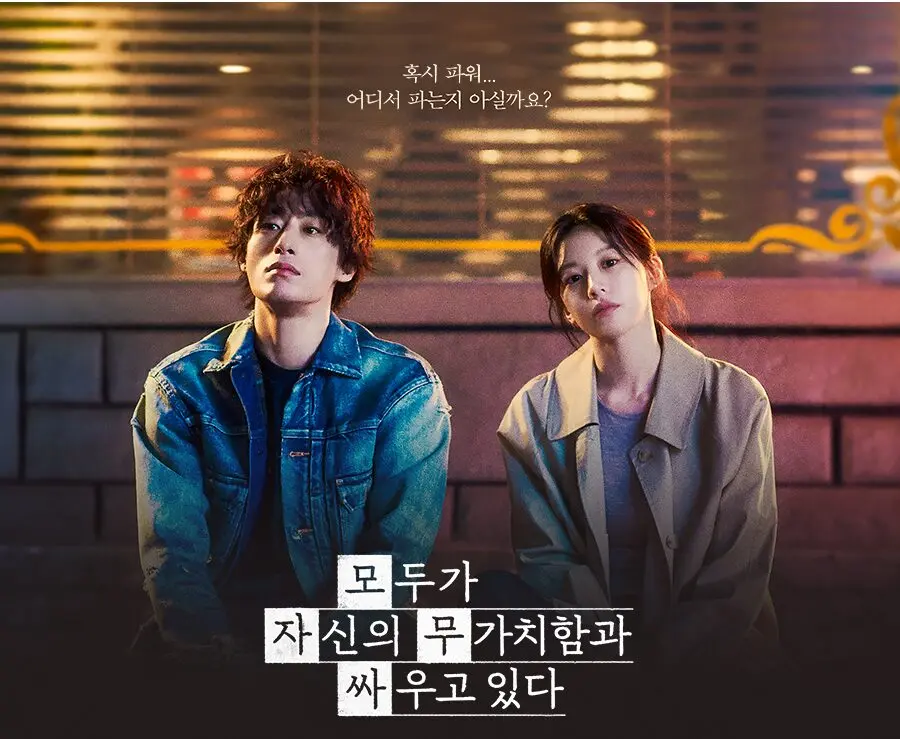
Why We Are All Trying Here Was Always Going to Matter
Let me be clear about something before we go any further.
Writer Park Hae-young is not a name that belongs in a drama profile table. It belongs in a different conversation entirely — the one about the small handful of Korean television writers who have, with quiet insistence, changed what the medium is capable of saying about human beings.
Her 2018 drama My Mister (나의 아저씨) is, for many people — myself included — not just a favourite show but a personal landmark. If you’ve read our piece on Perfect Crown (21세기 대군부인), you’ll remember how we explored IU‘s extraordinary range — from the raw, wounded Lee Ji-an in My Mister to her commanding presence as a modern chaebol heiress navigating a fictional constitutional monarchy. In My Mister, she plays Lee Ji-an: a young woman so accustomed to surviving that she’d forgotten what living felt like. And Lee Sun-kyun — the late, deeply missed actor — as the middle-aged man who didn’t save her so much as simply recognized her. They healed each other. Quietly. Without making a fuss about it.
That is what Park Hae-young does. She writes human beings the way human beings actually are — messy, self-defeating, occasionally unbearable — and then she finds the exact moment when something shifts, and the warmth that floods in at that moment is almost more than you can hold.
When We Are All Trying Here was announced, with Park Hae-young writing and Go Youn-jung leading — my absolute favourite Korean actress — I had exactly one reaction: this is going to be something.
And then I watched episodes 1 and 2 of We Are All Trying Here.
The Hwang Dong-man Problem: Why We Are All Trying Here Episodes 1–2 Will Test You
Koo Kyo-hwan is a genuinely excellent actor. Anyone who watched him in D.P. knows this. He has the kind of raw, unpolished screen presence that more conventionally handsome actors spend careers trying to manufacture. He’s not your typical K-Drama leading man — no flower-boy visuals, no easy charisma — and that is, normally, precisely why he’s interesting to watch.
In We Are All Trying Here, he plays Hwang Dong-man: an aspiring film director who is the only member of his prestigious college film group — “The Eight” — who has never debuted. Twenty years of almost. Twenty years of watching his peers collect awards while he collected excuses.
The character is, in the early episodes of We Are All Trying Here, almost physically difficult to spend time with. Petty. Paranoid. Consumed by a jealousy so acute it has curdled into something closer to self-destruction. If you had a friend like Hwang Dong-man in real life, you would — as I noted watching episode 1 — probably have already ended the friendship.
Online communities were vocal about it. The discomfort was real, and widely shared. Many people dropped the show. I nearly did too.
But I stayed. Because of two things.
What Kept Me Watching: Trust and Go Youn-jung
The first was simple faith in Park Hae-young. She has earned it.
The second was Go Youn-jung.
Playing Byun Eun-ah — a film production manager at Choi Films, perpetually overworked, perpetually underacknowledged — Go Youn-jung does something remarkable. She puts down her beauty like it’s a weapon she’s decided not to use today. In a industry where looking like Go Youn-jung would be reason enough to coast, she chooses instead to fight with pure emotion, pure presence, pure acting.
Her eyes in the early episodes carry the specific weight of someone who has been managing other people’s crises for so long that she’s stopped noticing her own. It is a performance of extraordinary restraint. And it made We Are All Trying Here worth watching from the first episode, even when Hwang Dong-man was making me want to look away.
Episodes 3–7: The Slow Alchemy
Something strange begins to happen around episode 3.
You start to see Hwang Dong-man differently. Not because he changes — he doesn’t, not yet — but because Park Hae-young reveals, layer by layer, what his unbearable behaviour is actually made of. The jealousy isn’t petty. It’s existential. The man has spent two decades watching everyone around him become someone, while he remains — in his own estimation, and apparently everyone else’s — nobody.
The show’s central premise cuts deep: 99% of people spend their entire lives trying to prove they are “a decent person” — through achievement, appearance, money — and when they can’t succeed through success, they feel compelled to become special through failure instead. But that claim is constantly frustrated, constantly falling short.
Koo Kyo-hwan’s erratic energy, his unpredictable physicality, his unusual vocal rhythms — all the things that felt wrong in episode 1 — begin to feel exactly right. He’s not miscast. He was perfectly cast for a character who takes time to understand, because Hwang Dong-man himself takes time to understand.
The show was asking for patience. Park Hae-young always asks for patience. She always makes it worth it.
Episodes 8–9: The Moment It Breaks Open
And then, episodes 8 and 9.
Everything that Park Hae-young has been quietly, carefully building — the humiliation, the small defeats, the desperate flickers of dignity — finally accumulates into something. Hwang Dong-man, who has spent his life writhing under the weight of feeling worthless, begins to glimpse the possibility that he might not be. A real opportunity arrives. A door, finally, opens.
Watching him receive it — watching someone who has spent twenty years being told, implicitly and explicitly, that he doesn’t count, suddenly begin to reclaim his self-respect — produces a very specific reaction. Not excitement. Something quieter. A smile that rises without permission, the kind that comes from watching a human being remember they exist.
It is not a grin at a plot twist. It is the exact same smile that My Mister produced — the warmth of watching one person be genuinely recognized by another. Of watching Byun Eun-ah see Hwang Dong-man — really see him — at the moment he needs it most. Of watching worthlessness, briefly, recede.
That is the catharsis this show has been building toward. And when it arrives, you will feel it in a way that has nothing to do with television.
“Why do people fight so desperately to prove they are someone decent?” Park Hae-young asks this question across all her work. And the answer she gives, every time, is the same: because that fight is the most human thing there is.
We are all, quietly, fighting our own version of Hwang Dong-man’s war.
The Park Hae-young Universe: Your Viewing Roadmap
We Are All Trying Here doesn’t exist in isolation. It is the latest chapter in a body of work by Park Hae-young that returns, again and again, to the same essential question from different angles.
If you’re new to Park Hae-young’s writing, here is the recommended order:
Step 1 — Start with My Mister (나의 아저씨, 2018) Available on Netflix. The one that started everything. IU and the late Lee Sun-kyun. Non-negotiable. If you’ve already been following IU’s work through our Perfect Crown review, this is the other side of her range — stripped of glamour, raw, and unforgettable.
Step 2 — Watch We Are All Trying Here (2026) Now on Netflix. Push through the first two episodes. By episode 9, you will understand why.
Step 3 — Attempt My Liberation Notes (나의 해방일지, 2022) Available on Netflix. Famous for requiring you to outlast its initial atmospheric heaviness before delivering something extraordinary. I haven’t started it yet either. We’ll tackle it together.
🔗 Watch: We Are All Trying Here on Netflix | My Mister on Netflix | My Liberation Notes on Netflix
Korea Pulse Verdict
We Are All Trying Here is not an easy drama. It earns its warmth slowly, through discomfort, through a character who is designed to test your tolerance before revealing why he deserved your patience all along.
That is, in the end, rather the point.
Because Hwang Dong-man isn’t an anomaly. He is the version of ourselves we most want to deny — the one that is still waiting for permission to exist, still measuring its worth against the shiny lives of people who seem, from the outside, to have figured something out that we haven’t.
Park Hae-young keeps writing this character, in different forms, because she knows that character lives in all of us. The drama’s Korean title — Everyone Is Fighting Their Own Worthlessness — is not a dramatic metaphor. It is a description of Tuesday.
Stay through episode 2. Stay through the cringe. Episode 9 is waiting for you.
It will make you smile in that particular way.
Have you been watching We Are All Trying Here? Did episodes 1 and 2 almost lose you — and did you stay? Let us know in the comments below.
🔗 Internal links: Perfect Crown (2026): Why This K-Drama is #1 on Disney+ | Unplanned Trip: Limited Edition — Another Must-Watch Korean Show
korea-pulse.com | K-Screen