
K-TRAVEL · MAY 2026
Myeongdong Cathedral
Seoul’s Gothic Soul, Hidden Above the Shopping District
128 years of history, a secret elevator entrance, and the crypt that stays with you longest.
Category: K-Travel
Previously on Korea Pulse: Myeongdong Street in May — Food, Vibes & the Real Pulse of Seoul | Best Myeongdong Restaurants — Verified Guide
We promised this one. In our Myeongdong street walk post, we mentioned Myeongdong Cathedral twice and photographed it once, and said it deserved its own post. Here it is — a long lunch break, an hour inside one of the most quietly remarkable buildings in Seoul, and everything I learned along the way.
I took a long lunch break, walked from my office near Euljiro 4-ga, and spent an hour inside one of the most quietly remarkable buildings in Seoul. Not remarkable in the way that the Louvre is remarkable, or Notre-Dame, or the Sagrada Família — Myeongdong Cathedral is smaller, softer, more personal than any of those. But remarkable in the way that a building can be when it has absorbed 128 years of a city’s grief, its faith, and its most difficult moments, and still stands there on a hill above a shopping district, patient and permanent, watching Myeongdong change around it without changing itself.
I’ve been inside a lot of European cathedrals over the years. This one felt different in ways I’m still working out.
A Short History: How a Gothic Cathedral Ended Up on a Seoul Shopping Hill
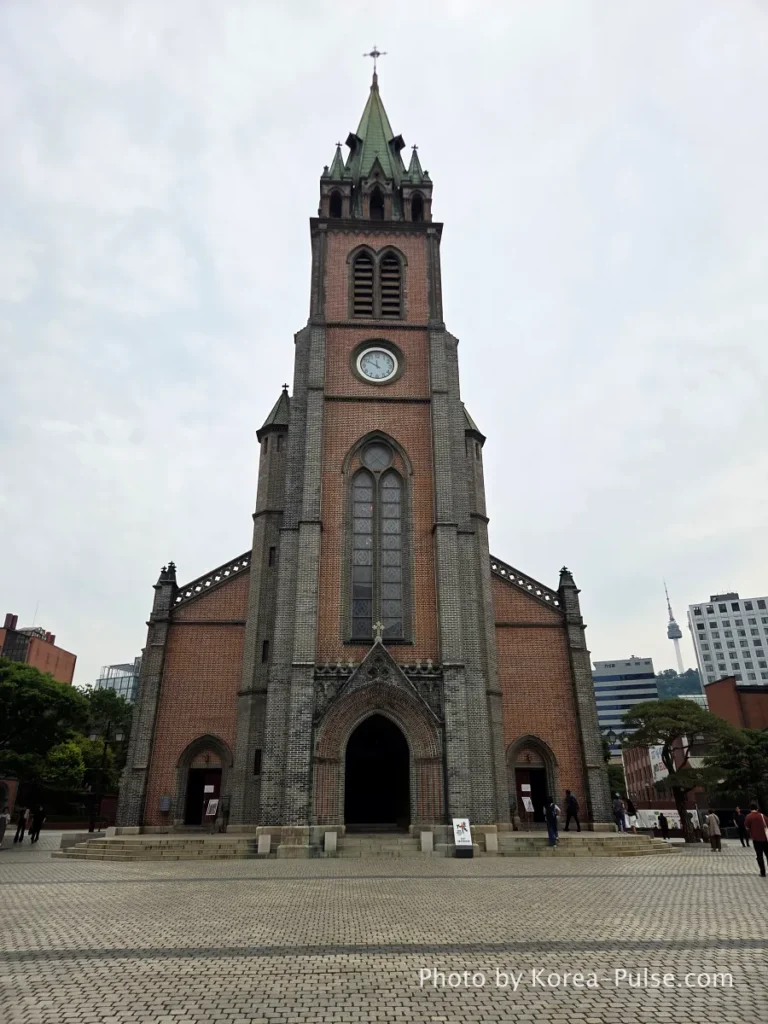
Catholicism entered Korea not as a religion but as a study — initially referred to as Western Learning (서학) by Confucian scholars who encountered it through Chinese texts. That academic curiosity eventually became a faith, and that faith was violently suppressed. Throughout the 18th and 19th centuries, the Joseon government executed thousands of Korean Catholics in a series of persecutions. Among the countless Korean Catholic martyrs, 103 have been canonized as saints and an additional 124 have been beatified.
The site where Myeongdong Cathedral now stands was home to one of the earliest Catholic communities in Seoul, known as the Myeong-rye-bang community. The cornerstone of the cathedral was laid on May 8, 1892, and after six years of construction under the direction of French missionary priests, the building was completed and consecrated on May 29, 1898.
It stands as the first major Gothic Revival-style brick cathedral in Korea. While the nearby Yakhyun Catholic Church (completed in 1892) is recognized as Korea’s first brick church built in a Gothic-Romanesque hybrid style, Myeongdong Cathedral was the first large-scale, fully Gothic brick cathedral. Its official name, the Cathedral Church of the Virgin Mary of the Immaculate Conception, reflects the Marian devotion that the early Korean church carried through its years of persecution.
Different from other Gothic architectures, Myeongdong Cathedral was built using bricks instead of stone. Various shapes of red and grey bricks were used in construction, creating a unique visual texture that gives the building a warmth that pure stone cathedrals rarely achieve.
The cathedral’s 45-metre bell tower is one of the most recognizable silhouettes in central Seoul. And for the past century, it has been visible from Myeongdong’s shopping streets as a reminder that not everything in this neighbourhood is for sale.
🔗 External: Myeongdong Cathedral Official Website | VisitKorea — Myeongdong Cathedral
The Secret Entrance: Through 1898 Plaza
Most visitors approach Myeongdong Cathedral the obvious way — up the main steps from the street, past the tour groups and the photographers, straight to the front plaza.
I came in through the back. Or rather, the bottom.
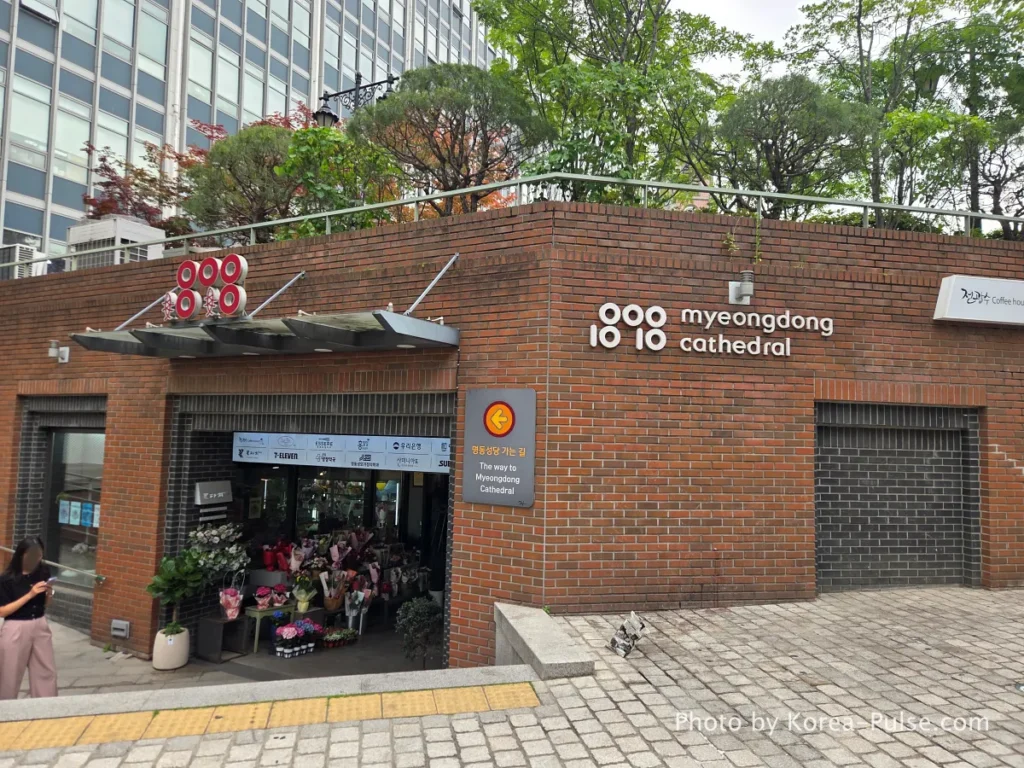
From Euljiro 4-ga, here is how it works: Follow the signs into the 1898 Plaza complex, which sits directly beneath the cathedral hill.
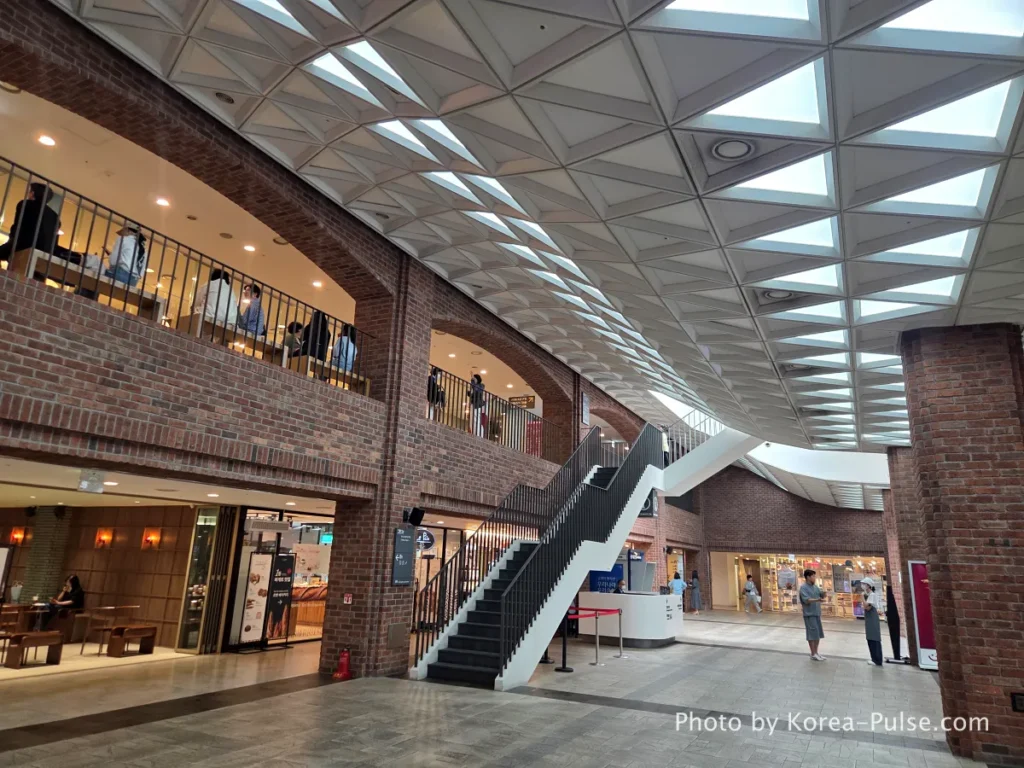
Inside, you’ll find a modern cultural space — cafes, a bookstore, exhibition areas — all quietly housed beneath the cathedral grounds. Follow the directional signs to the elevator lobby, press 3, and when the doors open, you are standing in front of Myeongdong Cathedral without having climbed a single step.
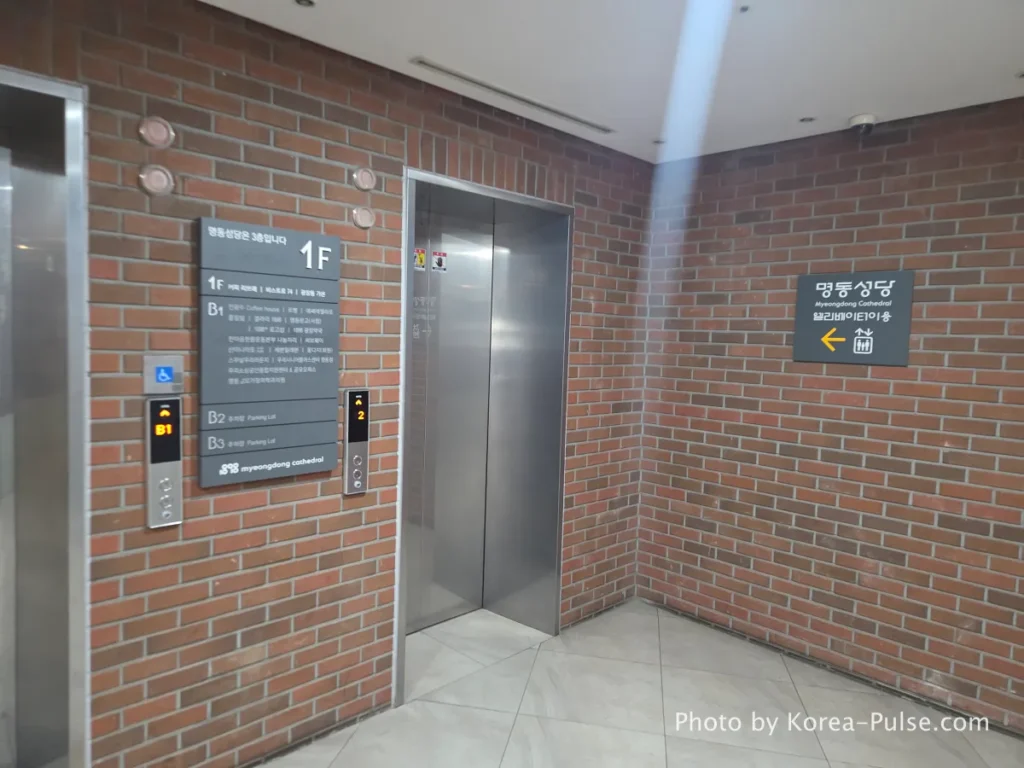
It is, for a building that has been making Koreans work to reach it since 1898, an unexpectedly gracious welcome.
The Bronze Doors: Korea’s Catholic History in Relief
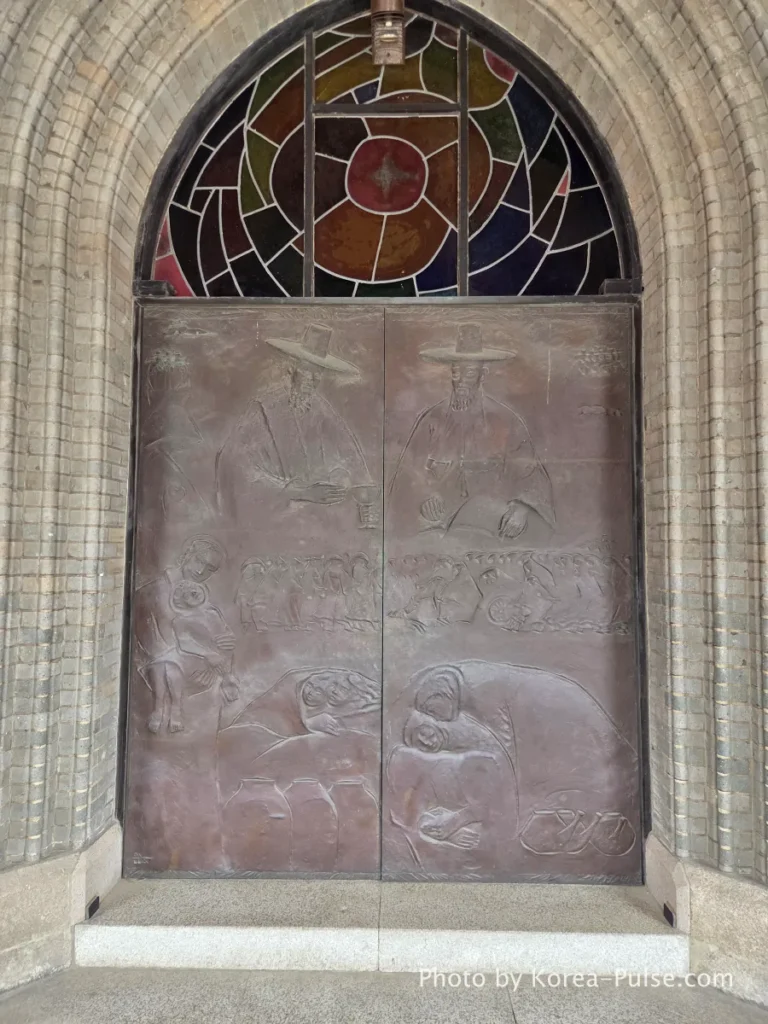
Before entering, stop at the main bronze doors. Most visitors walk straight through them without looking. Don’t.
Installed in 1987 to mark the bicentennial of the Catholic Church in Korea, the doors feature intricate relief sculptures depicting the complete arc of Korean Catholicism. The left door shows the early introduction of the faith — Korean scholars encountering Catholic texts, the translation of theology into Hangul, and the formation of the first lay communities. The right door shows what followed: the 19th-century state persecutions, the arrests, the executions, and the martyrs who refused to renounce their faith even under torture.
The story told across these two panels is, in its way, the most compressed account of Korean Catholicism you’ll find anywhere in the country. Give yourself five minutes with them.
Inside the Cathedral: Gothic Revival on Korean Soil
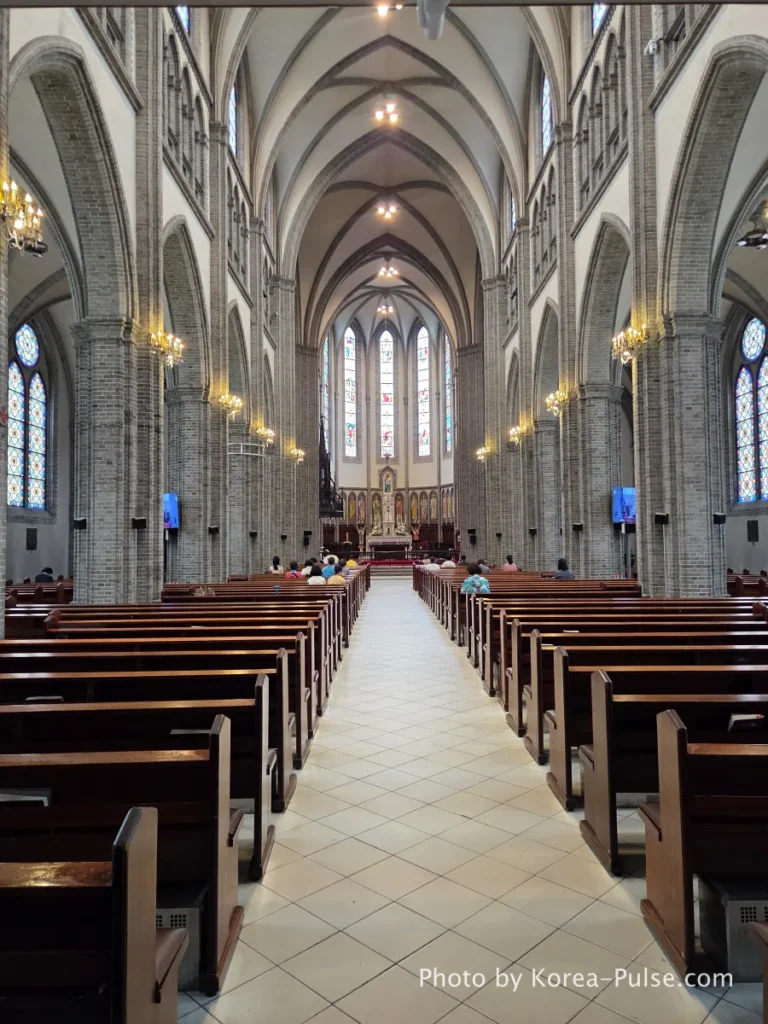
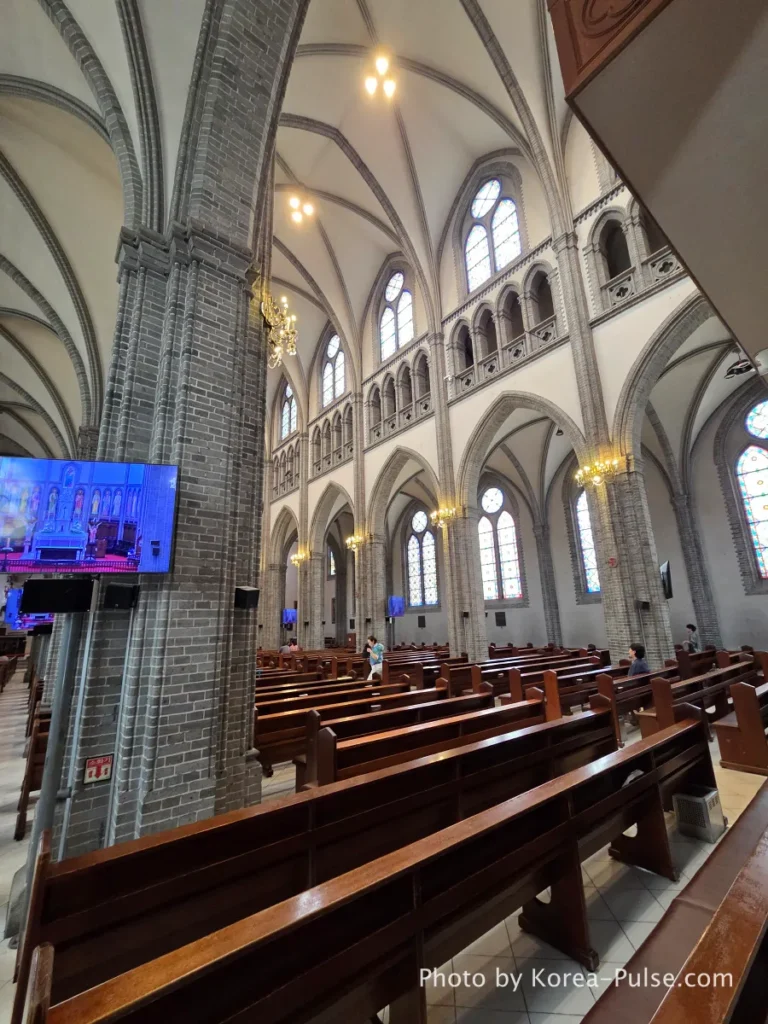
Stepping inside during a non-Mass hour, the contrast with the Myeongdong streets outside is almost physical. The noise drops. The air changes. The scale of the interior — longer and taller than it appears from outside — settles around you.
The architecture follows the classic Gothic Revival form:
- Latin Cross layout: A traditional floor plan with a central nave and lower side aisles running the length of the building. The Latin cross shape is visible in the building’s footprint and experienced as you move through the space.
- Ribbed vaulting: The high pointed ceiling vaults create a sense of upward movement, drawing the eye toward the peak of each bay. This is the definitive characteristic of Gothic construction — the engineering and the theology working in the same direction.
- Composite brick pillars: Rather than the stone columns typical of European Gothic cathedrals, Myeongdong uses composite brick pillars painted to resemble stone. The effect is subtle and successful.
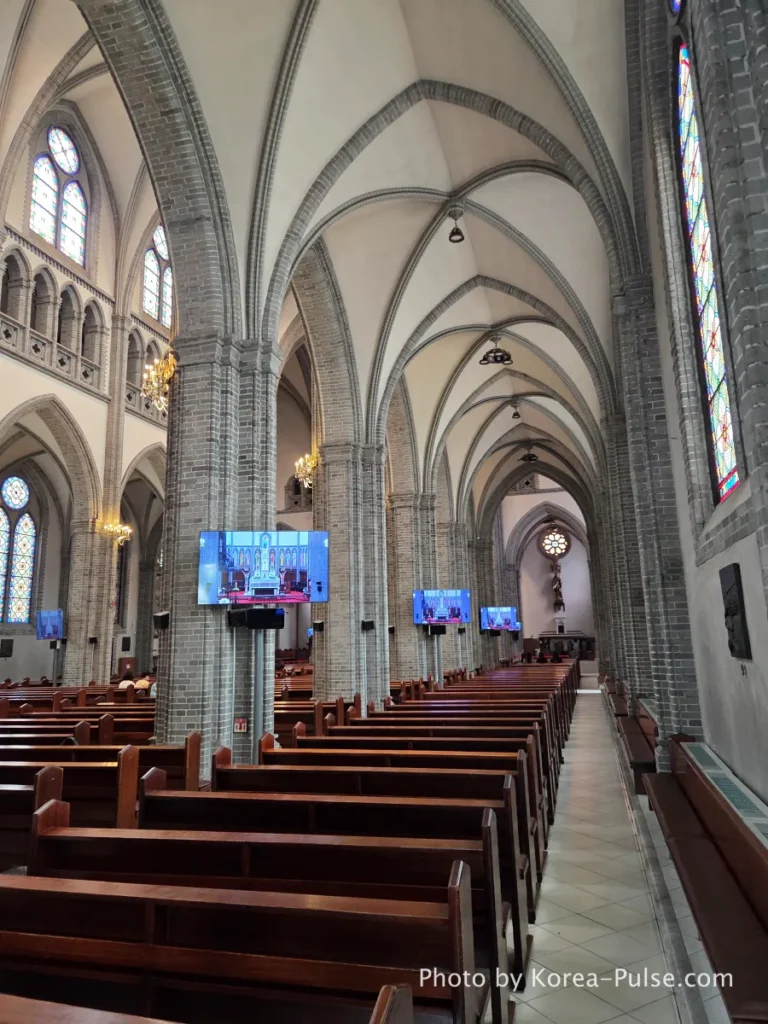
I’ve been inside Chartres, Cologne, Salisbury. Myeongdong Cathedral is none of those in scale or antiquity. But inside — particularly in the filtered afternoon light, with the brick absorbing and softening everything — it has a quality of its own. Something quieter than the great European examples. Something that feels, without being able to explain exactly why, specifically Korean.
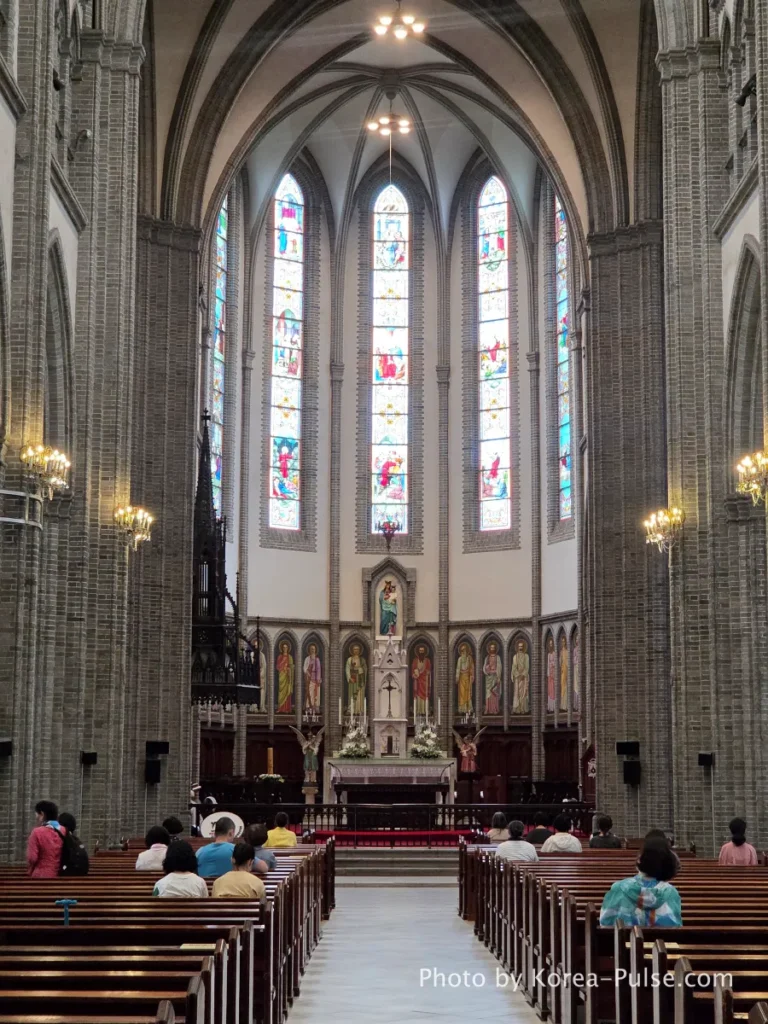
Looking back toward the entrance from the altar end — the full length of the nave, the choir loft at the rear, the pipe organ that fills this space with music during liturgies. The building reads differently from this direction: smaller, more contained, more intimate.
The Stained Glass: France, Filtered Through Seoul
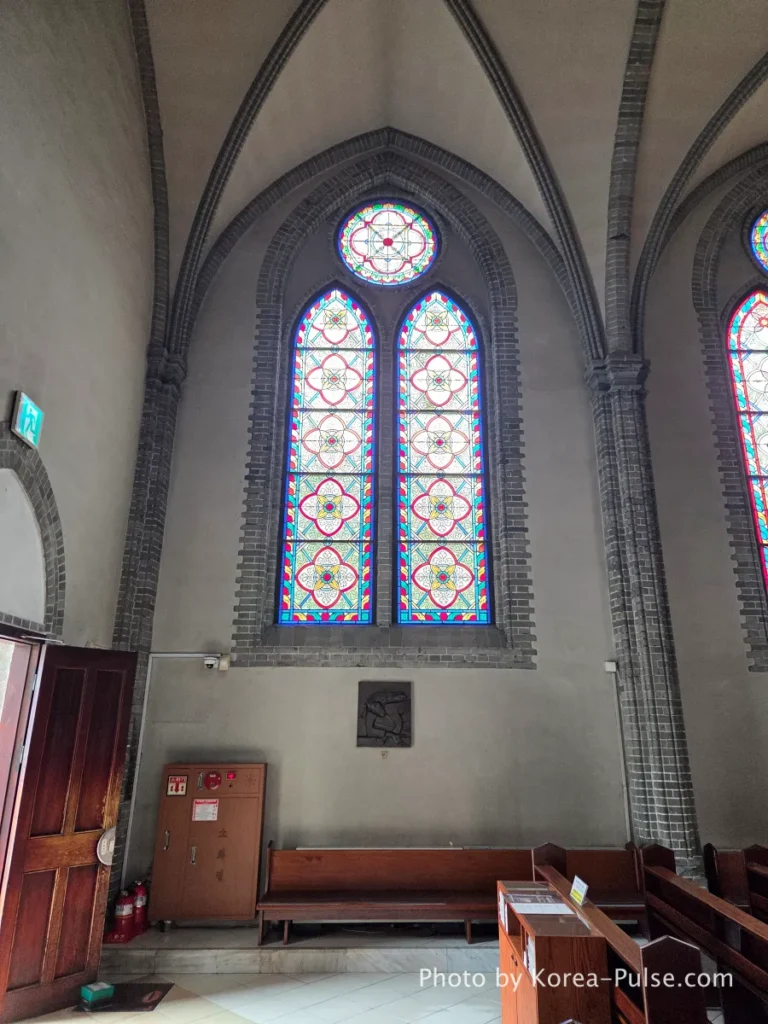
The stained glass windows were designed in France and installed during the original 1898 construction — making them among the oldest surviving Christian artworks in Seoul. They depict biblical scenes and the fifteen mysteries of the Rosary, arranged in lancet windows that run along both side aisles and anchor the east end behind the high altar. Following damage over the decades, they were meticulously restored in the late 20th century to return them to their original splendor.
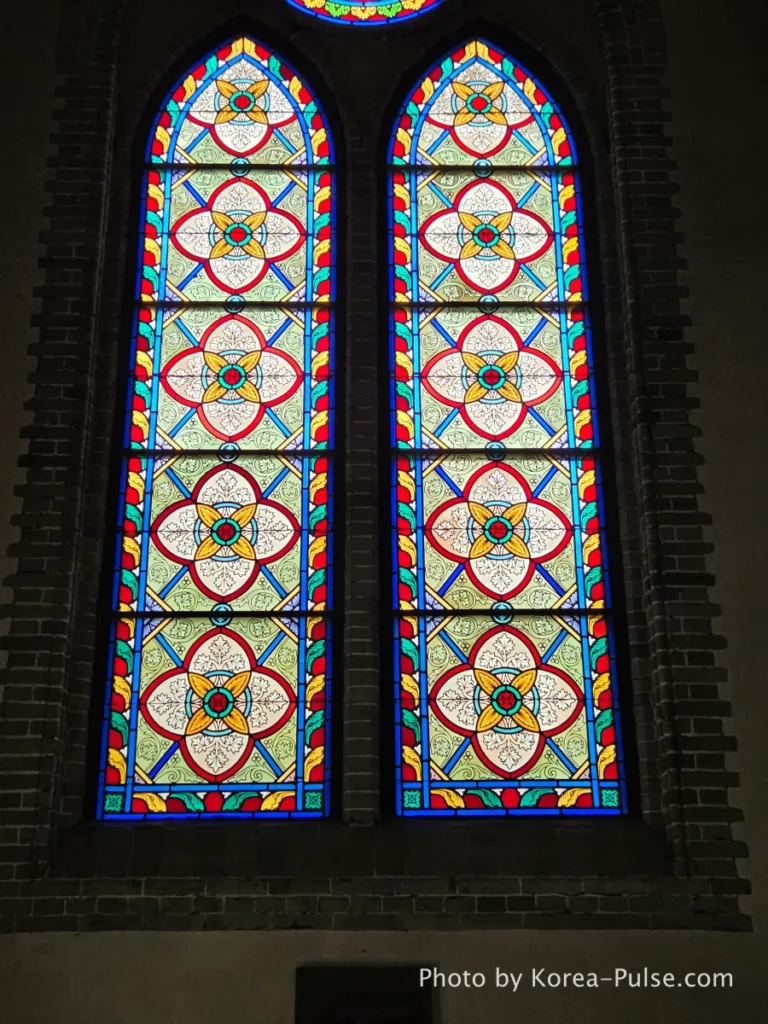
On a clear afternoon — which this was — the coloured light they cast across the brick interior is the visual highlight of any visit.
The Pope Francis Plaque
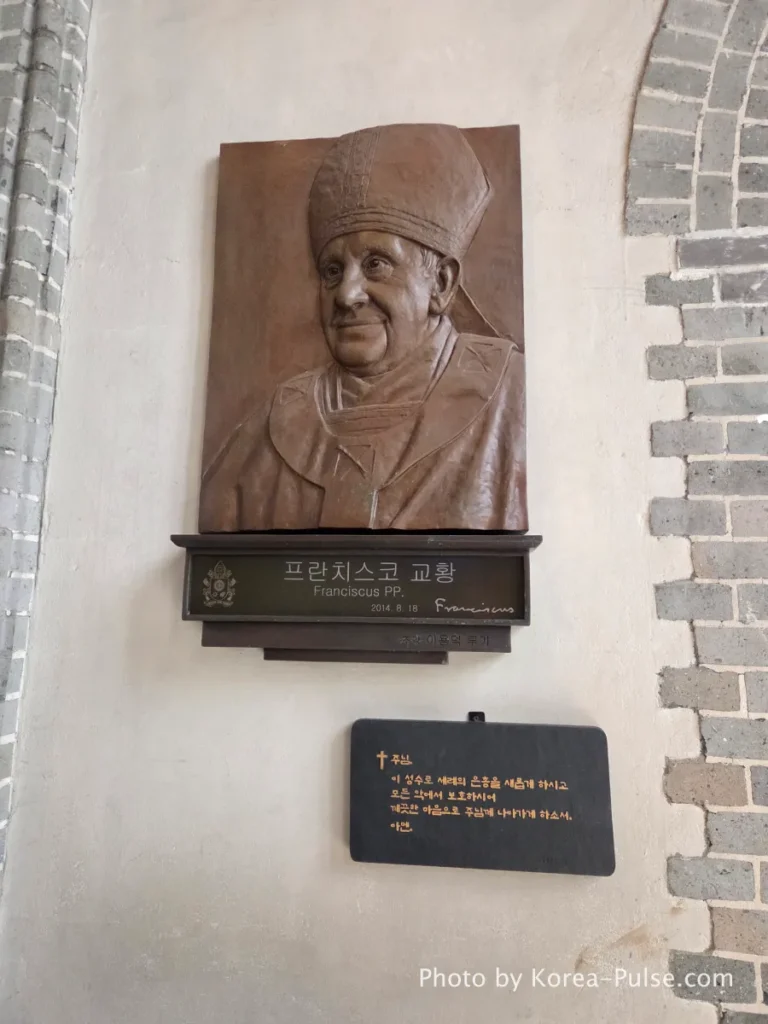
Along the interior walls, a bronze relief plaque commemorates Pope Francis’s historic visit to Myeongdong Cathedral.
He visited the cathedral on August 18, 2014, at the conclusion of his five-day pastoral visit to South Korea. During this historic event, he presided over the Mass for Peace and Reconciliation, delivering a message of forgiveness and dialogue for the divided Korean Peninsula. While the cathedral has a long history of hosting global spiritual leaders — including Pope John Paul II during his pastoral visits in 1984 and 1989 — this specific bronze relief honors the message of reconciliation brought by Pope Francis in 2014.
Outside: The Architecture Up Close
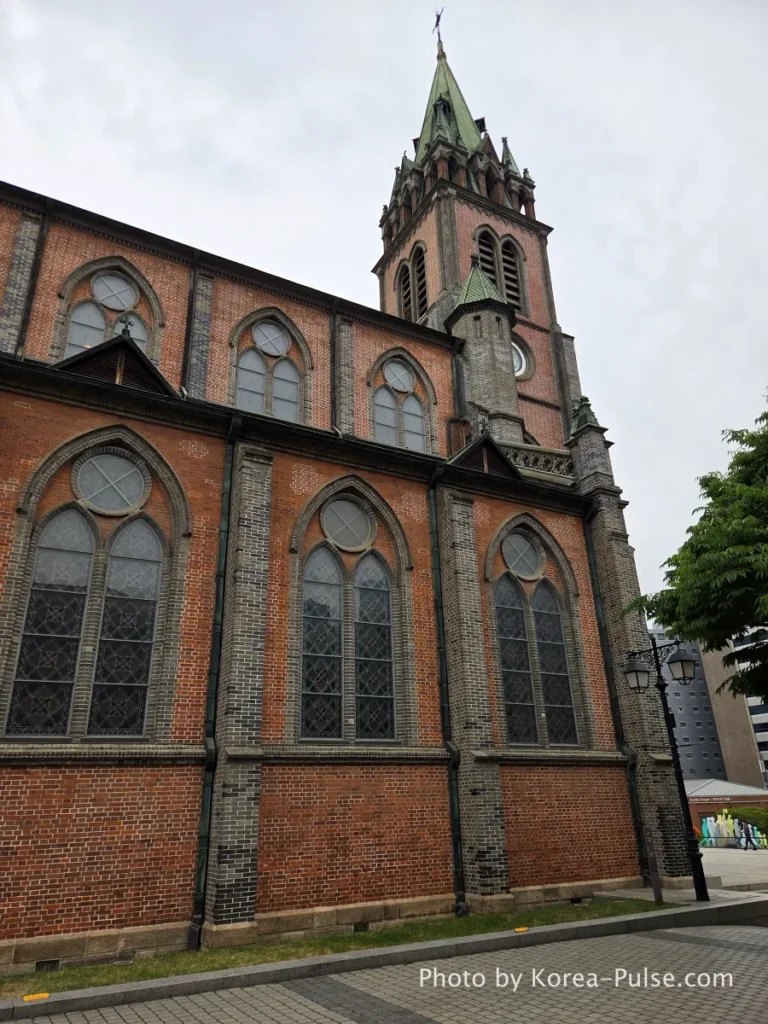
Walking around the exterior of the building reveals details that the front view doesn’t prepare you for. Various shapes of bricks in two colours were used in construction — red for the structural walls, grey for the decorative moldings, window frames, and structural corners — creating a highly textured and elegant aesthetic.
The buttresses along the side walls are smaller than their European counterparts but perform the same structural function, transferring the outward thrust of the vaulting to the ground. The pointed arch windows repeat along the full length of the building with a rhythmic consistency that is satisfying to walk past.
Saint Andrew Kim Taegon: Korea’s First Catholic Priest
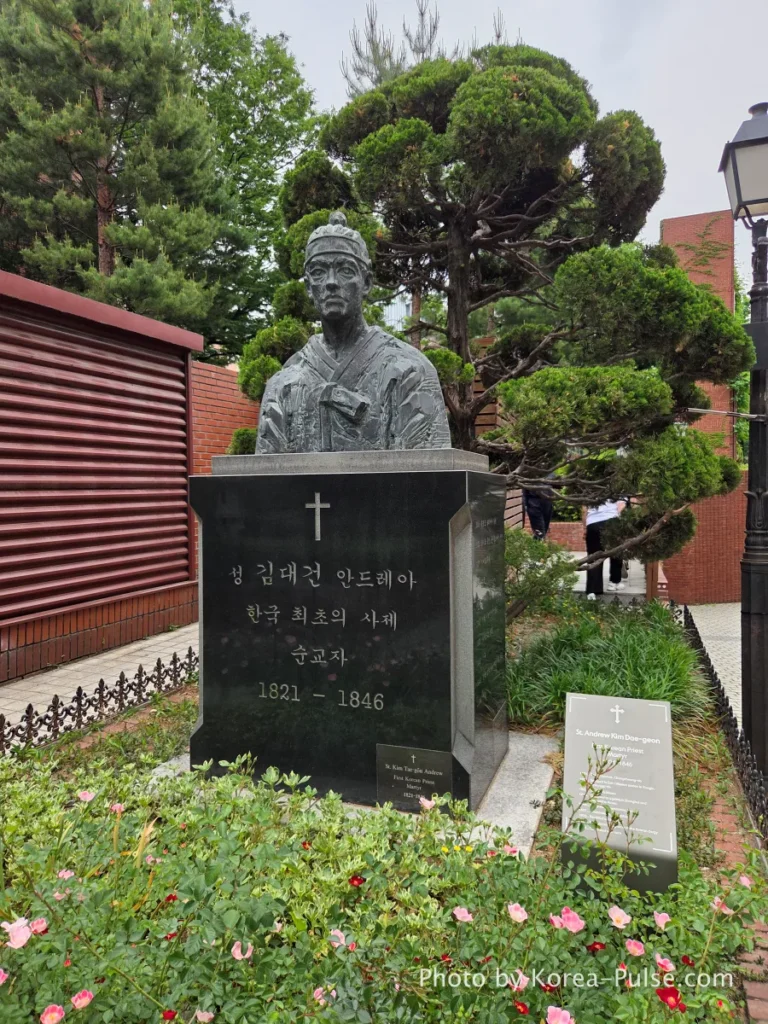
In the garden along the side of the cathedral stands a bronze statue of Saint Andrew Kim Taegon (김대건 안드레아), the first native Korean Catholic priest and one of the most important figures in Korean religious history.
Born in 1821 to a Catholic family, Kim Taegon travelled to Macau and Shanghai to receive his theological education, was ordained a priest in 1845, and immediately returned to Korea — then a country that was actively executing Catholics — to minister to the underground church. He was arrested in 1846 while attempting to smuggle French missionaries into the country and was martyred by decapitation that same year at the age of 25.
Pope John Paul II canonized him as a saint in 1984, during his first visit to Korea. He is the patron saint of the Korean clergy.
The Crypt Chapel: Where the Martyrs Rest
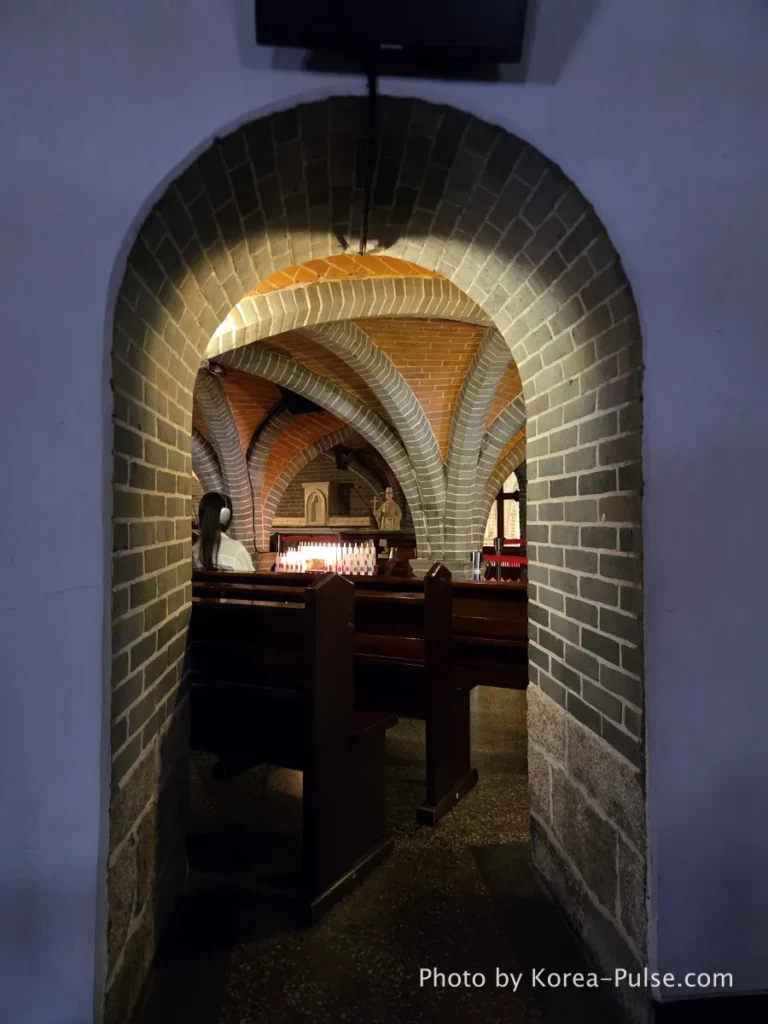
To the side of the main sanctuary, a narrow brick archway leads down to the Crypt Chapel (지하성당), located directly beneath the high altar.
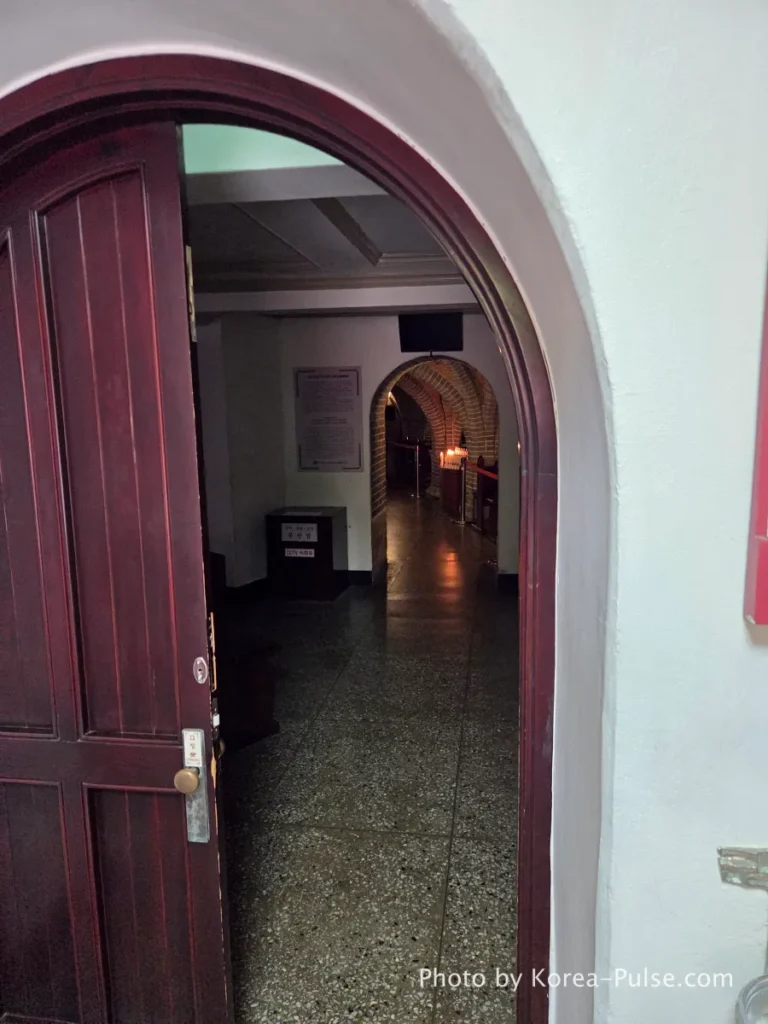
The crypt houses the remains of several missionaries and Korean martyrs, totaling nine individuals. Among these are French missionaries who smuggled themselves into Korea to minister to the underground church before being arrested, tortured, and beheaded during the Joseon Dynasty persecutions. These include Bishop Laurent Joseph Marie Imbert (1796–1839), priests Pierre Philibert Maubant (1803–1839), Jacques Honoré Chastan (1803–1839), Bishop Marie-Nicolas-Antoine Daveluy (1818–1866), and priest Just de Bretenières (1838–1866). Alongside them lie four Korean Catholic martyrs who sacrificed their lives for their faith.
These missionaries entered Korea knowing the deadly risks. The Crypt Chapel stands as a testament to that profound courage, and it is the part of Myeongdong Cathedral that stays with you longest after you leave.
The chapel is open to visitors during non-Mass hours. It is small, dimly lit, and quiet in a way that the main sanctuary — beautiful as it is — is not.
The Rear Garden: Our Lady of the Immaculate Conception
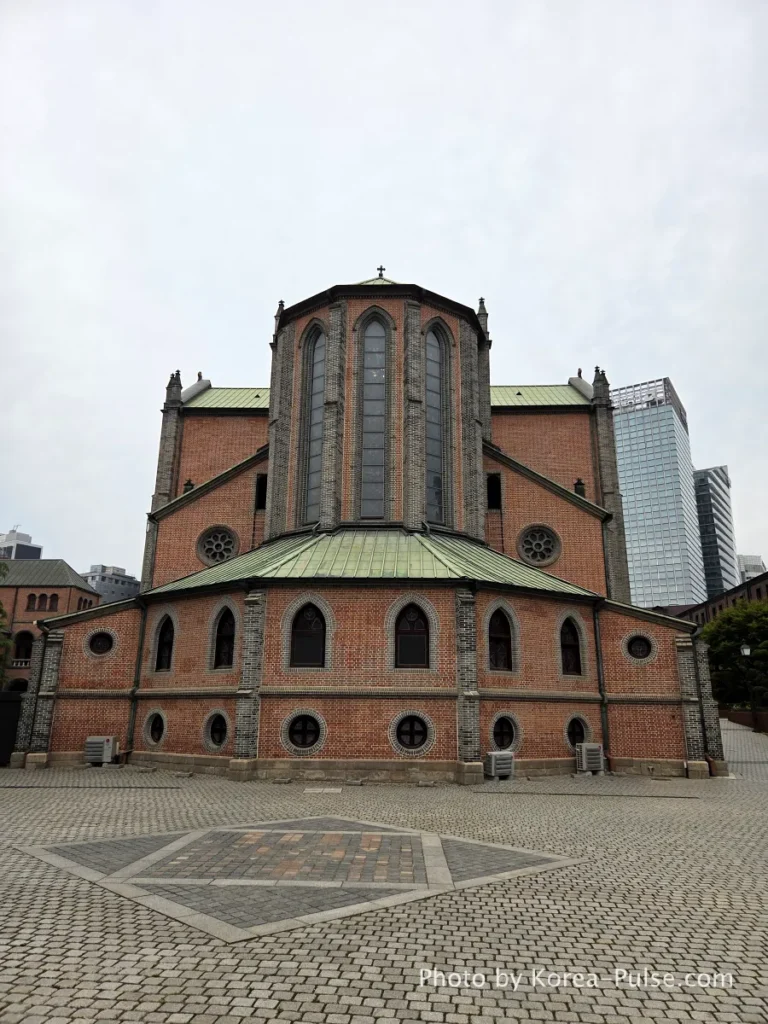
The rear garden wraps around the cathedral’s polygonal apse and contains one of the cathedral’s most visited spots: a stone grotto housing the statue of the Virgin Mary of the Immaculate Conception — the patron saint after whom the cathedral is formally named.
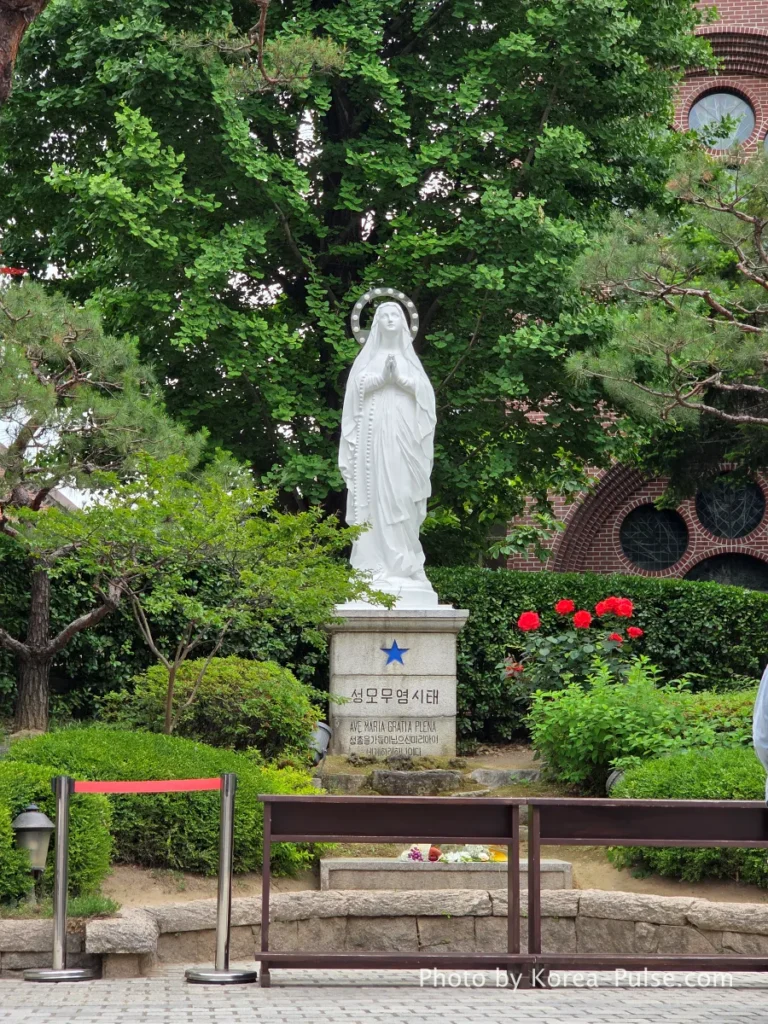
The grotto in the rear garden is a focal point of Marian devotion. The plaque at the base carries the Ave Maria (Hail Mary) prayer in Latin.
The cathedral’s full formal name — the Cathedral Church of the Virgin Mary of the Immaculate Conception — refers specifically to the Marian dogma proclaimed by Pope Pius IX in 1854: that Mary was conceived without original sin. The doctrine refers not to the birth of Jesus, but to Mary herself — that she was preserved from original sin from the very moment of her conception by the grace of God. In Catholic theology, this made her a pure vessel prepared in advance to become the mother of Christ.
For Korean Catholics, devotion to the Immaculate Conception was also deeply tied to their history of persecution, symbolizing purity, endurance, and divine protection in times of trial. Having survived decades of brutal suppression without formal church structures, early believers looked to Mary as a motherly protector of their underground community. The grotto in the rear garden is the most direct expression of that dedication, and it has been a place of Marian devotion for Korean Catholics since the cathedral’s completion in 1898.
A Cathedral with a Political History
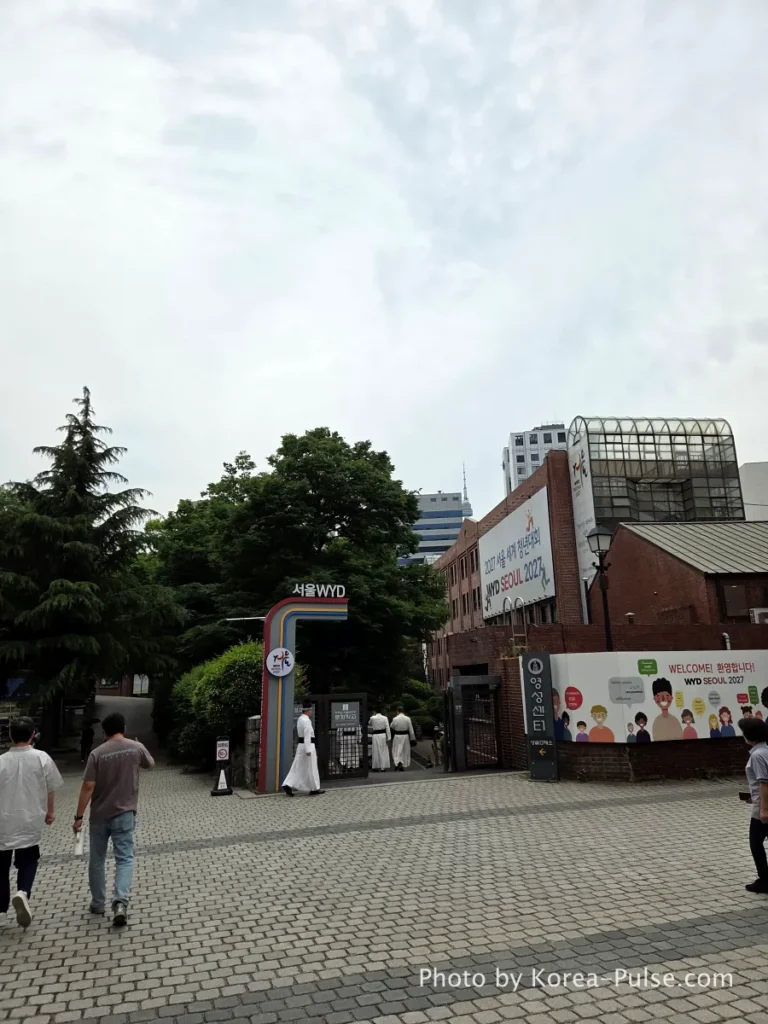
What doesn’t appear in the architecture — but belongs in any honest account of Myeongdong Cathedral — is its political history.
Beyond its religious functions, Myeongdong Cathedral gained prominence as a sanctuary during South Korea’s pro-democracy movements, notably sheltering student protesters in June 1987 during the June Democratic Uprising. By providing a safe haven, the cathedral served as a protected sanctuary where state authorities hesitated to intervene directly, shielding activists from arrest and catalyzing the nationwide protests that ultimately forced the military regime to accept direct presidential elections.
When Seoul National University student Park Jong-chul died under police torture, the cathedral held memorial masses that exposed government cover-ups. The cathedral has been, in other words, not just a place of faith but a place of national conscience. That history doesn’t announce itself loudly anywhere in the building, but it remains woven into the very fabric of the estate.
Back to the Plaza: A Final Look
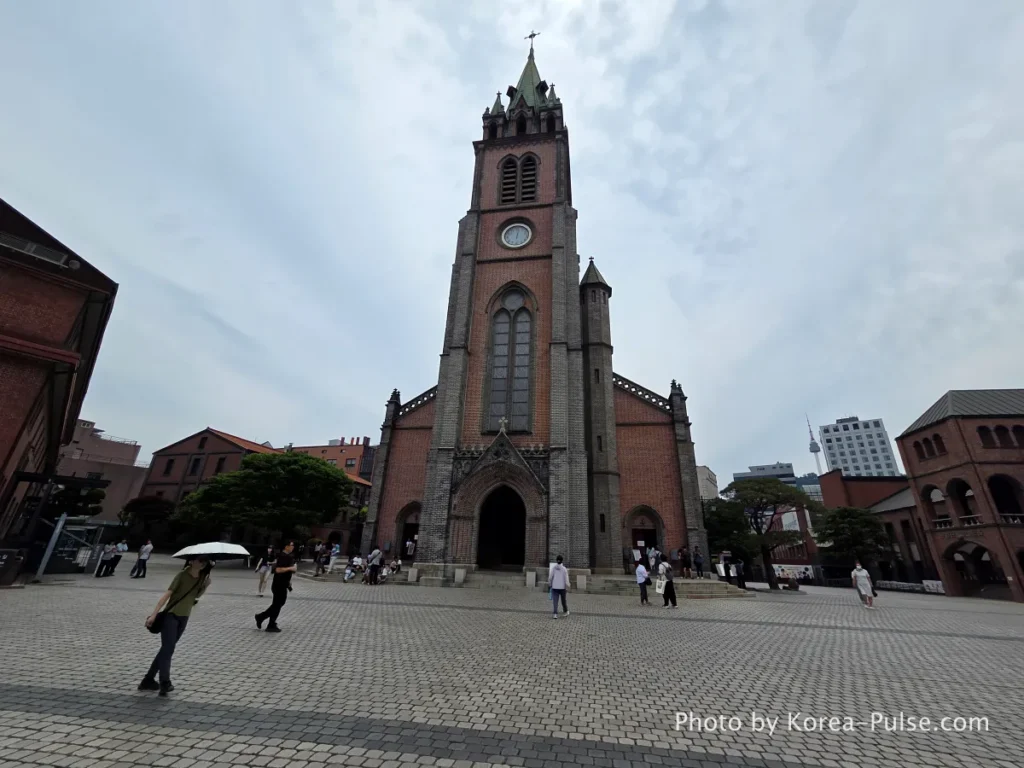
Walking back through the front plaza toward the elevator, I counted visitors from what appeared to be at least six different countries. A tour group with matching hats. A young couple photographing each other against the facade. An older man sitting alone on the steps, looking at nothing in particular.
Myeongdong Cathedral holds an English Mass on Sundays at 9:00 AM, making it one of the more accessible churches for English-speaking visitors to participate as active worshipers rather than just sightseers.
The cathedral has been watching this neighbourhood change for 128 years. The neon and the street food and the K-beauty flagships have come and gone and come back again. The spire has remained constant — visible from the main street, from the subway entrance, from the window of my office on a clear day.
Some things stay. This is one of them.
Practical Information
| Property | Details | Details |
|---|---|---|
| Official name | Cathedral Church of the Virgin Mary of the Immaculate Conception | |
| Address | 74 Myeongdong-gil, Jung-gu, Seoul (서울특별시 중구 명동길 74) | |
| Subway | Myeongdong Station Line 4, Exit 8 (10-min walk) or Euljiro 1-ga Station Line 2, Exit 5 | |
| Shortcut | Enter 1898 Plaza from Euljiro direction → elevator to 3F | |
| Visitor hours | Open daily during non-Mass hours | |
| English Mass | Sundays 9:00 AM | |
| Admission | Free | |
| Tel | +82-2-774-1784 | |
Verify current Mass and visitor hours directly on the Myeongdong Cathedral Official Site, and check the VisitKorea guide for broader tourist info. New to the transit system? Start with our How to Buy a Seoul Subway Ticket guide, alongside the Seoul Subway Guide for Foreigners.
Skip up the elevator, skip the crowds, and give the Crypt Chapel five extra minutes.
128 years, nine martyrs at rest, a secret entrance most tourists never find — worth an hour of any Myeongdong trip, even a short one.