Category: K-Travel | Related: Best Myeongdong Restaurants — Verified Guide
If you only have 40 minutes in Myeongdong — this is the walk.
One cathedral. Three Michelin institutions. A live streamer on the pavement. And a noodle queue that moves faster than it looks.
I grabbed my camera on a May lunchtime and walked the route I know best: from the Euljiro entrance past the legends, down the alleys, and straight to the bowl of Kalguksu I’d been thinking about since morning. Here’s exactly what I found — and where you should go first.
Contents hide🗺️ Quick Reference: The Myeongdong Street Walk
Stop What Why Myeongdong Cathedral Historic landmark, 1898 Best view before the crowds Hadongkwan Gomtang (beef bone soup) since 1938 8 Michelin plaques, entire building Eulji Tonkatsu Korean pork cutlet Old-school, unfussy, excellent Miseongok Seolleongtang since 1966 Packed with locals at noon — always a good sign Myeongdong Kyoja Kalguksu + Mandu since 1966 Michelin Bib Gourmand every year since 2017 🕒 Walk only: ~40 min | With a meal: ~1.5 hours | Nearest subway: Myeongdong Station, Line 4 (Exit 5 or 6)
Where Myeongdong street Begins: The Cathedral View
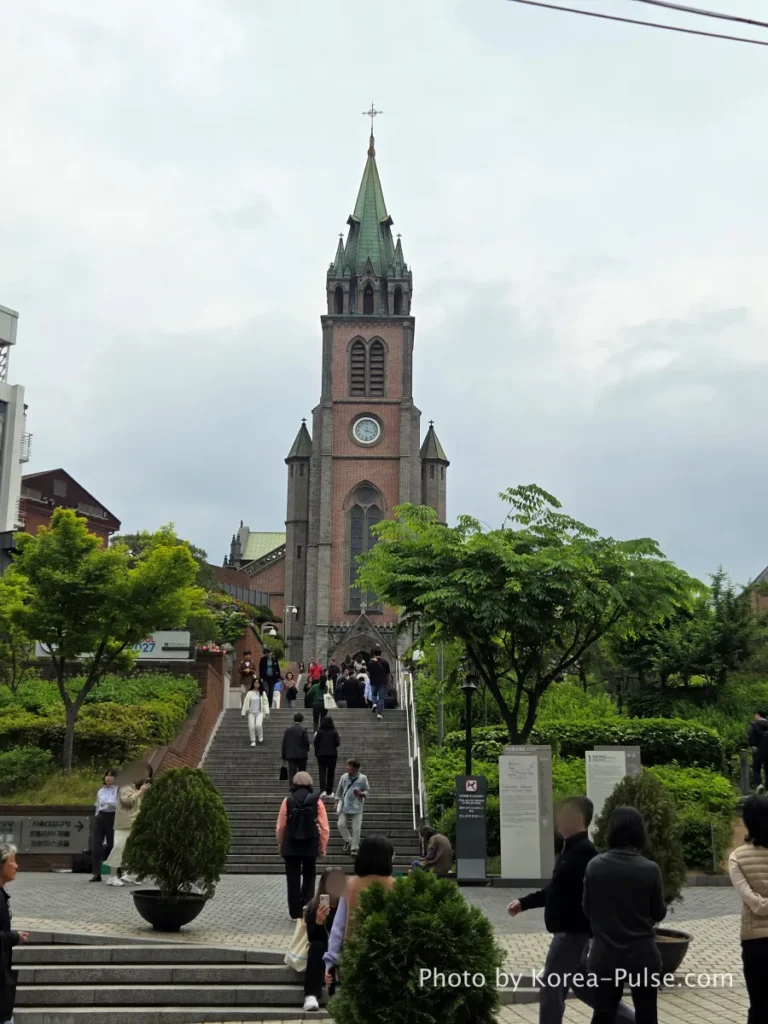
Step out of Euljiro and into Myeongdong street, and the first thing that greets you — if you look up, which most people forget to do — is the spire of Myeongdong Cathedral.
Built in 1898, it is the oldest Catholic cathedral in Korea and one of the most quietly magnificent buildings in all of Seoul. It sits at the top of a broad staircase, framed in May by fresh green leaves, watching over a neighbourhood that has gone from traditional market to global shopping district without apparently consulting it once. The cathedral seems unbothered. That kind of long-term perspective will do that.
Coming soon on Korea Pulse: A dedicated deep-dive into Myeongdong Cathedral — its history, architecture, and why it remains one of the most important spiritual sites in the country.
Stop 1: Hadongkwan — Where Gomtang Has Been Perfected Since 1938
Walking from the cathedral toward the main drag, the first landmark that stops you is Hadongkwan (하동관).
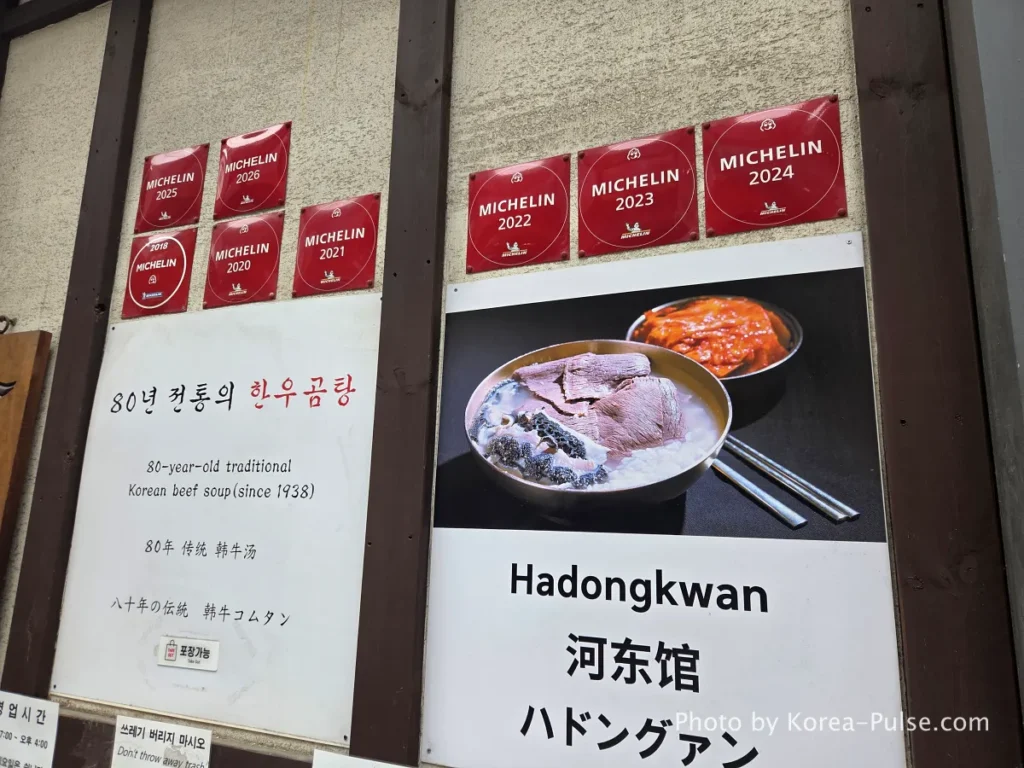
The wall tells the story before you even walk in. Michelin plaques from 2018, 2020, 2021, 2022, 2023, 2024, 2025, 2026 — lined up like a trophy cabinet that ran out of wall. Next to them, the menu in Korean, Japanese, Chinese, and English: “80-year-old traditional Korean beef soup (since 1938).”
Located right off the main track of Myeongdong street, Hadongkwan specialises in Gomtang — a slow-simmered Korean beef bone soup that is simultaneously the simplest and most demanding thing a kitchen can produce. There are no shortcuts to eight-hour broth. Hadongkwan has not taken any in nearly ninety years.
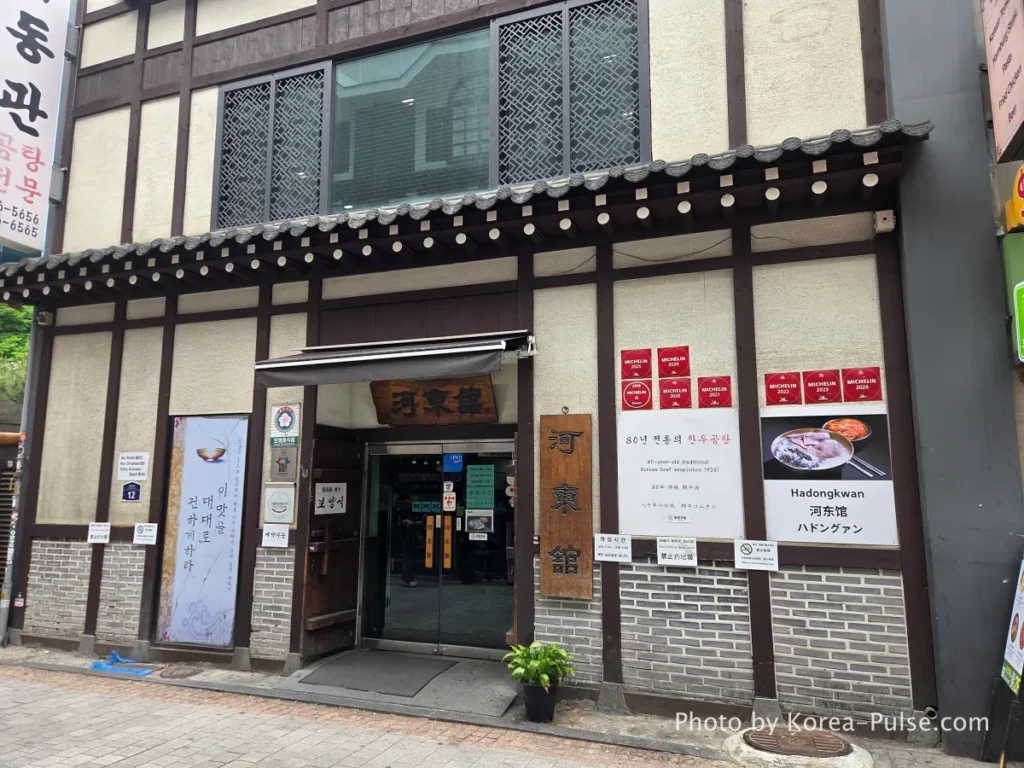
Step back and you see the full scale of it: an entire building, traditional Korean architecture, dark wood and tile roof in the middle of Myeongdong’s gleaming commercial corridor. In a neighbourhood where a single floor of retail can cost what most people would call an extraordinary amount of money, Hadongkwan owns the whole building.
That is what eighty-eight years of good soup gets you.
🔗 Full review: Hadongkwan — Myeongdong Restaurants Verified Guide
Stop 2: Eulji Tonkatsu & Miseongok — The Legends in the Alleys
While the wider avenues of Myeongdong street belong to global brands and K-beauty flagships. Its alleys belong to the restaurants that have been there longer than most of those brands have existed.
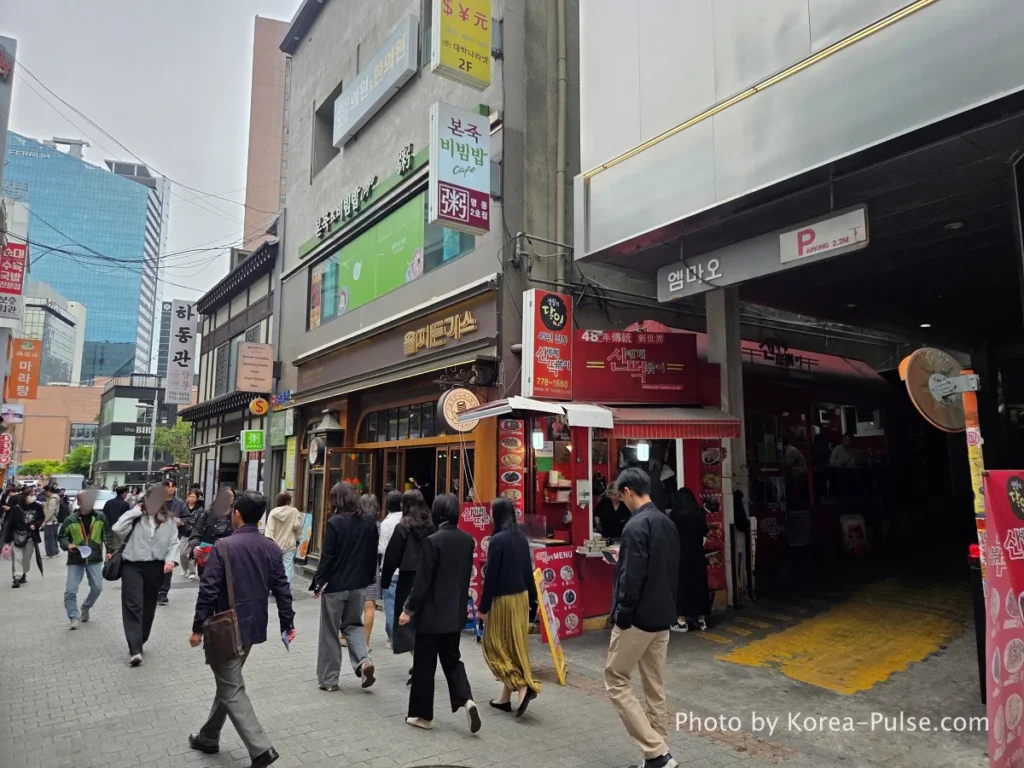
Eulji Tonkatsu sits in one of these alleys — a beloved institution serving old-school Korean-style pork cutlets, thick and satisfying in a way that no amount of modern gastronomy has managed to improve upon. If you want a break from soup, this is the detour to take.
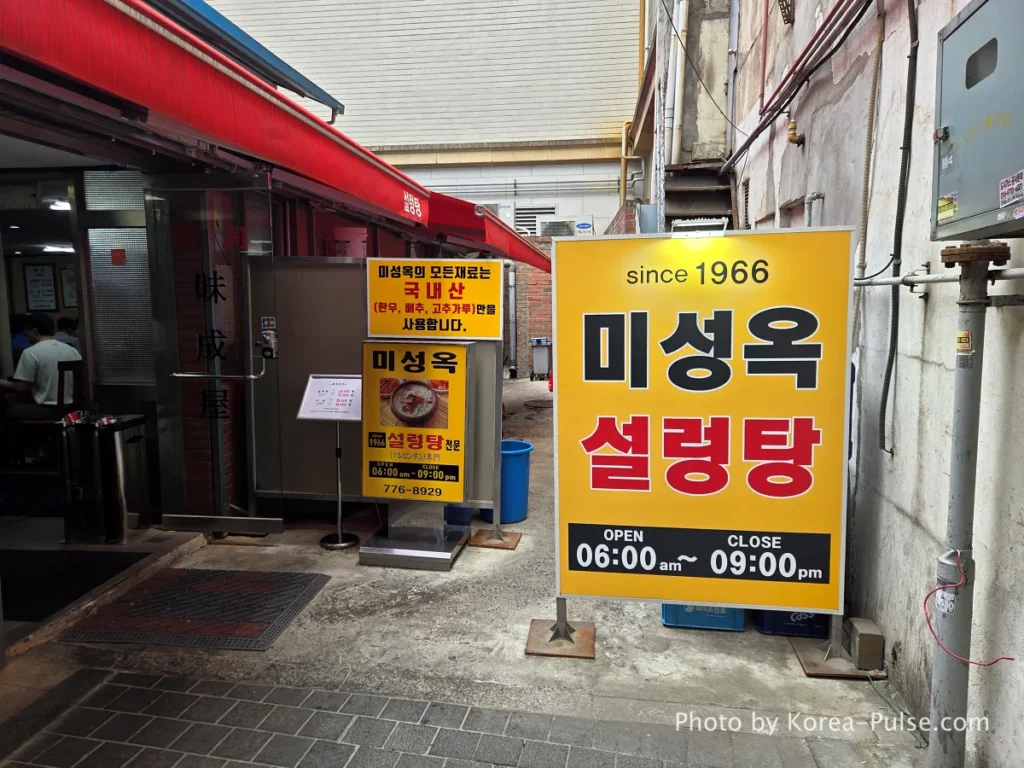
Miseongok (미성옥), established in 1966, specialises exclusively in Seolleongtang — a milky-white ox bone soup served with rice, sliced brisket, and a quiet confidence that it doesn’t need to be anything other than what it is. The bright yellow sign announces it’s been open since 6:00 AM. All ingredients are Korean domestic. Everything else is implied by the queue of business-suited locals you’ll find here at noon.
When a restaurant in the middle of Seoul’s busiest tourist district is packed with people who actually live and work in the city, you’ve found the real thing. Tourists eat there because they were told to. Locals eat there because they know.
🔗 More details: Miseongok — Myeongdong Restaurants Verified Guide
Interlude: Myeongdong’s Living, Breathing Street Culture
Halfway through any Myeongdong street walk, something happens that no guidebook quite prepares you for. The neighbourhood stops being a place you’re visiting and starts being a place that’s happening around you.
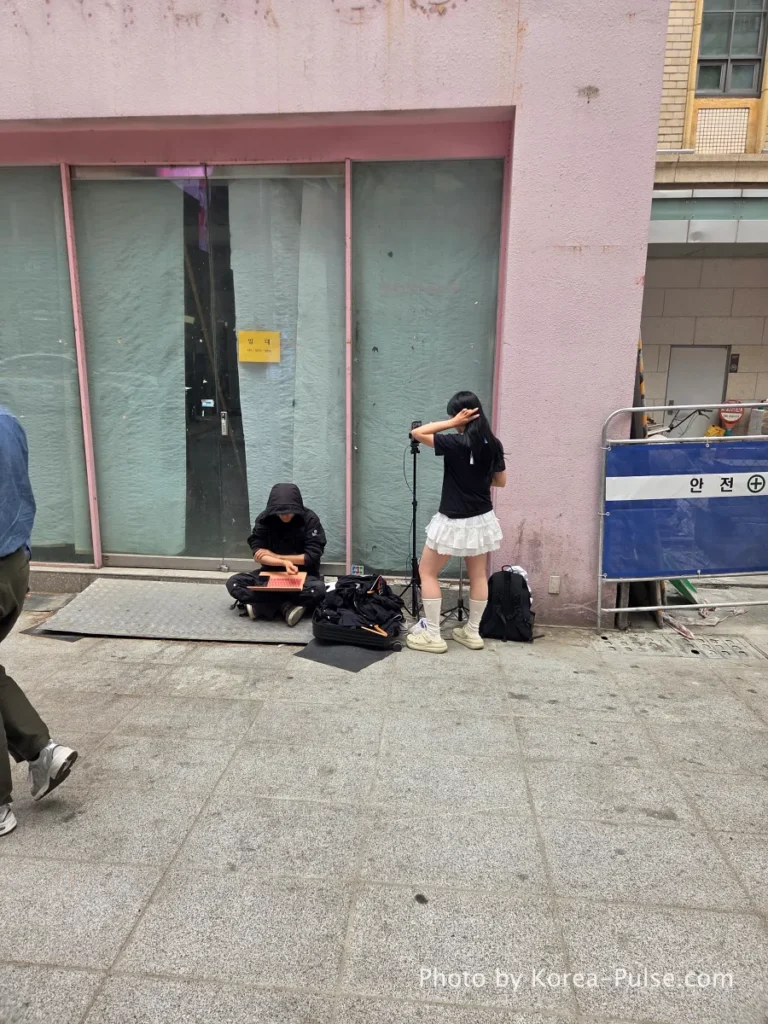
In the middle of foot traffic, I passed a young woman hosting a live stream — Chinese-language, confident presentation, camera framed perfectly against the Myeongdong backdrop. Next to her, a crew member sat cross-legged on the pavement managing the broadcast equipment, monitoring comments, keeping the signal clean.
It took me a moment to fully process: this is what Myeongdong has become. Not just a destination but a set. Not just a street but a stage. Korean food, Korean street culture, Korean aesthetics — broadcast live to audiences across Asia and beyond, from a pavement in Jung-gu, Seoul, on a Tuesday lunchtime.
I’ve been walking through this neighbourhood for years. I’m still not entirely used to it.
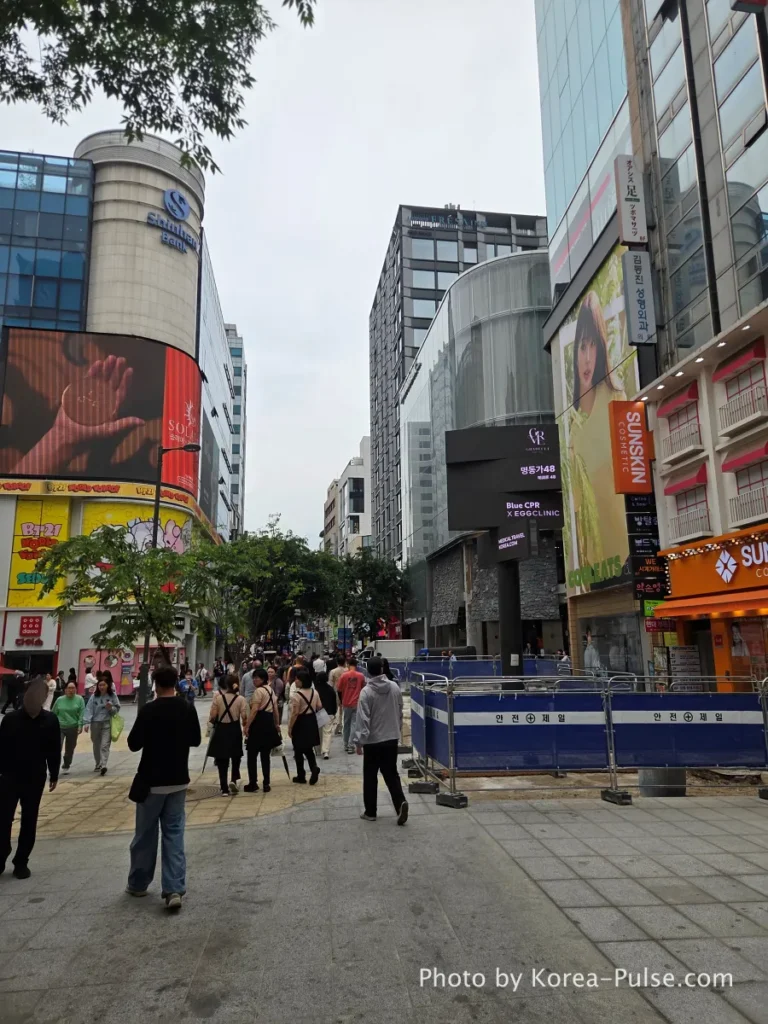
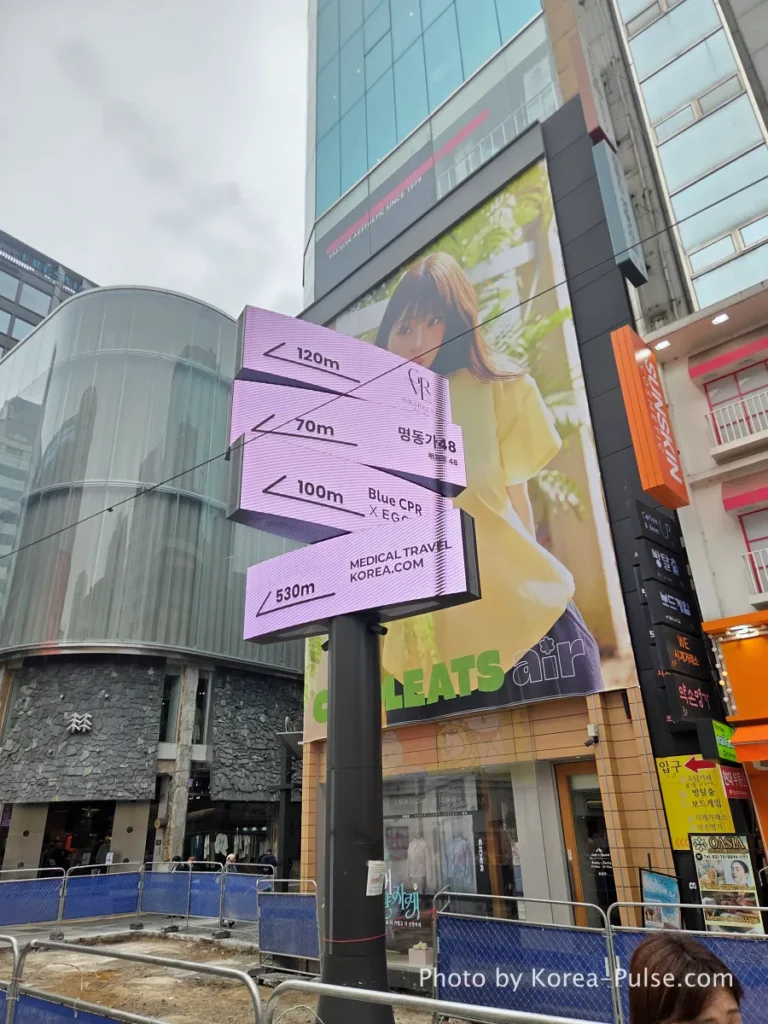
Just ahead, a construction crew was installing a new digital wayfinding pillar — large, purple-backlit, pointing visitors toward nearby landmarks with distances in metres. Myeongdong is, as always, mid-renovation. It has been adding, removing, and replacing parts of itself for decades. At this point the construction barriers are almost a permanent feature.
The Main Street: Where Myeongdong Goes Full Volume
Turning the corner back onto the primary Myeongdong street boulevard, the volume goes up — not in sound exactly, but in everything else. LED screens on every building face. Global brands: MLB, FILA, Covernat, Kodak. Korean beauty clinics. Street food vendors. International visitors with maps and bags. Domestic visitors who know exactly where they’re going and are walking there briskly.
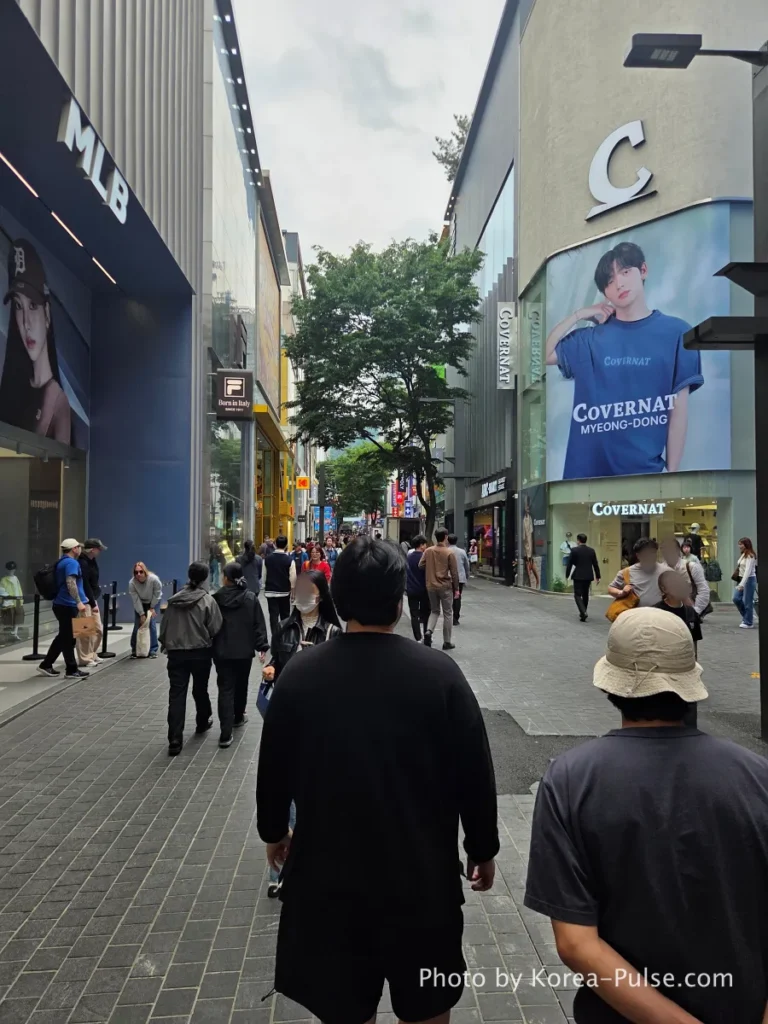
The tree-lined shopping alley that runs through the centre is, in May, almost pretty — green leaves overhead, brands on either side, the particular human energy of a place where everyone has somewhere to be and most of them are hungry.
Stop 3: Myeongdong Kyoja — The Noodle Institution That Needs No Introduction
At the end of every Myeongdong walk, if you’re doing it correctly, you end up outside Myeongdong Kyoja (명동교자).
![Myeongdong Kyoja restaurant entrance with red signage showing established 1966 and Michelin Bib Gourmand plaques from 2017 onwards [Myeongdong street]](https://img.korea-pulse.com/2026/05/myeongdong-kyoja-entrance-michelin-bib-gourmand-1966-1024x768.webp "Myeongdong Street in May: Where Seoul's Best Food Hides in Plain Sight 10")
Founded in 1966, Myeongdong Kyoja is the home of Seoul’s most famous Kalguksu (hand-cut noodles) and Mandu (dumplings). It has held the Michelin Bib Gourmand designation every year since 2017 — the guide’s recognition for exceptional food at moderate prices — and has absolutely no plans to stop.
The building is four floors. All of them are usually full.
![Side wall of Myeongdong Kyoja restaurant displaying full history timeline from 1966 to present alongside row of annual Michelin Bib Gourmand plaques [Myeongdong street]](https://img.korea-pulse.com/2026/05/myeongdong-kyoja-michelin-history-wall-exterior-1024x768.webp "Myeongdong Street in May: Where Seoul's Best Food Hides in Plain Sight 11")
Walk around to the side of the building and the full history is laid out in a timeline on the wall: from 1966 founding through trademark registrations in the US, Japan, and China, to the first Michelin plaque in 2017, and every subsequent year’s plaque lined up in a row below it.
It reads like the résumé of a restaurant that has never once doubted itself. Earned confidence is a beautiful thing.
A manager at the entrance directs the flow with practiced efficiency — pointing, waving, dispatching groups upward. I ate here last time in the 3rd floor, reached by elevator, steaming bowl of garlicky noodles on the table within minutes. The whole experience, from door to first sip, was faster than ordering coffee at most cafés. This is operational excellence in the service of carbohydrates, and it is magnificent.
🔗 Full review + ordering tips: Myeongdong Kyoja — Myeongdong Restaurants Verified Guide
How to Do This Walk Yourself
The exact Myeongdong street route I took — Euljiro entrance → Cathedral view → Hadongkwan → alleys (Eulji Tonkatsu, Miseongok) → main street → Myeongdong Kyoja — takes about 40 minutes at a comfortable pace. Add another 45 minutes if you’re eating, which you should be.
Practical notes:
| Best time to visit | Weekday lunch 11:00–11:30 AM (before the main rush) or 3:00–4:00 PM |
| Nearest subway | Myeongdong Station, Line 4 (Exit 5 or 6) |
| Hadongkwan hours | 07:00–21:00, closed Sundays |
| Miseongok hours | 06:00–21:00, seven days |
| Myeongdong Kyoja hours | 10:30–21:30, all week |
| Budget for lunch | ₩12,000–18,000 per person at any of these three |
🔗 External: Michelin Guide Seoul — Official Site | Myeongdong Cathedral — Official
What’s Next
I walked past Myeongdong Cathedral twice on this visit and photographed it once. It deserves considerably more than that. A dedicated post is coming — the history, the architecture, what it means to have a nineteenth-century Gothic cathedral at the heart of one of Asia’s busiest shopping districts.
Until then: go eat the noodles. Join the queue. Look up at the cathedral from the bottom of the stairs. Let Myeongdong be exactly as much as it is.
It will be.
🔗 Internal links: Best Myeongdong Restaurants — Verified Guide | How to Get to Myeongdong by Subway | KTX Korea — Seoul Day Trip Guide
korea-pulse.com | K-Travel