
K-SCREEN · June 2026
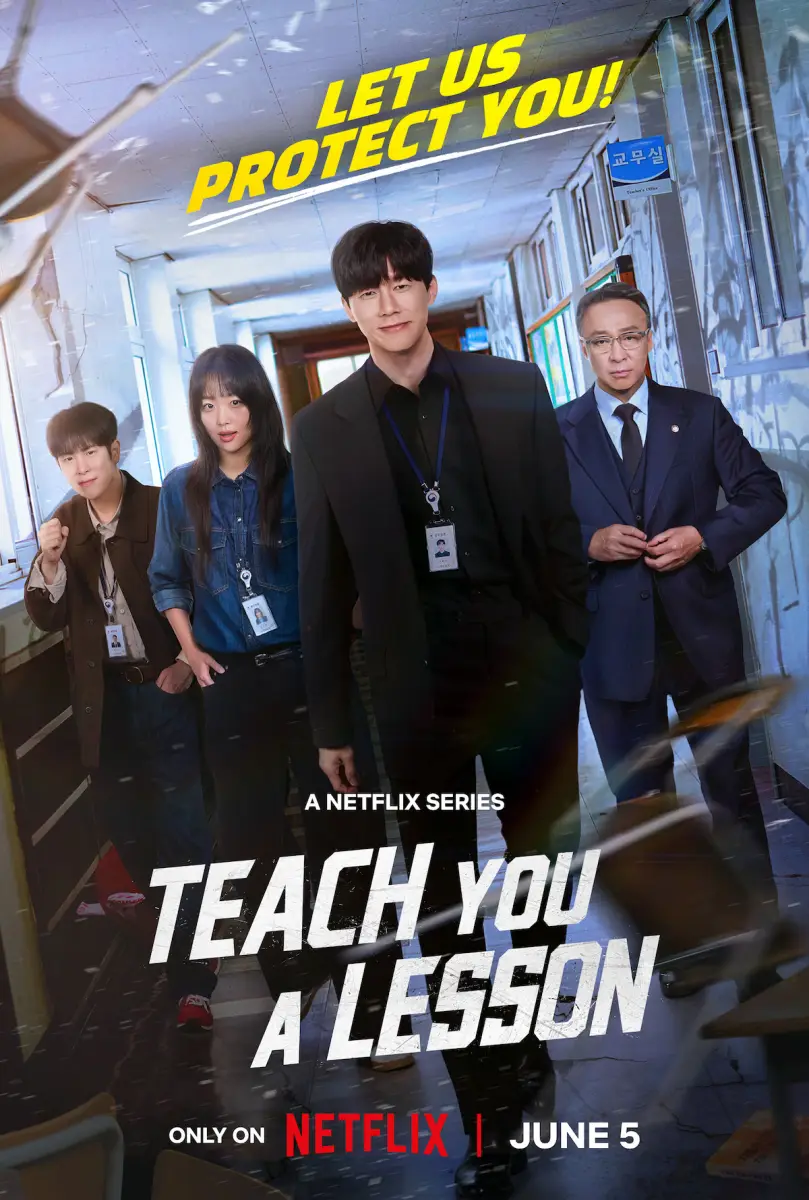
Teach You a Lesson Netflix
Korea’s Most Satisfying Binge of 2026
A Global Dad living in Korea burns through all 10 episodes in one weekend — and finally understands why everyone around him seems to be talking about this.
All dropped June 5
(early ratings)
Korea (Restricted)
The Fast Facts: Before We Get Into It
The Crisis Is Real: Korea’s Classroom in 2026
To international viewers, Teach You a Lesson Netflix might look like a stylized action fantasy set in an over-the-top alternate-universe school. To those of us actually living in South Korea in 2026, the premise is uncomfortably, precisely accurate.
The drama centers on the ERPB — Educational Rights Protection Bureau (교권보호국), a fictional government agency created to step in when schools completely collapse. What makes it land so hard is how little of it feels fictional. Two massive, colliding societal forces have put enormous pressure on Korean classrooms in real life:
Korea’s 촉법소년 (Juvenile Act) protects children under 14 from criminal prosecution. Originally designed for rehabilitation. Today, many educators and parents say it has become widely understood among teenagers — in some cases used as a shield against consequences by students who know they face no criminal liability. Combine that with a generation in which many students are physically larger than the adults responsible for maintaining order, and you start to understand why so many teachers say they feel powerless.
Layer on top of that the Hagwon (학원) ecosystem — the private night academy culture that means students often cover their entire school curriculum before the school year begins. Many public school teachers, through no fault of their own, find themselves in classrooms where their authority has quietly eroded.
Strict bans on physical discipline, student rights ordinances, and the very real threat of parental complaints have left educators with very few tools when situations escalate. Teach You a Lesson Netflix takes these exact headlines, sharpens them into a narrative blade, and slices clean through the bureaucratic paralysis. It is impossible to watch without feeling — as a parent, as a citizen — the deep, accumulated frustration of a system that has failed its teachers.
The Cast of Teach You a Lesson Netflix: When Heavyweights Carry Heavy Material
Teach You a Lesson Netflix works because it doesn’t rely on star power for its own sake — it relies on actors who treat the material with complete gravity. This is not a cast coasting. This is a cast that understood what they were making.

Kim Mu-yeol plays Na Hwa-jin, an ERPB inspector whose past is classified at a level that makes you genuinely wonder what branch of government he came from. Special forces? Intelligence? Whatever the answer is, it’s above your clearance.
He carries out his school interventions with a cold, nonchalant lethality — dismantling juvenile bullies, corrupt principals, and entitled rich-kid gangs with the kind of serene efficiency that makes every viewer quietly think: “I wish someone like this actually existed.” It’s no coincidence that Kim and director Hong Jong-chan already worked together on Juvenile Justice (2022) — they have a shorthand for exactly this kind of morally weighted action storytelling.

Then there’s Lee Sung-min as Minister Choi Gang-seok, the ERPB’s founder and the immovable political force behind the whole operation. Lee Sung-min is incapable of being boring on screen, and here he plays something rare: a politician with actual follow-through.
Watching him bulldoze bureaucracy, override school boards, and authorize unconventional interventions is the purest form of political fantasy I have experienced since… ever. I found myself thinking, half-seriously: if someone like this ran for office, I would vote for them twice. And there’s a quietly devastating personal layer here too — his daughter is Na Hwa-jin’s fiancée. The man didn’t just build the agency out of principle. He built it out of grief.

And then there’s Ha Young, playing Choi Ga-yun — Na Hwa-jin’s fiancée, and a dedicated teacher killed by one of her own students. The details around her death carry a quietly devastating political dimension: her father, Minister Choi Gang-seok, had already been building the groundwork for the ERPB long before she died.
And precisely because of that — because he knew the optics of a grieving politician father would overshadow the real issue and invite accusations of personal agenda — her connection to him was never made public. She was known only as a teacher killed by a student. Not a lawmaker’s daughter. That restraint, that deliberate erasure of his own grief from the public record, tells you everything about what kind of person Lee Sung-min is playing.
I’ve been following Ha Young since her turn as Nurse Cheon Jang-mi in Trauma Center: The Golden Hour (중증외상센터) — that performance had such warmth and precision that she immediately became one of those actors you clock in every project. She brings that same radiant, grounded quality here. Screen time limited by design, impact completely unlimited. She’s one of the finest rising talents in Korean drama right now, and I cannot wait to see what she leads next.
Kim Mu-yeol, Lee Sung-min, and director Hong Jong-chan previously collaborated on Netflix’s Juvenile Justice (소년심판, 2022) — another unflinching look at Korea’s legal blind spots around young offenders. That series also became a cultural flashpoint. If you haven’t seen it, consider it essential viewing alongside this one. These three clearly have a gift for finding the exact nerve to press.
Pure Catharsis: Why Teach You a Lesson Netflix Has Everyone Talking
What separates Teach You a Lesson Netflix from a standard revenge fantasy is the precision of its social honesty. The show doesn’t soften the complicity of school boards. It doesn’t give wealthy parents a redemption arc they haven’t earned. It doesn’t pretend that bureaucratic reform is coming to save anyone.
And because it doesn’t flinch, the catharsis it delivers — when justice finally, decisively arrives — is something close to medicinal. Korean teachers have described watching this series as feeling seen for the first time in years. Because what the show captures so precisely isn’t just the violence or the legal loopholes — it’s the suffocating helplessness of being a professional who has had every tool of authority systematically removed, while being told to keep smiling and maintain order.
The ERPB doesn’t offer a realistic solution. It offers something better: a fantasy where the frustration finally has somewhere to go. That emotional release is why Teach You a Lesson Netflix spread the way it did — not just in Korea, but across Asia and beyond. I saw it sitting at No. 1 in India while I was there on a business trip. It’s a pressure valve for anyone who has ever watched institutional failure up close and felt completely powerless about it.
My middle schooler saw it trending at school and spent the better part of Saturday lobbying me to let her watch it together. It’s a hard no — the 19+ (Restricted) rating in Korea exists for a reason; the violence is raw and the themes are genuinely dark. She did not take this verdict gracefully. The pouting was impressive. But protecting her headspace comes before any weekend viewing agreement. (She’ll understand when she’s older. Probably.)
As a small side note: Teach You a Lesson Netflix has resonated so loudly that it’s even surfaced in public discussions about whether Korea needs a real institutional equivalent to the ERPB. Nothing is decided — but the fact that a drama is prompting that kind of conversation says everything about how accurately it captured the national mood.
FAQ: Teach You a Lesson Netflix
The questions I’ve been getting since I started posting about this one — answered straight.
Not at all. The series stands completely on its own. That said, if you finish and want more, the original “Get Schooled” (참교육) webtoon by Chae Yong-taek on Naver Webtoon is worth diving into — the adaptation is faithful in spirit while fleshing out the world considerably.
Not directly — different story, different characters. But the director (Hong Jong-chan) and two lead actors (Kim Mu-yeol, Lee Sung-min) are the same team. If you loved Juvenile Justice, this is essentially the same creative DNA applied to school violence rather than the juvenile court system.
Not directly. The ERPB is entirely fictional — no such agency exists in Korea. But the issues it responds to are very real: the 촉법소년 (Juvenile Act) loophole, the erosion of teacher authority, and the rise of student-on-teacher violence are all widely discussed in Korea right now. The drama is fiction built on a foundation of real frustration.
Genuinely violent. The 19+ (Restricted) rating in Korea is not decorative. The action sequences are intense and the consequences are shown with unflinching realism. Not gratuitous — every punch lands with purpose — but this is not background-viewing content. Full attention required.
Yes — Netflix carries it with full English subtitles globally. The Korean is fast and sometimes uses heavy slang, but the subtitle quality is solid. All 10 episodes dropped simultaneously on June 5, so no weekly waiting.
No official Netflix announcement yet — but the buzz is loud enough that the question is being asked everywhere. The original webtoon has extensive material, director Hong Jong-chan has hinted at the possibility, and the viewership numbers speak for themselves. The fact that Season 2 is already a hot topic barely a week after release tells you everything about how this one landed. Watch this space.
The Verdict: Should You Stream Teach You a Lesson Netflix?
“One of the most cathartic, impeccably cast, and socially urgent K-dramas in years. Teach You a Lesson Netflix doesn’t just entertain — it makes you angry about the right things.”
If you’re after a soft, nostalgic school romance, walk away now. If you want 10 episodes of tight, relentless, action-packed social commentary that leaves you simultaneously furious at real-world injustice and deeply satisfied by fictional justice — this is your next mandatory binge. Lock the door. Clear Sunday. Keep the teenagers in the other room. Rating: 9.5 / 10.
If this one resonated, you might also enjoy some of the other K-dramas and Korean culture content we’ve covered recently: