
K-TRAVEL · JULY 2026
Korea Travel SIM Card: 3 Proven Ways to Get Data From $4
A Seoul Dad’s Honest Price Breakdown
Airport counters, global eSIM apps, and the local hack that beats them both.
I spent years living in the UK with my family, and from there we’d fly out to places like Vietnam or Dubai for cheap. In every one of those countries, I could grab a local SIM for less than ten dollars at the airport. So when I started digging into the best Korea travel SIM card options for a friend visiting this summer, I expected the same. Instead I found ₩35,000 counters and eSIM apps charging even more for less data. That sent me down a rabbit hole, and what I found actually saves real money.
Do You Even Need a Korea Travel SIM Card?
Before you spend anything, it’s worth knowing that South Korea is one of the most Wi-Fi-saturated countries I’ve experienced. Subway cars, most city buses, cafes, and many convenience stores offer free connections, and they’re surprisingly fast, faster than I expected from public transit. I’ve clocked public bus Wi-Fi in Korea at speeds that genuinely surprised me. If you’re mostly navigating with maps, messaging people back home, or checking a subway app, you don’t need a data-hungry plan. You need just enough to bridge the gaps between free networks, which is exactly where this guide comes in.
A tourist SIM in this category usually lets you pick a daily high-speed cap, commonly 500MB, 1GB, 2GB, or 3GB, before dropping to a slower 384kbps unlimited tier for the rest of the day. For many travellers, 1GB is a solid middle ground: maps navigation and messaging use a small amount of data, and photo-heavy apps use more, but unless you’re live-streaming or downloading shows to watch offline, 1GB of full-speed data covers a normal day of tourist activity for most people. If you know you’ll be a heavier user, the 2GB or 3GB tiers cost a little more but remove most of the guesswork. The slow tier after your cap runs out still handles maps and messaging just fine.
3 Ways to Buy a Korea Travel SIM Card
I compared three paths for a 10-day trip: the airport counter, a global eSIM app, and a local MVNO deal sold through a travel booking platform. The prices genuinely surprised me.
| Option | 10-Day Price | Structure | Best For |
|---|---|---|---|
| Airport Counter | ~₩18,000–₩40,000+ | Fully unlimited (speeds and throttling vary by carrier and plan) | Landing without a plan, want a Korean number on the spot |
| Global eSIM App (Saily, Airalo) | ~$4–$25 (metered) or ~$20–40 (unlimited pass) | Fixed GB or unlimited day-pass, no Korean number | Multi-country trips, heavy streamers, zero interest in comparison shopping |
| Local MVNO via Travel Platform | ₩5,481–₩8,330 ($4–$6) | 500MB–3GB/day high-speed, then 384kbps unlimited | Light users leaning on Korea’s free public Wi-Fi |
Prices checked July 2026. Telecom pricing and throttling policies change often, so confirm current terms before you buy.
An Incheon Airport SIM card from SK Telecom, KT, or LG U+ sells fully unlimited data with no daily cap, and that’s genuinely the right call if you’re going to be streaming or tethering a laptop the whole trip. Walk-up prices vary a lot by carrier and duration, but as a rough anchor, a week-long unlimited SIM runs about ₩35,000 ($24) at the standard rate, and a single day can be closer to ₩6,000. Speed and throttling policies vary by carrier and specific plan (check current terms on SK Telecom’s official roaming site before you buy), so it’s worth asking at the counter what you’re actually getting.
All three keep staffed counters in the arrivals halls of both terminals, with English-speaking staff and activation that’s usually quick, though lines can add time during busy arrival windows. If you land after working through my Incheon Airport arrival guide and just want a Korean phone number with voice and text on the spot, this is still the most straightforward option, and pre-booking through a reseller before you fly is usually cheaper than buying cold at the counter.
Global eSIM apps like Saily and Airalo turned out cheaper than I assumed. Saily’s cheapest South Korea plans started around $3.99 for a small metered package at the time I checked, and they now sell unlimited-data passes too. The catch is structural, not a rip-off: metered GB plans run out if you stream or navigate heavily, and their unlimited day-passes cost more than the local MVNO trick below because you’re paying for a global network of local partnerships, not a single Korean carrier’s own tourist rate.
Which brings me to the local MVNO deal, the actual reason I wrote this post. South Korea has a large budget MVNO (mobile virtual network operator) market that mostly sells to residents through domestic apps and carrier-branded budget lines. Occasionally that same tiered data product, sold with a choice of 500MB, 1GB, 2GB, or 3GB per day, shows up listed as an “activity” on global travel platforms like KKday and Agoda rather than on a telecom storefront, priced for the local market instead of the tourist market. That’s the trick: instead of a tourist product with a markup baked in, you’re getting a similarly structured budget data plan, packaged for a short stay.
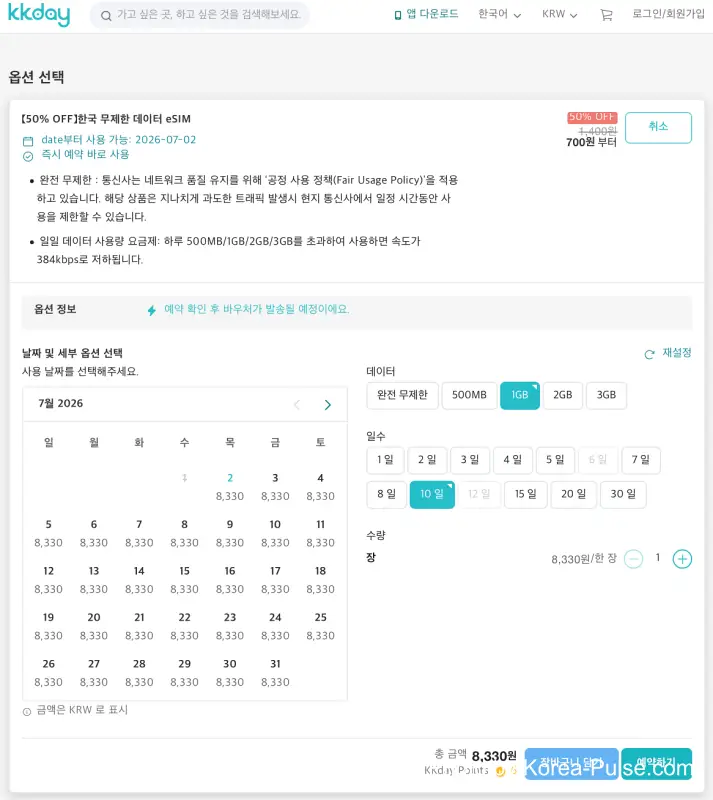
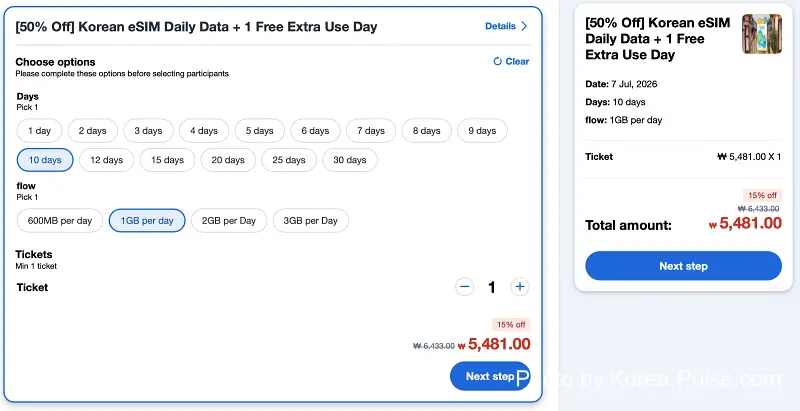
On KKday’s Korea eSIM listing, a 10-day plan at the 1GB/day tier runs ₩8,330 (the 500MB tier is cheaper, 2GB and 3GB cost more). On Agoda, under Activities → Seoul → eSIM, I found the same 1GB/day tier for ₩5,481, about $4 for 10 full days, at the prices I saw in July 2026. Both platforms let you pick your daily cap at checkout. Both are typically instant eSIM delivery, no counter, no queue.
I’m not linking my exact Agoda listing here because the link I tested carried someone else’s affiliate ID baked in, and sending readers through it would credit that person, not you. Search “eSIM” under Activities → Seoul once you’re in the app instead — the same listings come up.
eSIM or Physical SIM: Which Should You Pick
Most iPhones since the XS and XR (2018) support eSIM, and so do many recent Android phones, including Galaxy models from the S20 series on and Pixel 3 and later (check Apple’s official eSIM device list if you’re unsure about yours). If your phone is that age or newer, skip the physical SIM entirely. You buy the Korea eSIM before your flight, scan a QR code once you land, and you’re online without ever finding a counter. No plastic, no paperclip tool, no swapping trays in an airport bathroom.
None of this works if your phone is carrier-locked to your home network. Before you fly, call your carrier and confirm your phone is unlocked, or ask for an international unlock. This takes five minutes at home and is a real hassle to sort out once you’ve landed.
When You Actually Need a Number, Not Just Data
A cheap Korea data plan from KKday or Agoda gets you online, but it doesn’t come with a Korean phone number. That’s fine for most trips. It stops being fine if you want to book a table through a restaurant queueing app, call a taxi through Kakao T, or need a business to be able to reach you directly. For that, the official tourist plans from SK Telecom, KT, or LG U+ include a temporary 010 number valid for your stay, registered with your passport at the counter or through their pre-order sites. That’s the one case where I’d skip the budget hack and just pay the airport rate.
FAQ: Korea Travel SIM Card
For short trips with light data needs, no. Subways, buses, and cafes cover most of your time. A cheap eSIM with a 500MB–1GB daily tier just fills the gaps, like the walk between the station and your hotel. The official Visit Seoul phone and internet guide has a good rundown of free Wi-Fi coverage if you want a second opinion.
Not automatically, the price depends on the seller, not the format. But eSIMs skip the counter entirely, and the cheapest deals in this guide happen to be sold as eSIMs.
Yes. Every option in this guide, airport pre-order, global eSIM apps, and the KKday/Agoda local deals, can be bought and, for eSIMs, activated before you board.
Usually only if you buy directly from SK Telecom, KT, or LG U+. Budget eSIMs from global apps or local MVNO deals are data-only, with no Korean number attached.
Don’t panic-buy at the counter. If you’re a light data user, the KKday or Agoda tiered eSIM deal was the cheapest option I found by a wide margin. If you need real unlimited data or a Korean number, pay the airport rate and don’t feel bad about it.
Once your data’s sorted, plan the rest of your route from the terminal with our Korea Transit Guide.