
K-SCREEN · June 2026
The Legendary Military Cook
Korea’s Most Addictive Drama of 2026
tvN’s military fantasy just wrapped its finale tonight. Here’s my honest take — from a Global Dad who ordered late-night delivery after every single episode.
What do you get when you mix the raw emotional weight of Korea’s mandatory military service, the dopamine-hit pacing of a fantasy webnovel, and food visuals that make army rations look Michelin-worthy? You get The Legendary Military Cook — officially titled The Legend of Kitchen Soldier (취사병 전설이 되다) globally — tvN’s 12-episode Monday-Tuesday drama that just aired its finale tonight, and that my wife and I absolutely could not stop watching.
In this review of The Legendary Military Cook, the first thing worth saying is: don’t judge it by the premise.
At first glance, a K-drama about a chwisabyeong (취사병) — a military cook assigned to feed hundreds of hungry soldiers three times a day — might not scream prestige television. But under the sharp direction of Jo Nam-hyung and an ensemble cast that punches far above its weight, this show turns a sweaty military kitchen into a full-blown emotional arena. It’s one of the strongest live-action webnovel adaptations in recent years, and I say that as someone who’s watched far too many of them.
The King’s Warden · box office admissions
Nielsen Korea · Ep 4 & 5
Indonesia · Singapore · Taiwan · Thailand
Quick Stats: The Legendary Military Cook
Where to Watch The Legendary Military Cook
| Region | Platform | Notes |
|---|---|---|
| South Korea | TVING + tvN | Mon & Tue 20:50 KST · All 12 episodes now available |
| USA & Canada | Rakuten Viki | Subtitles available · Subscription required |
| Asia (select) | HBO Max | Indonesia, Singapore, Thailand, Malaysia, Philippines, Hong Kong, Taiwan |
| Global | Rakuten Viki | Multi-language subtitles · Check regional availability |
The Legendary Military Cook is trending on HBO Max globally at #10, with #1 rankings in Indonesia, Singapore, Taiwan, and Thailand — and #2 in Hong Kong, Malaysia, and the Philippines. If you’ve been sleeping on this one, the algorithm noticed before you did.
Park Ji-hoon: From Wink Boy to Wok Boy
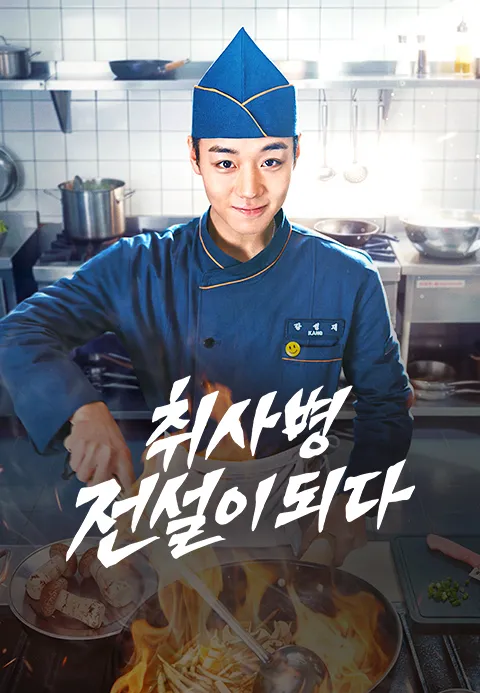
Let’s be honest about something: the beating heart of The Legendary Military Cook is Park Ji-hoon. About three episodes in, I turned to my wife mid-scene — Park Ji-hoon was flipping a massive wok with terrifying precision in full fatigues — and said, “Wait. Isn’t that the same kid from the audition show? The one who did the wink?” She stared at me like I’d personally insulted her intelligence. Of course it was.
For international fans who only know him from heavier roles, here’s the full arc: Park Ji-hoon first became a national sweetheart via the TV audition program Produce 101 Season 2, earning the nickname “Wink Boy” and debuting with Wanna One. He then made the pivot into serious acting that most idol-actors attempt but few actually pull off — shocking critics in the dark school thriller Weak Hero Class 1.
And then, earlier this year, he obliterated the Korean box office in the historical drama film The King’s Warden (왕과 사는 남자, directed by Jang Hang-jun), playing the tragic deposed King Danjong with such wrenching restraint that the film reached 16.28 million admissions — making it the second most-watched and highest-grossing Korean film in box office history. Park Ji-hoon personally won the Best New Actor award in the film category at the 62nd Baeksang Arts Awards for that performance.
Park Ji-hoon filmed The Legendary Military Cook as a pre-enlistment actor (미필) — he hasn’t completed his mandatory military service yet. In interviews, director Jo Nam-hyung explained he specifically wanted a non-veteran for Private Kang Seong-jae, reasoning that genuine first-timer energy — the awkward salutes, the sensory overload of barracks life — would make the character’s bewilderment completely authentic. It worked. The first three episodes play like an extremely high-budget reenactment of every Korean man’s worst memory of their first week in the army.
Why Military Dramas Hit Different in Korea
To fully appreciate why The Legendary Military Cook resonates so deeply here in Korea, international viewers need to understand what mandatory military service actually means in South Korea. This isn’t a volunteer army. Every able-bodied Korean man serves roughly 18–21 months, and the shared weight of that sacrifice is baked deep into the national identity. Army stories aren’t just entertainment — they’re collective memory.
The standards the public sets around this duty are unforgiving. The most cautionary tale: pop star Steve Yoo (유승준), one of the biggest names in Korean music in the early 2000s. When he obtained US citizenship right before his scheduled enlistment — effectively avoiding his duty — the public response was swift and permanent. He has since faced repeated visa denials and remains effectively barred from re-entering Korea, over two decades later. It’s the story every public figure here knows by heart.
Living here as an expat dad, I’ve sat through enough dinners where Korean men bond over army stories to understand what this show taps into. When Private Kang Seong-jae pours his whole soul into making a proper meal for his exhausted unit, he isn’t just cooking. He’s offering comfort to men who gave up years of their lives to be there. That emotional layer doesn’t exist in voluntary-army dramas. It’s uniquely, specifically Korean — and it lands in a way that’s impossible to fake.
The Status Window: Webtoon Logic Done Right
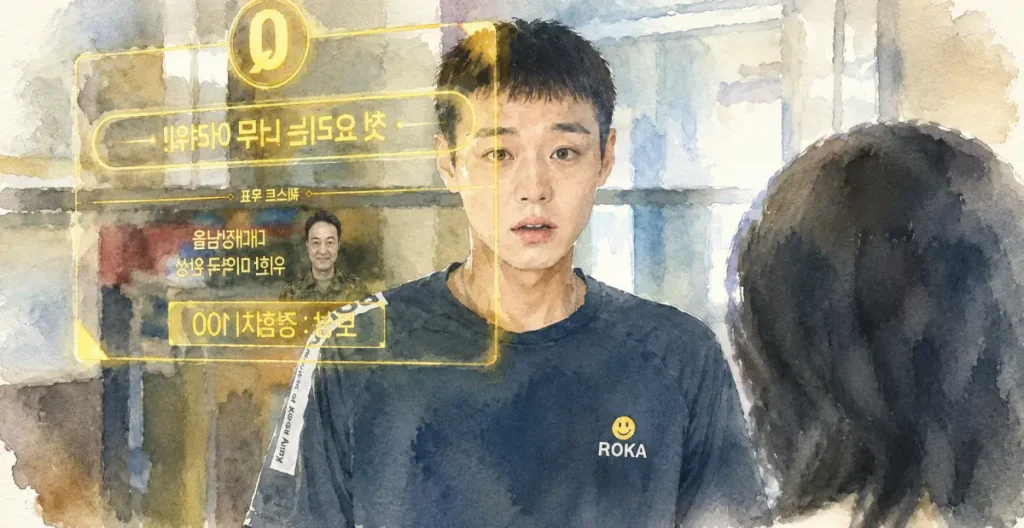
There’s a clear wave of webtoon and webnovel adaptations dominating Korean screens right now, and The Legendary Military Cook rides that wave while doing something genuinely risky: it imports a pure gaming fantasy trope — the “Status Window” (상태창) — directly into live-action television.
If you’ve read any Korean web fiction, especially the so-called “system” or “status window” sub-genre, you know the format: the protagonist gets a floating holographic interface showing their skills, active quests, level-up notifications, hidden stats. It’s hugely popular on the page. On screen, it could easily look cheap or gimmicky. The production team pulled it off. When Seong-jae activates his culinary skills or reads the hidden taste preferences of his demanding officers through that glowing interface, it feels sharp and earned — not a distraction but a genuine part of his character’s visual language.
The original webtoon is published on Naver Webtoon under the title Kitchen Soldier by J Robin. The screenplay adaptation was written by Choi Ryong, who draws on his own experience as a military cook during conscription — and it shows in every small detail of the kitchen sequences: the chaos of feeding hundreds of men on a tight schedule, the unspoken politics of who gets the best cut of meat, the strange pride in making a hard man clean his tray. Korean internet commenters have been comparing the food reaction scenes to the classic anime Cooking Master Boy (요리왕 비룡). The comparison is accurate, affectionate, and very funny.
The Ensemble: No Stars Needed
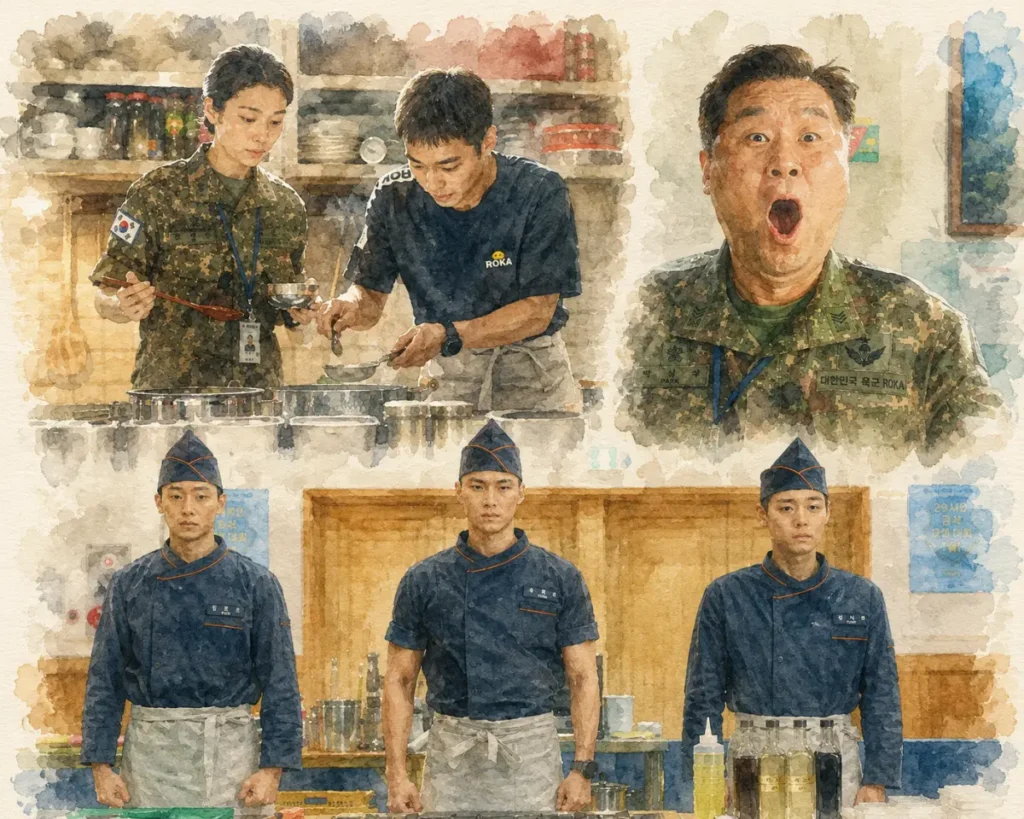
Park Ji-hoon aside, the supporting cast of The Legendary Military Cook isn’t stacked with Hallyu megastars — and that’s precisely why it works. Yoon Kyung-ho plays Sergeant Park Jae-young, a veteran supply officer who claims a notorious gangster past from Yeosu but can’t produce a shred of evidence — a man who has watched every colleague get promoted while he stays forever a sergeant, creating incidents at a rate that only accelerates with Seong-jae’s arrival. Han Dong-hee is Lieutenant Cho Ye-rin, the ROTC-trained outpost commander who is very much the odd one out among military academy officers, and who spent most of her posting waiting quietly to leave — until Kang Seong-jae showed up and ruined that plan entirely.
Lee Hong-nae plays Yoon Dong-hyeon, the head cook who takes his gym routine far more seriously than food and whose cooking has cast a shadow of misery over every mealtime at the base. Lee Sang-yi rounds out the main cast as Captain Hwang Seok-ho, the company commander with an elaborate gourmet persona he absolutely cannot back up. Together, they are the most unexpectedly endearing ensemble on Korean television this year.
Pros & Cons: The Honest Version
Here’s my honest breakdown of The Legendary Military Cook before you commit to a 12-episode binge.
| Pros | Cons |
|---|---|
| Completely original concept — military + cooking + RPG status system | The “status window” CGI may take 1–2 episodes to warm up to |
| Park Ji-hoon delivers a performance well beyond his years | Episodes 1–2 spend significant time on setup — patience required |
| Ensemble chemistry that rivals the best Korean workplace dramas | Food scenes so visually intense they will 100% make you order delivery |
| Earns its emotional moments rather than manufacturing them | 12 episodes felt short — you will want more |
| Finale sticks the landing without the easy dramatic choice | Heavy Korean military-culture context may need googling for some viewers |
The Finale: Worth Every Bite
No spoilers on The Legendary Military Cook finale — but the decision to strip Seong-jae of his Status Window going into the final episode was structurally perfect. The whole series builds toward a question that only becomes visible in retrospect: was it the system that made him extraordinary, or were the skills always his? Tonight’s finale answered that. Decisively. The kind of ending that makes you feel slightly embarrassed about how emotionally invested you got in a man cooking rice for soldiers.
The finale stuck the landing. It didn’t go for the obvious dramatic choice — it went for the earned one. If you’ve been watching since Episode 1, the payoff is proportional. If you haven’t started yet: now is the perfect time. All 12 episodes are available, you can binge straight through, and you’ll skip the six weeks of Monday-Tuesday agony the rest of us endured.
FAQ: The Legendary Military Cook
The questions I get asked most about this one — answered straight.
Yes — same show, different title depending on where you watch it. The official Korean title is 취사병 전설이 되다. In Korea it’s known colloquially as “The Legendary Military Cook,” while the international release title on Viki and HBO Max is The Legend of Kitchen Soldier. Search either one and you’ll find it.
Not exactly — but closer than you’d think. The original webtoon is fiction, but screenwriter Choi Ryong drew on his own experience as a military cook during conscription. The kitchen chaos, the ingredient sourcing, the strange pride of feeding a unit well — that authenticity is real, and it shows in every episode.
In the US and Canada: Rakuten Viki under the title The Legend of Kitchen Soldier. In Asia (Indonesia, Singapore, Thailand, Malaysia, Philippines, Hong Kong, Taiwan): HBO Max. In Korea: TVING and tvN. All 12 episodes are now available.
Not at all. The drama is completely self-contained. If you fall in love with it and want more, the original Naver Webtoon is right there — but it’s not required homework. Jump straight in.
Yes. The military setting is the backdrop, not the point. The point is: a young man finding something he’s genuinely good at, for the first time, in the most unlikely place. My wife, who fast-forwards through anything involving army scenes in literally any other drama, watched every episode without complaint. That says everything.
“The Legendary Military Cook earns its finale by being completely honest about what it is — a story about finding dignity in an unglamorous job, and the people who see you clearly when you don’t see yourself at all.”
★★★★½ · A must-watch. Binge it this weekend while the finale is still fresh.
The Legend of Kitchen Soldier (The Legendary Military Cook) is streaming now — all 12 episodes available on Rakuten Viki (US/Canada), HBO Max (select Asia), and TVING (Korea). If you’ve already watched it — was the finale worth it for you? Let me know in the comments.
If The Legendary Military Cook left you wanting more from Park Ji-hoon, The King’s Warden (왕과 사는 남자) and Weak Hero Class 1 are both essential — and both are currently riding the 박지훈 신드롬 algorithm wave if you need a push to start.