K-POP · JUNE 2026
K-Pop World Cup 2026
How Korea Took Over the Planet’s Biggest Stage
EJAE opened Mexico. Lisa owned LA. BTS closes the final. My wife saw it coming before I did.
My wife and I were deep into a late-night conversation — the kind that starts as casual catch-up and quietly becomes a cultural reckoning — when she said it plainly: “K-pop didn’t just get a performance slot at the World Cup. It wrote the soul of the whole thing.” I had no argument. The K-Pop World Cup 2026 has produced three landmark moments across three continents, and at the center of it all is a Korean-American songwriter named EJAE — Grammy, Golden Globe, and Oscar winner — a woman who spent over a decade being told her voice was wrong, and just sang it to the world.
I’ll be upfront: I’d been following EJAE since KPop Demon Hunters blew up last year, but I hadn’t fully connected all the dots until my wife laid out the full picture. The K-Pop World Cup 2026 story, as she told it, is bigger than any single performance. She’d been deep in the YouTube rabbit hole — You Quiz clips, radio interviews, the whole thing. By the time she was done talking, I needed to sit with it for a minute. This isn’t just a feel-good story about a singer making it big. It’s something more specific than that.
The Voice They Said Was Wrong: EJAE’s 12 Years at SM Entertainment
Born Kim Eun-jae in Seoul in 1991, EJAE is the artist at the heart of the K-Pop World Cup 2026 story. She started training at SM Entertainment at age 11 and was there from 2003 until around 2015 — twelve years. And here’s the thing my wife explained that reframed everything for me: there’s a hierarchy inside the trainee system that outsiders don’t usually know about. It goes like this — 연습생 (trainee) → 데뷔준비조 (debut prep squad) → 데뷔조 (debut group). Most people assume that if you train long enough, you eventually get promoted up the ladder.
EJAE never made it past the first rung. Twelve years as a trainee. Not once did she get called up to the debut prep squad. And the reason, as she has spoken about in interviews including her emotional You Quiz appearance: her natural voice didn’t fit what the industry was looking for at the time. The house sound she was being measured against — think Taeyeon, clear and crystalline — was the opposite of her deep, soulful, husky tone. So she spent over a decade trying to reshape herself, training toward a style that wasn’t hers, until she was finally let go at age 23.
By the end of those 12 years, she had actually gotten there — she could do both styles. The high, clear SM-approved sound and the deep, husky voice that is uniquely hers. She mastered what they asked for. They still didn’t debut her. She left the company having learned everything, received nothing, and carrying a voice that the industry had spent a decade telling her was a flaw. That voice just sang the opening anthem of the K-Pop World Cup 2026.
That voice — the one they spent a decade trying to fix — is now the sound of the K-Pop World Cup 2026 opening ceremony.
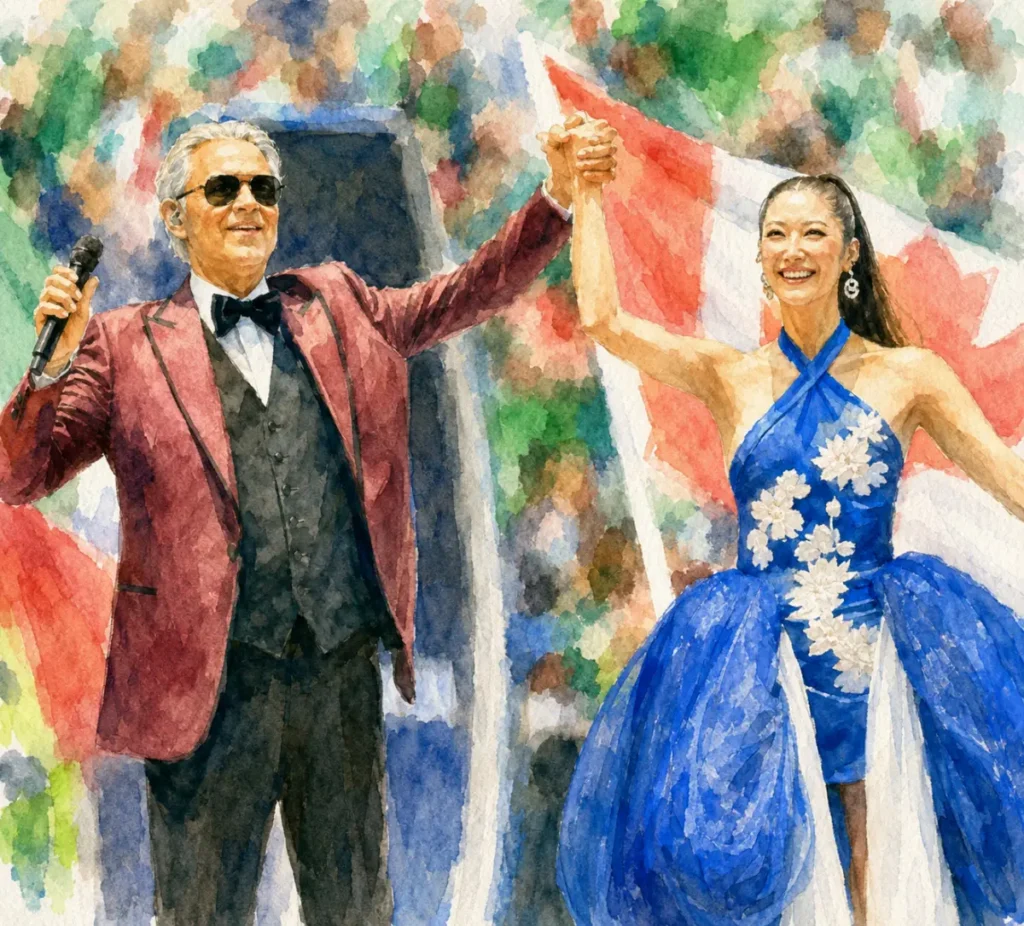
▶ EJAE & Andrea Bocelli — “DNA” Live at Estadio Azteca
FIFA World Cup 2026 Opening Ceremony · @fifaworldcup on Instagram
From Trainee to Songwriter to Stage: The Career No One Planned
After SM, EJAE shifted completely into songwriting and producing — studied at NYU, built a catalog that includes Red Velvet’s “Psycho,” tracks for aespa, TWICE, LE SSERAFIM, and more. By the time KPop Demon Hunters came around, she was already well-established and financially comfortable as a behind-the-scenes hitmaker. She had the money. She had the respect. She’d simply never considered herself a performer.
Then director Maggie Kang heard her demos for the film and made her the singing voice of Rumi — setting in motion the chain of events that led to the K-Pop World Cup 2026 stage. “Golden” went to No. 1 on the Billboard Hot 100 — topping the chart for multiple weeks. A Grammy (Best Song Written for Visual Media — one of five nominations that year, including Song of the Year). A Golden Globe for Best Original Song. And an Oscar — Best Original Song, the first ever for a K-pop track. And suddenly EJAE was being booked for live performances, radio shows, television — a career arc she had never mentally prepared for.
“She said herself — the mental pressure of suddenly having to perform live, after years as a composer, was enormous. The stress was real. But then she realized: those 12 years of trainee life weren’t wasted. She knew exactly how to prepare for a stage. The training she did for someone else’s dream ended up serving her own.” That landed differently after midnight, I’ll tell you that.
My wife had watched EJAE’s You Quiz appearance — the one after Golden blew up — and described a moment where she broke down crying talking about her trainee years. Not with bitterness, but with the kind of emotion that comes from looking back at a long, painful road and finally being able to see where it led. I haven’t watched it yet. I kind of don’t want to, because I suspect I’ll cry too, and I have a reputation to maintain.
“DNA (More Than a Game)”: The Song That Is Her Life
The official FIFA World Cup 2026 anthem is called “DNA (More Than a Game),” and EJAE co-wrote the Korean lyrics for this K-Pop World Cup 2026 anthem. The line she sings near the climax — 또 넘어져도 나 또다시 일어나, “even if I fall again, I rise once more” — is, as my wife put it, not just a World Cup anthem. It’s autobiography. It’s twelve years of being passed over, written into a melody and sung in Korean at Estadio Azteca in front of the world.
Worth noting for anyone tracking the K-Pop World Cup 2026 music story: David Guetta and Megan Thee Stallion are credited on the studio recording, but neither performed live at the opening ceremony in Mexico City. The live debut of “DNA” was EJAE and Andrea Bocelli, alone on that stage. My wife made the comparison to “Golden” immediately — same DNA in the songwriting, she said. The way EJAE writes, her soul goes into it. You feel it even when you don’t know the backstory. When you do know the backstory, it’s something else entirely.
K-Pop World Cup 2026: Korea Owns Every Slot That Matters
Here’s the thing that stopped my wife mid-sentence and made me put down my drink. It wasn’t just EJAE. Pull back and look at the full picture of the K-Pop World Cup 2026 and what you see is Korea holding three completely different, completely dominant positions across the entire tournament. Not one slot. Three. Each one a different flavour of what Korea can do.
| World Cup Moment | Korean Artist | What Actually Happened |
|---|---|---|
| Mexico Opening Ceremony June 11 · Estadio Azteca, Mexico City | EJAE | Co-performed official anthem “DNA (More Than a Game)” live with Andrea Bocelli. Wrote the Korean lyrics herself. Guetta and Megan Thee Stallion on record only — the live stage was hers. |
| USA Opening Ceremony June 12 · SoFi Stadium, Los Angeles | LISA (BLACKPINK) | Performed her track “Goals” alongside Anitta and Rema. Katy Perry and Future also performed at the same ceremony, but as separate acts on their own songs — not alongside Lisa. |
| World Cup Final Halftime Show July 19 · MetLife Stadium, New Jersey | BTS | Co-headlining with Madonna and Shakira. The first-ever halftime show in World Cup Final history. Curated by Chris Martin of Coldplay. |
My wife’s framing: “FIFA is one of the most purely capitalist organizations on earth. They don’t hand out prime slots based on vibes. The fact that Korea got the emotional soul of the opening ceremony, a headline slot in the biggest pop spectacle of the US leg, and the halftime show of the final — that’s not a coincidence. That’s a verdict.”
She also raised something that’s been circulating in Korean media coverage of the K-Pop World Cup 2026 ceremony — reports that the production team handling sound and camera direction for the Mexico opening was Korean. If accurate, the cultural footprint goes even deeper than the performance credits suggest. It’s an argument some Korean commentators are making: this isn’t just Hallyu anymore. It’s Korea setting the technical standard for how the world stages its biggest moments.
On the BTS side of the K-Pop World Cup 2026 equation: if you’ve been following their comeback arc, you already know the weight of this. Their album ARIRANG debuted at No. 1 on the Billboard 200 after all seven members completed mandatory military service.
They’re currently on a world tour. On July 19, they step off that tour to co-headline the most-watched sporting event on earth — alongside Madonna and Shakira, in the first halftime show in World Cup Final history. As I wrote when covering BTS’s record-breaking AMA wins, the “K-pop moment” framing stopped applying a while ago. This is something more permanent.
And Lisa — the other face of the K-Pop World Cup 2026 story — my wife had the cleanest take on the contrast between her and EJAE: “They’re two completely different expressions of what K-pop can be. EJAE is the songwriter-turned-vocalist who arrived sideways after a decade of invisible labor. Lisa is the fully-formed icon who walked onto that LA stage like she owns the entire genre. Both of them are right.” If you want more on Lisa and BLACKPINK’s dominance in 2026, I went deep on that earlier this year.
The American Radio Moment: 34 and Flawless
After her K-Pop World Cup 2026 opening ceremony performance, EJAE appeared on a major American radio show, and my wife had caught the clip. The panel’s reaction — part admiration, part genuine bewilderment — tells you everything about what the K-Pop World Cup 2026 moment means outside of Korea.
My wife’s commentary on this: “She’s not going to be shaken by this. The success isn’t going to swallow her. Because she already knows who she is — she figured that out during the hard years, not after the easy ones.” That feels right to me. And it’s the exact opposite of a lot of the cautionary tales that come out of the Western pop machine.
The Copyright Nobody Talks About: “Golden” and the Real Money in Music
Here’s the part of the K-Pop World Cup 2026 conversation that made my wife put her cup down and stare at the ceiling for a moment. People assume the money in music goes to the performers. It doesn’t. It goes to whoever holds the copyright. And EJAE holds the copyright on “Golden.”
One host on a Korean talk show compared the scale of “Golden”‘s annual royalty income to the total prize money from Squid Game — as a way of gesturing at the sheer size of the number. Nobody stated a precise figure. But nobody contradicted the comparison either.
KPop Demon Hunters became Netflix’s most-watched content ever, surpassing 300 million views. The official “Golden” lyric video crossed 1 billion YouTube views in January 2026 — before the World Cup, before the Oscar, before any of this.
Every one of those streams generated royalties. Every time “Golden” played in a shopping mall, a café, a store, a film trailer, an ad — that’s copyright income. My wife’s conclusion: “People think singers make the money. The person writing the song at 2am in a studio, that’s where the real money goes.” EJAE has been that person for years. Most people just didn’t know her name.
The lottery comparison my wife threw out was probably the most visceral way to put it. “You’d have to win the lottery about 30 times to get there.” Whether or not that’s precise, the scale is right. And the bittersweet footnote is that she built all of that equity while being completely invisible to the public — writing songs other people sang, under her name in the credits that nobody reads. Now everybody knows the name.
FAQ: K-Pop World Cup 2026
These are the K-Pop World Cup 2026 questions coming up most — answered straight.
Completely different song. The 2026 FIFA World Cup anthem “DNA (More Than a Game)” is an original track co-written by EJAE featuring Andrea Bocelli, David Guetta, and Megan Thee Stallion. No connection to the BTS song beyond sharing a title.
No. Both appear on the studio recording of “DNA” but were not at Estadio Azteca on June 11. The live performance was EJAE and Andrea Bocelli only.
Not on the same song. All three performed at the SoFi Stadium opening ceremony, but as separate acts — Lisa’s “Goals” featured Anitta and Rema, Katy Perry performed “Wonder” with Tius Luka, and Future performed “Game Time” with Tyla and DJ Sanjoy.
No — and this is a common misconception worth clearing up. EJAE was at SM during the same period as Girls’ Generation members, but she never reached the debut prep squad at all. She spent all 12 years at the trainee (연습생) level and was never in consideration for any specific group debut.
July 19, 2026 — the World Cup Final halftime show at MetLife Stadium in New Jersey. They’re co-headlining with Madonna and Shakira in the first-ever halftime show in World Cup Final history, curated by Coldplay’s Chris Martin.
Three major awards: a Grammy (Best Song Written for Visual Media — one of five nominations including Song of the Year), a Golden Globe for Best Original Song, and the Academy Award for Best Original Song at the 2026 Oscars — the first K-pop song to win all three. The official lyric video also crossed 1 billion YouTube views in January 2026.
If the K-Pop World Cup 2026 story got you thinking about how deep Korea’s cultural reach goes, these posts will take you further.
“K-Pop didn’t just get a seat at the table. It built three different tables — at three different World Cup moments — and invited the world to sit down.”
That’s what my wife said, more or less. And she was right before I caught up. EJAE’s story is the most Korean story of the K-Pop World Cup 2026 — the perseverance arc, the unconventional path, the voice they said didn’t fit, singing in Korean to a global audience of hundreds of millions. The K-Pop World Cup 2026 will be remembered not just as a cultural milestone, but as the moment the Hallyu wave stopped being called a wave and started being called the tide. My wife called it months ago. I’m just writing it down.