
K-FOOD · July 2026
Inside Korea’s Unmanned Ice Cream Store Boom
No Cashier, No Problem
A pink-lit freezer aisle, a self-checkout kiosk, and zero human beings — the shop that has quietly become a fixture of Korean neighborhood life.
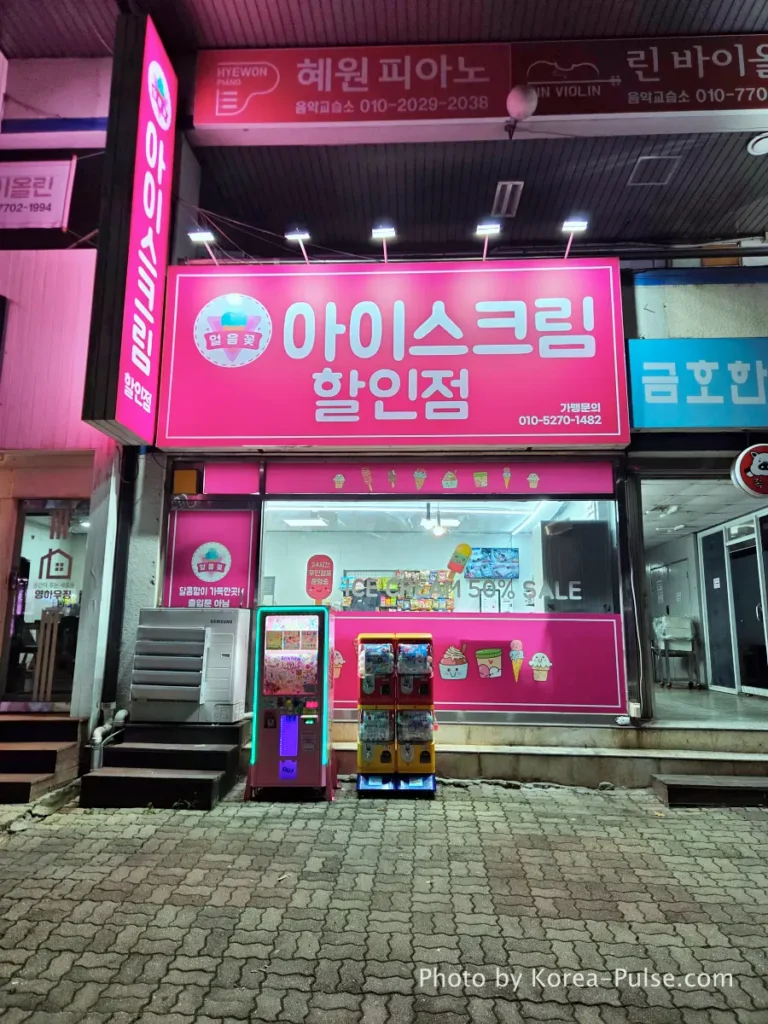
There’s an unmanned ice cream store across the street from my apartment in Ilsan, and another one two minutes further down, and I’m fairly sure a third opened while I wasn’t looking. Nobody calls these places by their franchise name — they’re just “the ice cream discount shop” — no staff, no register, just a fridge full of 600-won bars and a kiosk that trusts you completely. Here’s what actually happens when you walk in, basket in hand, and try to pay.
Wait — There’s Genuinely No One Watching?
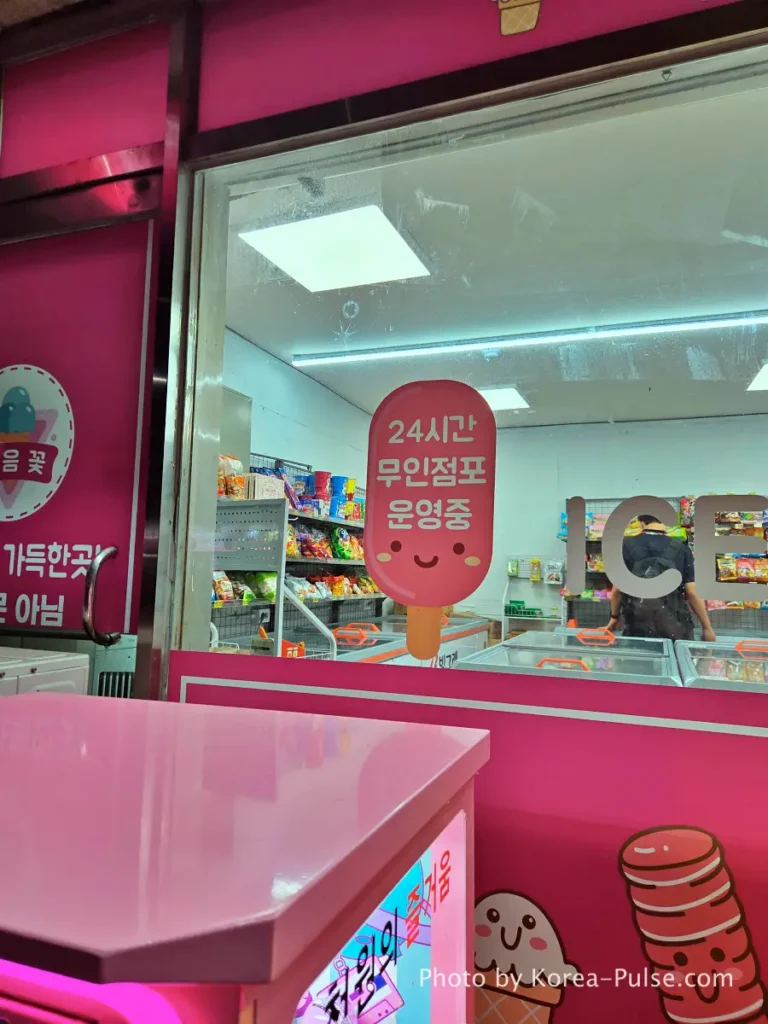
Yes. Genuinely no one. This is a 24-hour unmanned store in the most literal sense — the sign by the door reads 24시간 무인점포 운영중, “operating unmanned, 24 hours,” and it means exactly that. You walk in, you shop, you pay yourself at a kiosk, and you leave. There’s no buzzer, no staff member physically in the shop — just you and the freezers. It can feel stranger than your first palace ticket machine. An entire retail category in Korea runs on a quiet bet: that theft stays low enough for the numbers to work.
And it’s not a niche experiment. This is one of the fastest-growing corners of Korean retail. According to Samsung Card’s own transaction tracking, the number of unmanned stores in Korea grew roughly 314% between 2020 and early 2025 — compared to just 8% growth across franchise businesses overall. Ice cream discount shops, along with coin laundries, study cafes, photo booths, and meal-kit shops, make up the core of that boom. Industry estimates counted roughly 9,300 franchise-registered unmanned ice cream stores as of April 2025 — past the 10,000 mark once independent shops are included.
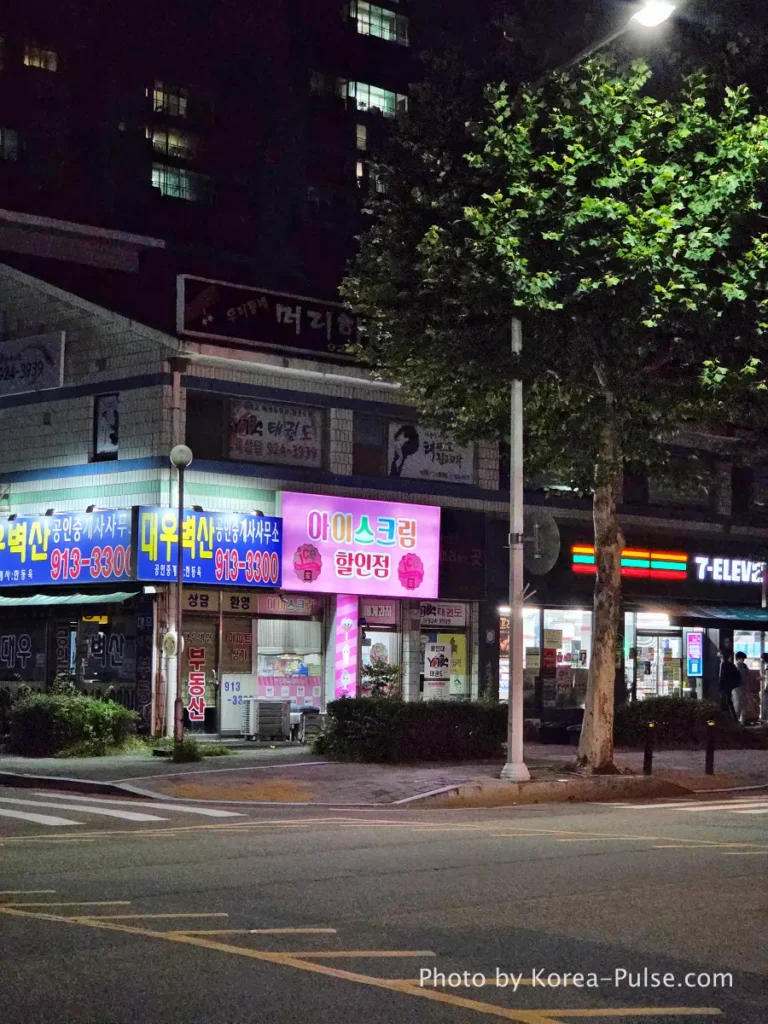
These aren’t hidden away in back alleys, either. In my own apartment complex in Ilsan, it feels like almost every block now has one tucked between the parking garage and the playground. Recent industry reporting even flags the flip side of that growth: so many shops have opened so close together that some owners are now seeing their own sales cannibalized by the store that opened two doors down. It’s a familiar Korean retail pattern: boom first, crowding five minutes later. It also happens to explain why the prices stay so stubbornly low.
Grab a Basket — You’ll Need It
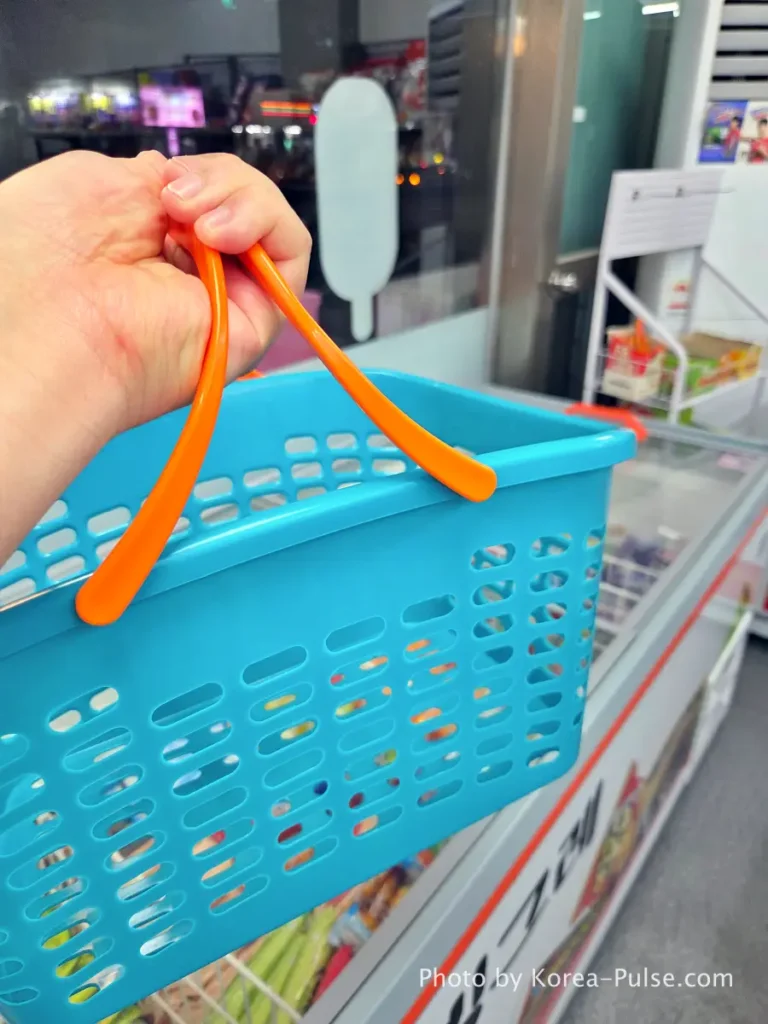
Step one, every time: pick up a basket by the door. The shop itself is nothing more than a wall of chest freezers, organized loosely by price rather than flavor — which turns out to be the more useful system anyway. Bars in one bin, cones in another, tubs at the end, each with a big handwritten price card, so you can navigate the entire store without reading a single product name.
The Price Tiers: 600 Won Bars to 6,000 Won Tubs
Once you’re inside, the pricing logic becomes obvious fast. Everything is grouped into rough tiers, and once you know them, you can price a whole freezer just by glancing at which shelf something sits on. At the exchange rate in mid-2026 (roughly ₩1,500 to the dollar), here’s how that actually breaks down:
| Tier | Price (KRW) | Roughly (USD) |
|---|---|---|
| Bar / hard-type (watermelon bar, pig bar, Melona, Nugabar) | ₩600 | ~$0.40 |
| Premium bar (chocolate-coated, Crunky-style) | ₩1,000 | ~$0.67 |
| Cone & lidded-cup types (Bravo Cone, World Cone, Double Biyanco) | ₩1,400 | ~$0.93 |
| Sandwich-type (biscuit or wafer + ice cream) | ₩1,800 | ~$1.20 |
| Small cup | ₩2,000–₩2,800 | ~$1.33–$1.87 |
| Family-size tub (Together, Hodu Maru) | ₩5,500–₩6,000 | ~$3.67–$4.00 |
Even the top tier here costs less than a decent latte in Seoul — that’s the whole appeal in one sentence. And a quick language note: most Koreans call the bar-and-stick category 하드 (hardeu). I always assumed that was just shorthand for “the hard kind, as opposed to soft-serve.” It isn’t. The name traces back to 삼강 하-드, a mass-produced ice bar launched in 1962 as Korea’s first hygienically manufactured frozen treat — such a hit that “하드” became the generic word for every stick-type ice pop in the country, the way “Kleenex” swallowed “tissue” in English.
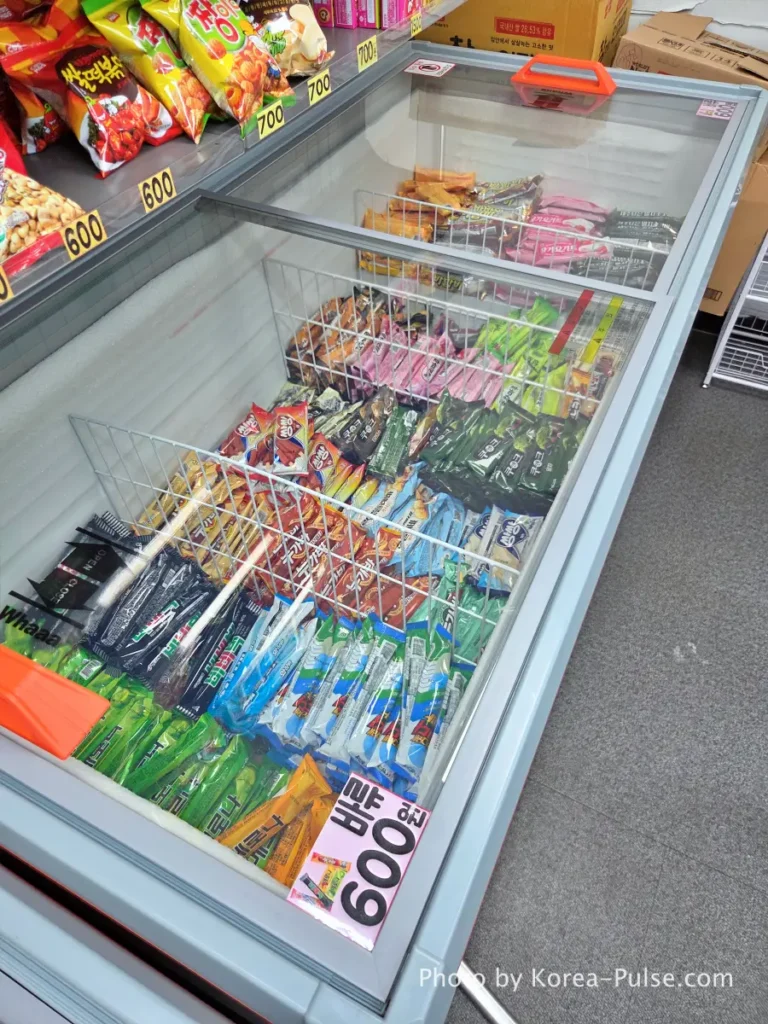
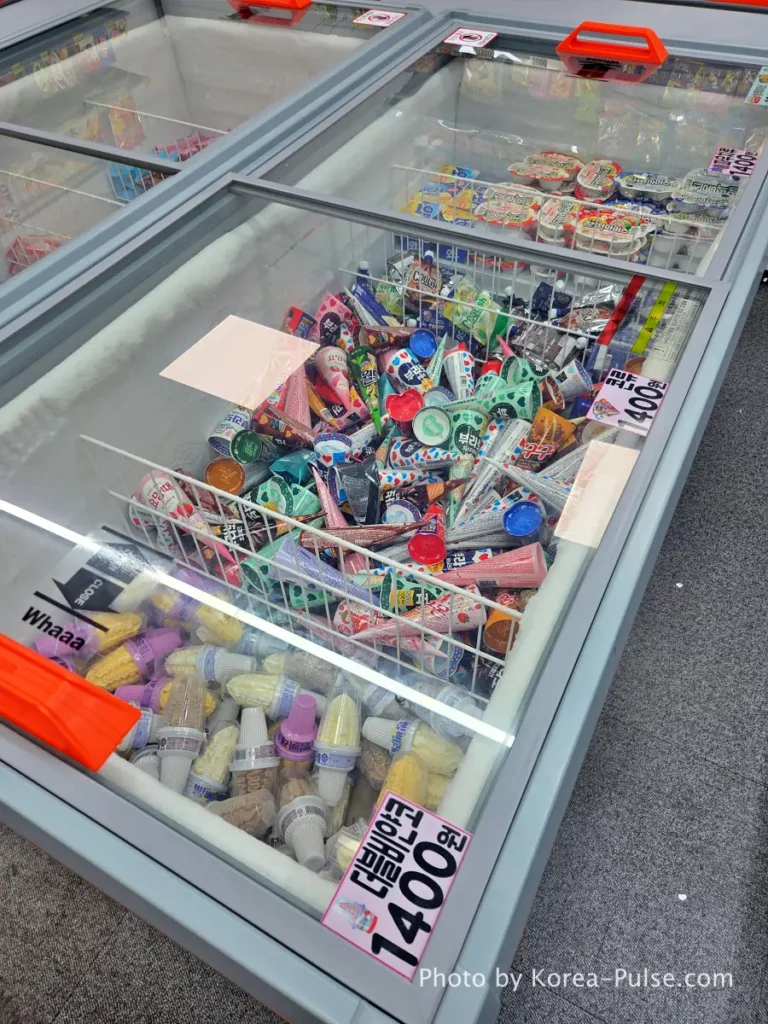
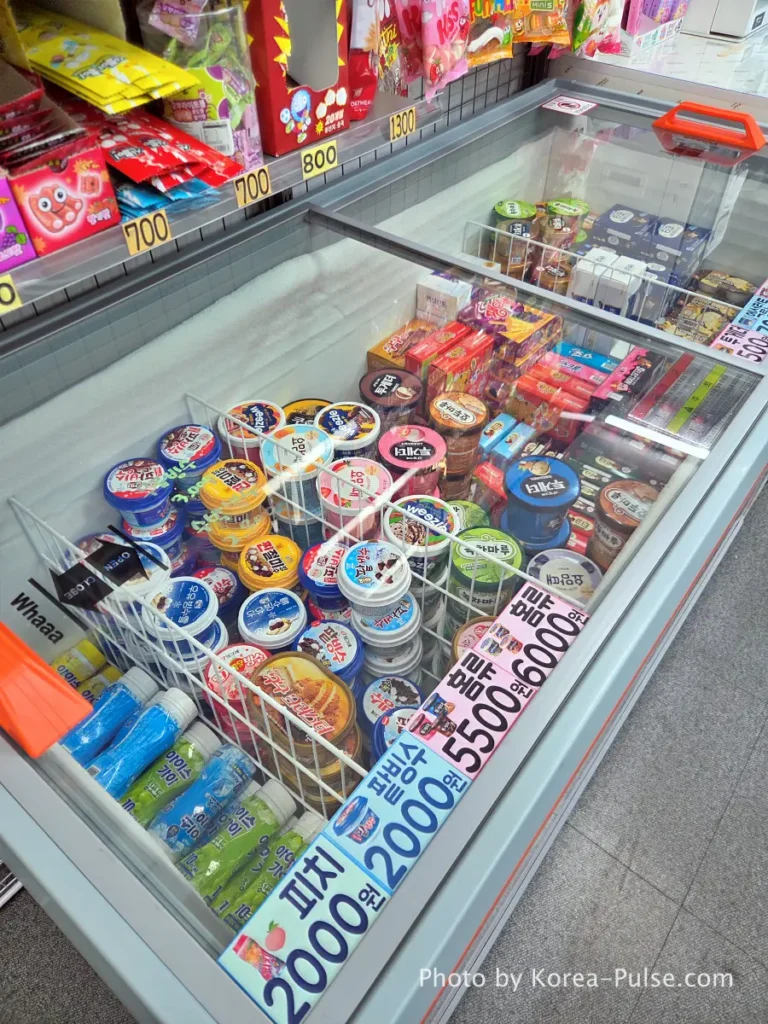
Honestly, though, most people — myself included — end up back at the cheap shelf. A big tub feels like a bargain until you’re carrying it home melting, whereas a single bar is something you can eat on the walk back without any commitment. Convenience beats value more often than I’d like to admit.
Unmanned stores skew toward a narrower set of brands than convenience stores do — mostly Lotte Wellfood, Binggrae, and Haetae. If you want something more obscure or seasonal, a convenience store is still your better bet; these shops win on price and volume, not variety.
Why Doesn’t Everyone Just Walk Out Without Paying?
It’s usually the first question friends visiting from abroad ask me, and the honest answer starts with the ceiling: the camera you’ll spot the second you look up near the kiosk. Every unmanned store I’ve seen runs on constant CCTV, traceable payments, and ordinary social pressure — and everyone using the machine knows it. The cameras make a ₩600 crime look like spectacularly poor value, and that math keeps almost everyone honest.
I’ll push back on my own optimism a little here, though: it isn’t a perfect system. Industry coverage of this same boom regularly notes ongoing issues with theft, skipped payments, and equipment breakdowns at unmanned shops — it’s a known, tolerated cost of the model, not a myth that these stores have somehow eliminated. Yet I keep seeing new ones open anyway — which tells you the economics work even with some leakage.
The other half of the answer is that daily life in Korea feels nearly cashless — cash hasn’t disappeared, but card and mobile cashless payment are so dominant that carrying bills has become the unusual choice, not the default one. Almost every transaction here leaves a digital trail. That combination, contactless payment plus constant camera coverage, is really what makes an unstaffed store commercially viable at scale.
Reading the Kiosk When Everything’s in Korean
Here’s the part that actually trips people up: the kiosk. Not the concept of self-checkout — everyone understands that — but the fact that there’s no English toggle at all. I tried switching mine over out of habit and there simply wasn’t an option. The good news is the icons carry almost the entire interaction, so you don’t need to read a word of Korean to get through it. But it helps to know what you’re looking at.
| 한글 | Romanized | English |
|---|---|---|
| 무인결제 키오스크 | muin gyeolje kioseukeu | unmanned payment kiosk |
| 카드결제 | kadeu gyeolje | card payment |
| 간편결제 | ganpyeon gyeolje | simple pay — QR-based apps like Naver Pay, Kakao Pay |
| 현금 | hyeongeum | cash |
| 계좌이체 | gyejwa iche | bank transfer |
| 시작 | sijak | start |
| 영수증 출력 | yeongsujeung chullyeok | print receipt |
Screenshot this table before you go — a melting Nugabar is not the ideal translation assistant.
Checking Out: A Step-by-Step Walkthrough
The whole process is genuinely simple once you’ve seen it done once. Here’s exactly how it went for me — I scanned a 부라보콘 (Bravo Cone) and a 누가바 (Nugabar) together first just to show how the barcode step works, then cleared one item and actually paid for just the Nugabar, since that’s the one I wanted to eat on the walk home:
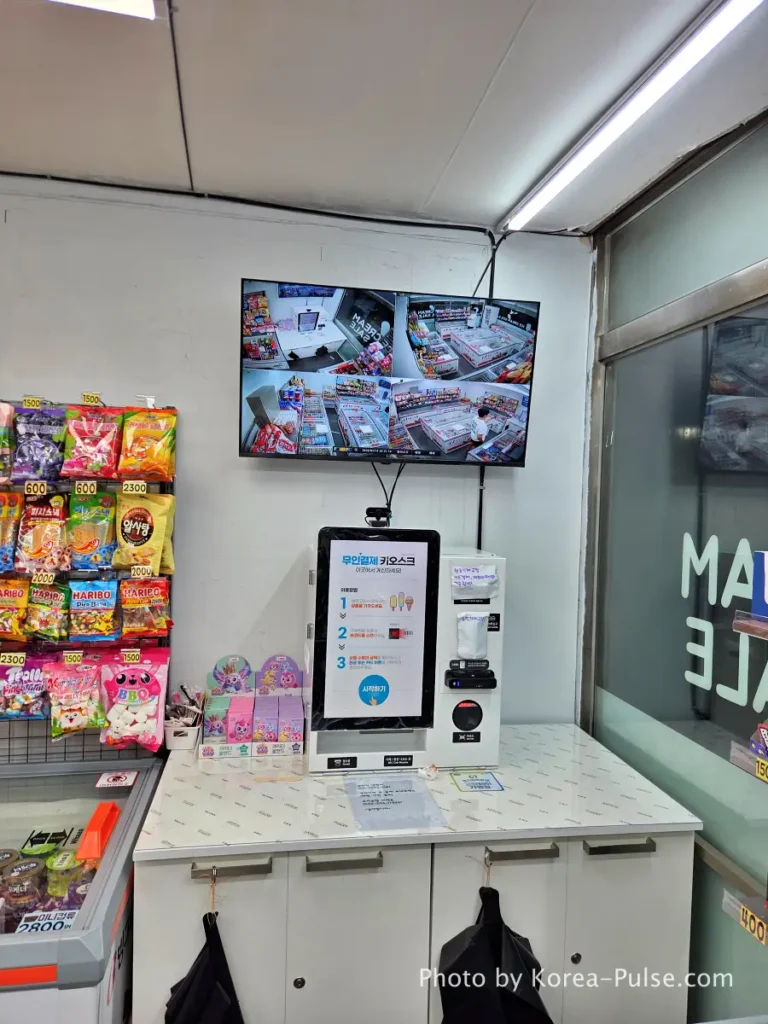
1. Hit start. The kiosk’s home screen lays out the process in three illustrated steps — bring your items, scan the barcode, confirm and pay. The illustrations do most of the work, even where the Korean text doesn’t.
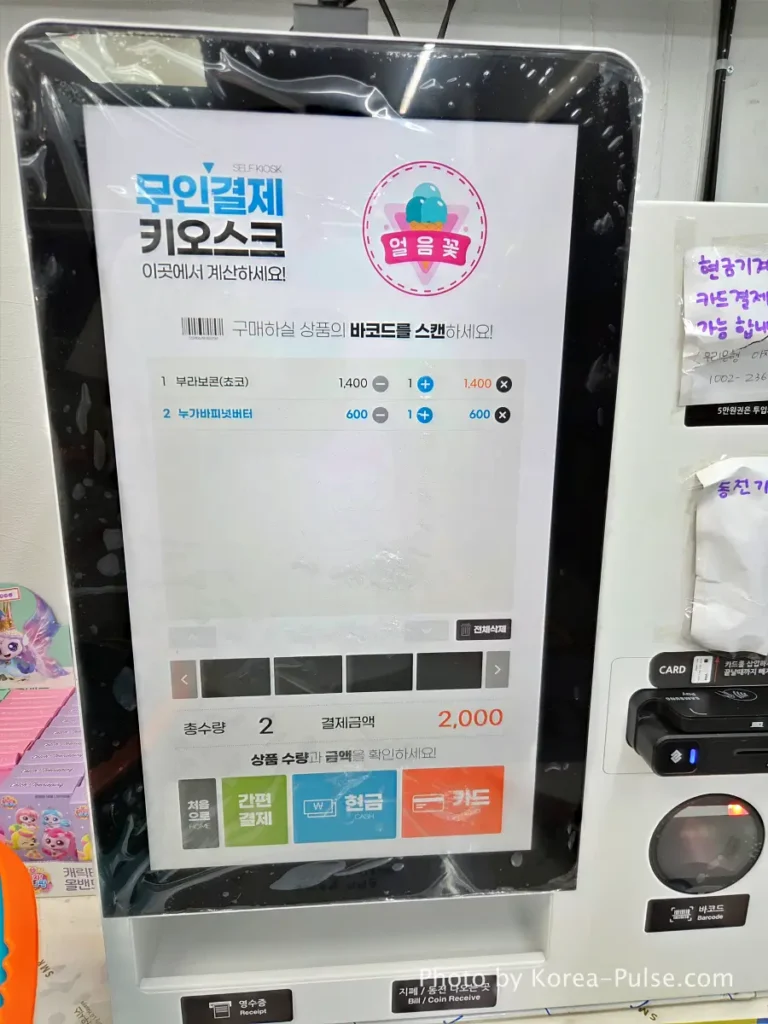
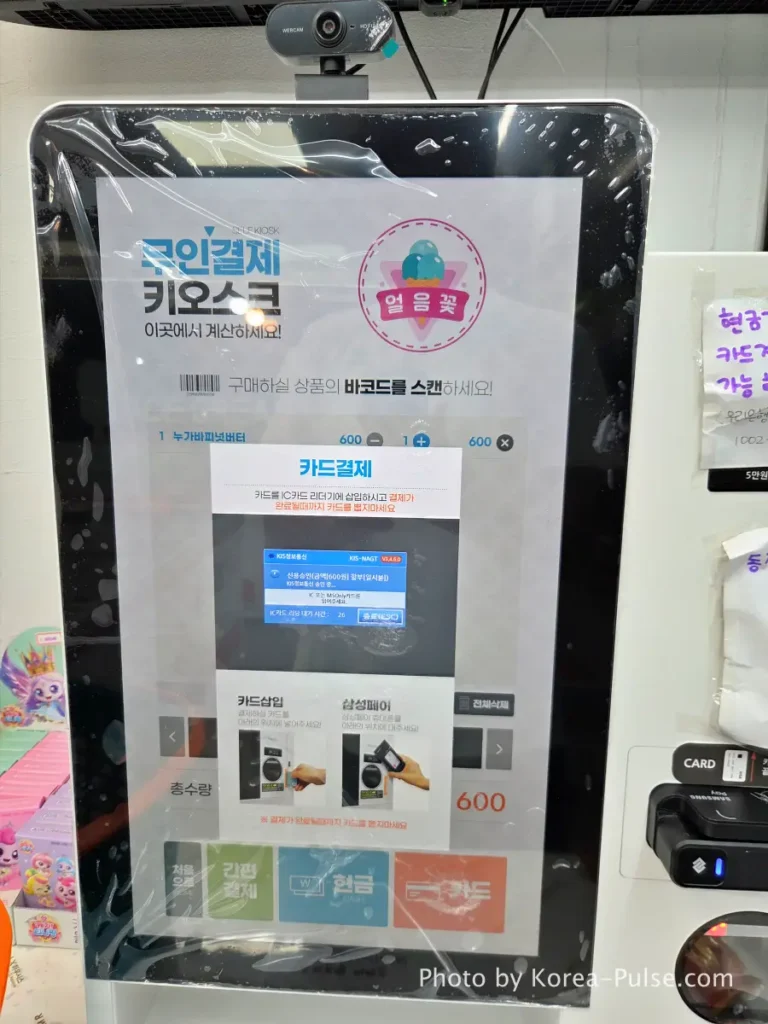
2. Choose your payment method. The screen gives you three buttons: simple pay (QR-based apps), cash, and card. I went with card, since that’s where phone-based tap payment lives too. At this store’s terminal, my Samsung Pay went through without any trouble — but there was no Apple Pay option anywhere on screen, which tracks with how limited Apple Pay’s real-world acceptance still is in Korea. If an iPhone is your only payment method, bring a physical card as backup for machines like this one.
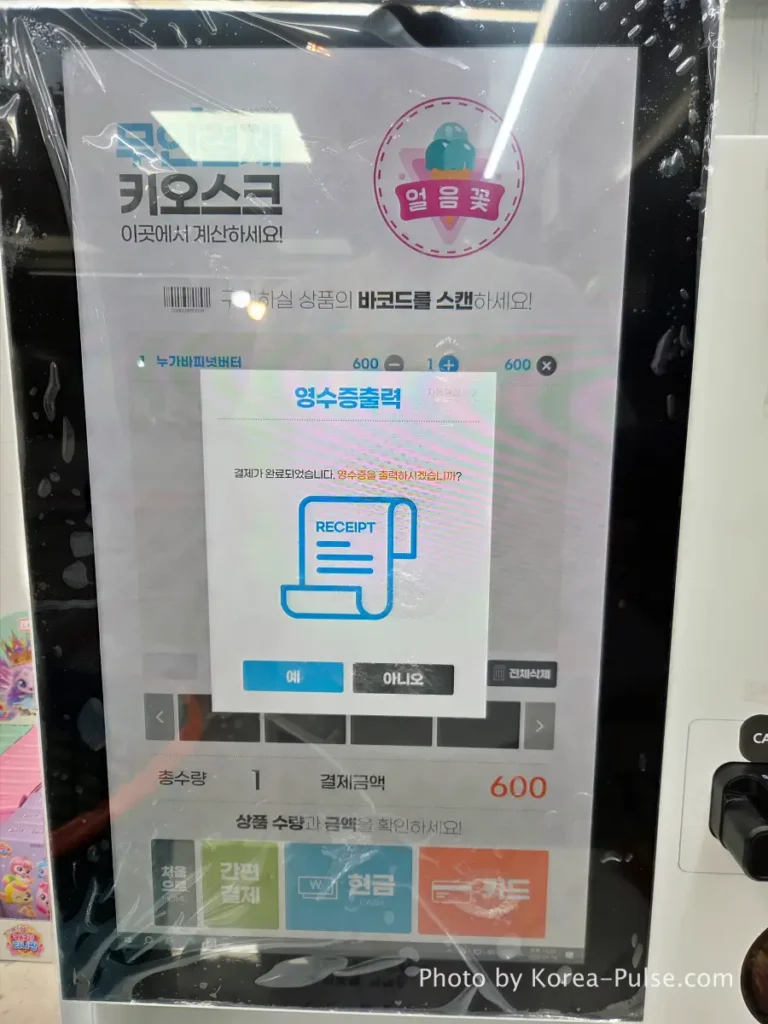
3. Tap or insert, then take your receipt. The kiosk asks if you want a printed receipt, and that’s the entire transaction. After clearing the Bravo Cone from my cart, the final checkout screen showed just the one Nugabar — ₩600, paid, cash-free, receipt declined — genuinely one of the fastest, most frictionless purchases I’ve made anywhere in Korea. Worth remembering, too: small-value card payments weren’t always this smooth here. Korean stores could and did refuse card payment on tiny amounts as recently as a decade or so ago; that friction is essentially gone now.
I filmed the whole visit — storefront to receipt — on a short walkthrough if you’d rather see it than read it.
FAQ: Unmanned Ice Cream Stores in Korea
Q. How much does ice cream cost at Korea’s unmanned stores in 2026?
Bars start around ₩600 (about $0.40), with cones near ₩1,400 and family-size tubs up to ₩6,000, based on prices I photographed in July 2026.
Q. Can I pay with cash at an unmanned ice cream store?
Sometimes — many kiosks have a cash slot, but it’s common for it to be out of service, as it was at the store I visited. Card or a Korean mobile pay app is the more reliable option.
Q. Is it safe or legal for a tourist to use a self-checkout kiosk without staff around?
Yes — these stores are designed for exactly this kind of self-service, and there’s nothing tourist-specific about how they work. Just scan each barcode and pay like any local customer would.
Q. Is an unmanned ice cream store actually cheaper than a convenience store?
Usually, yes. As of 2024–2025 industry data, unmanned stores captured roughly a third of all ice cream sales nationwide, well ahead of convenience stores, largely on price.
An entire retail category built on the quiet bet that most people are honest — and so far, the bet keeps paying off.
It’s an easy stop for visitors curious about how Korea actually runs day to day: no reservation, no language requirement, just a basket, a kiosk, and a 600-won ice cream bar to prove the system works.