K-FOOD · June 2026
Gwangjang Market Food Alley
A Monday Lunchtime Street Food Marathon
Three routes. Fifteen stalls. One very full Global Dad.
This is Part 2 of our Gwangjang Market series. If you missed Part 1 — the history, the gates, and how to get there — that’s a good place to start. But if you’re already inside and hungry, you’re in exactly the right place.
Monday. Lunchtime. And Gwangjang Market food alley was absolutely heaving.
in one visit
starts from
completely packed.
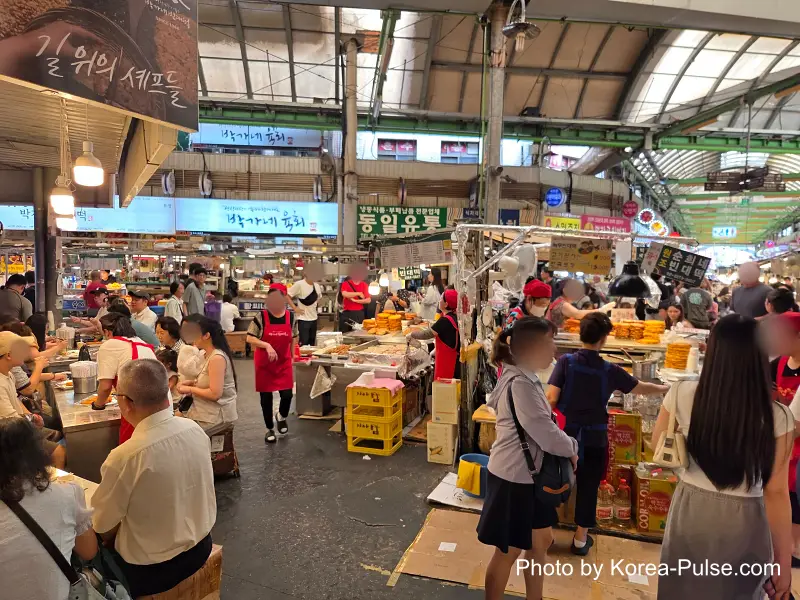
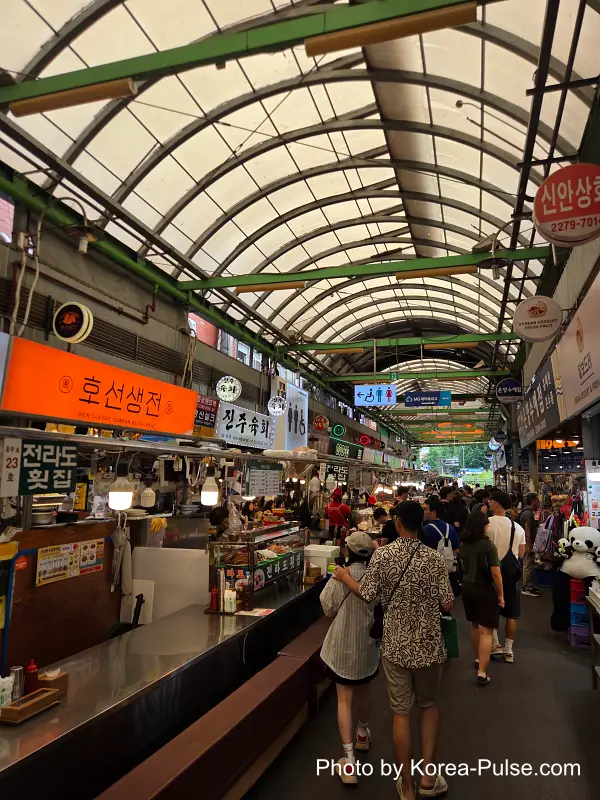
I came in through the center — the absolute bullseye of the food alley labyrinth — expecting a quiet weekday lunch. Instead, I got hit by a wall of steam, the metallic clang of spatulas, and a crowd so thick I had to do the “polite sideways shuffle” just to move three meters. More than half the people packed onto those wooden benches? Foreign visitors. Every continent represented, all united by one shared goal: eating everything in sight. If you’re trying to figure out how to navigate Gwangjang Market food alley — and what’s actually worth eating — this guide breaks it down route by route.
I walked the three main spokes of the alley — north toward Gate 2 (북2문), east toward the East Gate (동문), and south toward Gate 1 (남1문) — and came back to the center between each leg. Here’s exactly what I found.
| Route | Highlight Food | Vibe |
|---|---|---|
| Center → North Gate 2 | Bindaetteok (빈대떡) | Sizzling oil, packed benches, budget heaven |
| Center → East Gate | Dakbal, Sundae, Jokbal, Gimbap | Everything-menu stalls, families, long stretch |
| Center → South Gate 1 | Hoe, Kalguksu, Fruit juice | Seafood-heavy, hand-rolled noodles, cool-down drinks |
If you only have one hour, follow this exact loop — it hits all three zones without backtracking.
📽️ Catch the Vibe First: 60 Seconds in the Alley
Before I break down the route, here’s a short video I shot on-site. One minute. No narration needed — the sizzle does all the talking.
Gwangjang Market Food Alley Center: Where Every Route Starts
The central junction is your orientation point and your reality check. If you’re entering from the main gate, you’ll know it immediately — it’s the busiest intersection with the most seating, the loudest sizzle, and the most overwhelming smell. From here, every spoke of the food alley radiates outward, and every direction looks equally tempting. Rows of stalls stretch as far as you can see under that famous arched iron roof. The benches are full. The oil is hot. And the smell is aggressively, wonderfully Korean. This central point connects all three main routes of the food alley.
North Gate 2 Route: Bindaetteok Territory
Head north from the center and the air changes within ten steps. The frying oil hits first, then the sound — a deep, steady sizzle that tells you exactly what’s cooking before you even see it.
Bindaetteok (빈대떡) is a thick, savory Korean pancake made from ground mung beans (녹두), mixed with kimchi, pork, and green onions, then pan-fried in a generous amount of oil until the outside crisps to a deep golden-brown while the inside stays soft and slightly chewy. It’s been a Gwangjang Market signature for decades — the kind of dish that tastes best eaten at the stall, too impatient to find a seat.
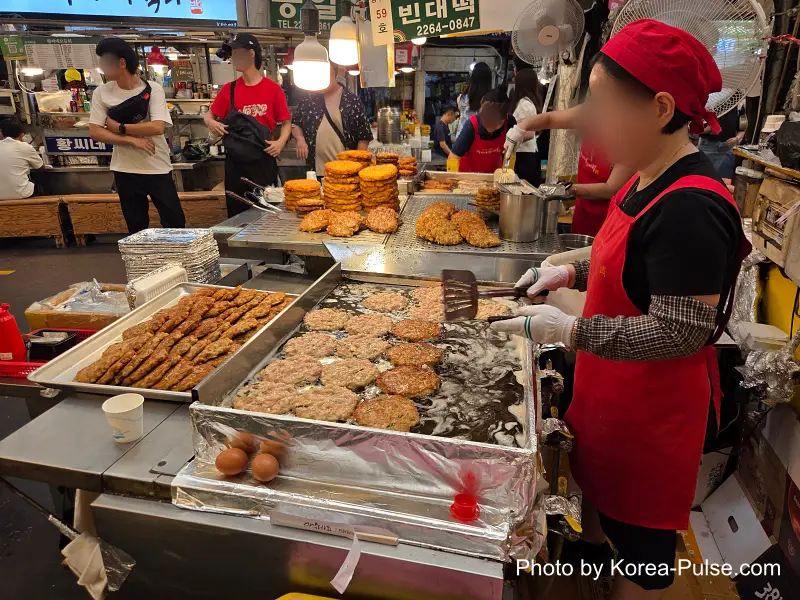
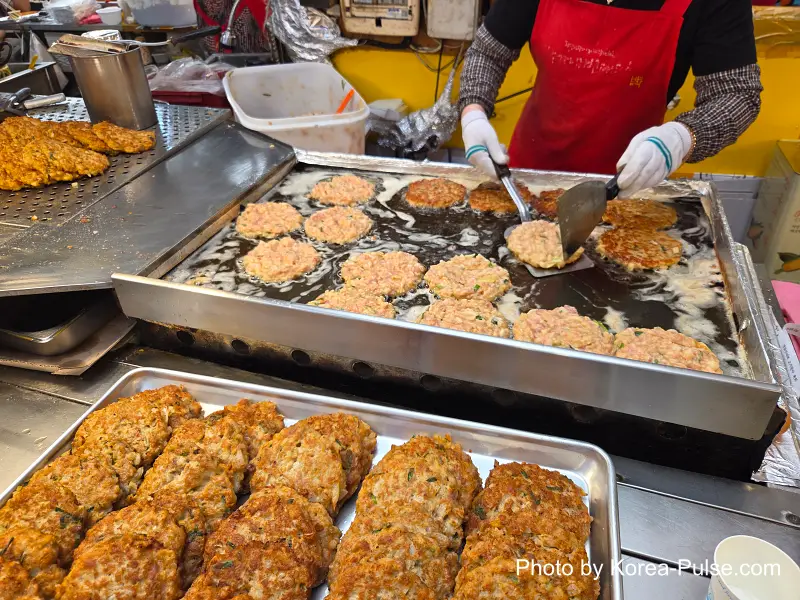
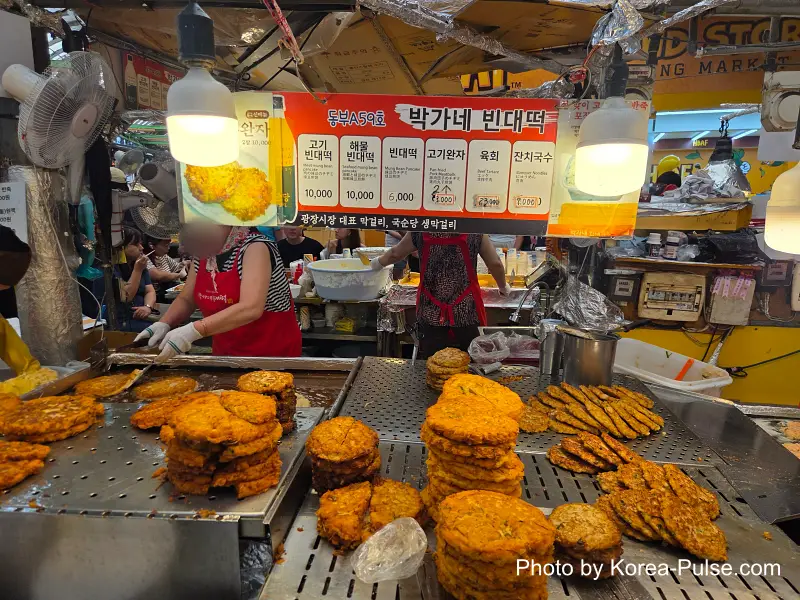
Bindaetteok here runs ₩5,000–₩10,000 depending on size and stall. If you see an empty seat, take it first — then order. Seats go fast and standing orders are harder to manage with a plate in each hand. Once you’re settled, get the makgeolli (rice wine) that every table seems to have. Don’t plan anything for the next hour. You won’t want to leave.
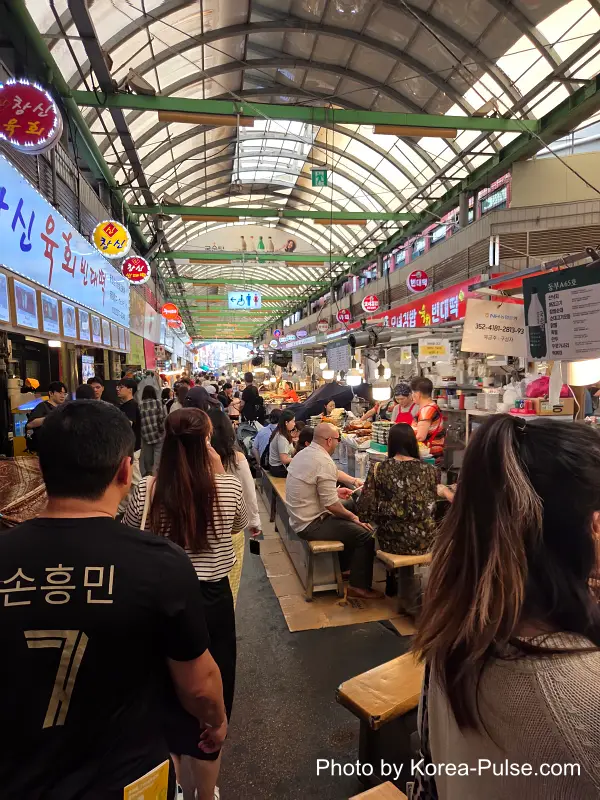
Keep walking toward North Gate 2 and the crowd thickens steadily. Both sides of the alley are lined solid with stalls — not a gap in sight. On a Monday. At lunch.
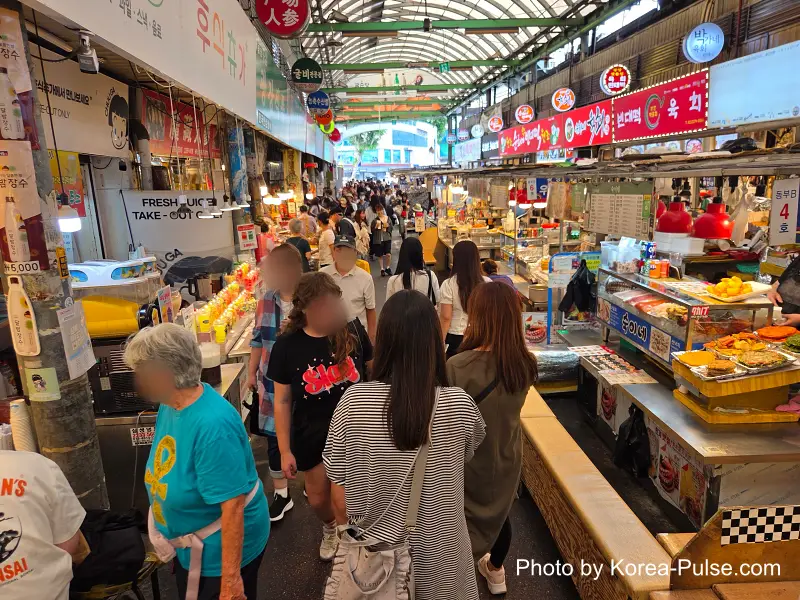
Alongside the fried food, this stretch also has traditional Korean dry goods tucked in on the left — hard candies, grain powders, and bags of Misutgaru (미숫가루), a roasted multi-grain powder you mix with cold water for a nutty, slightly sweet drink that’s genuinely perfect in summer heat.
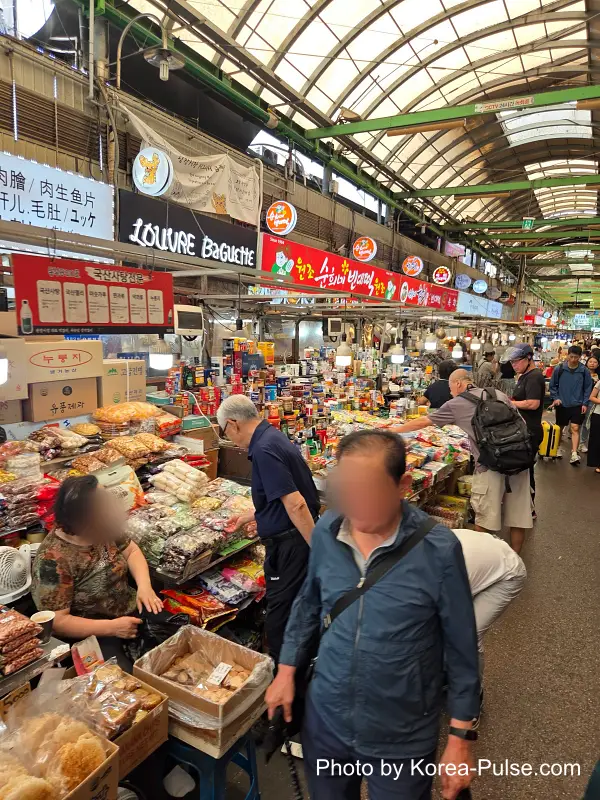
Back to Center, Then East: The Everything Stalls
Tracking back to the central junction and pivoting east, the menu situation expands dramatically. This is where the multi-concept stalls live — one counter selling bindaetteok, tteokbokki, sundae, and three other things simultaneously, operated by vendors with the spatial efficiency of a Tetris grandmaster. And if you’re wondering what to eat at Gwangjang Market beyond the bindaetteok, this is the stretch that answers the question.
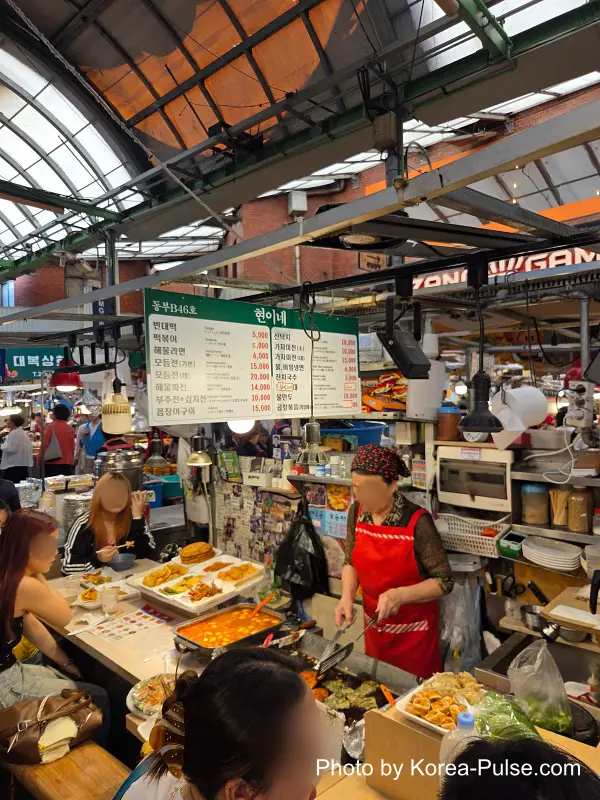
Sitting at the central benches here is a sensory experience in itself. Look left: dakbal (닭발) — spicy chicken feet, sticky with gochujang sauce. Look right: sannakji (산낙지) — freshly cut octopus served immediately after preparation, famous for its uniquely firm texture and the slightly dramatic presentation. Straight ahead: sundae (순대), Korean blood sausage stuffed with glass noodles and vegetables, and steaming bowls of janchi guksu (잔치국수), thin wheat noodles in anchovy broth traditionally served at celebrations. Scattered throughout: international visitors eating all of it, happily, with zero hesitation.
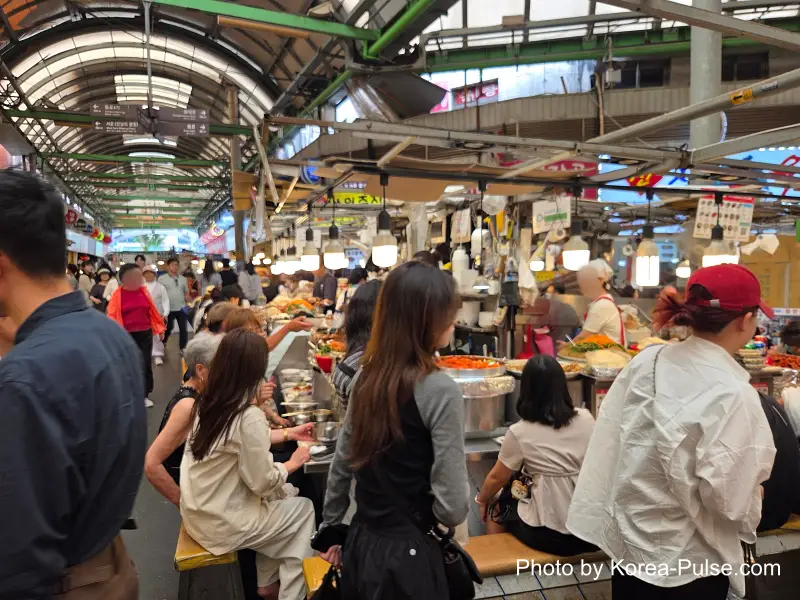
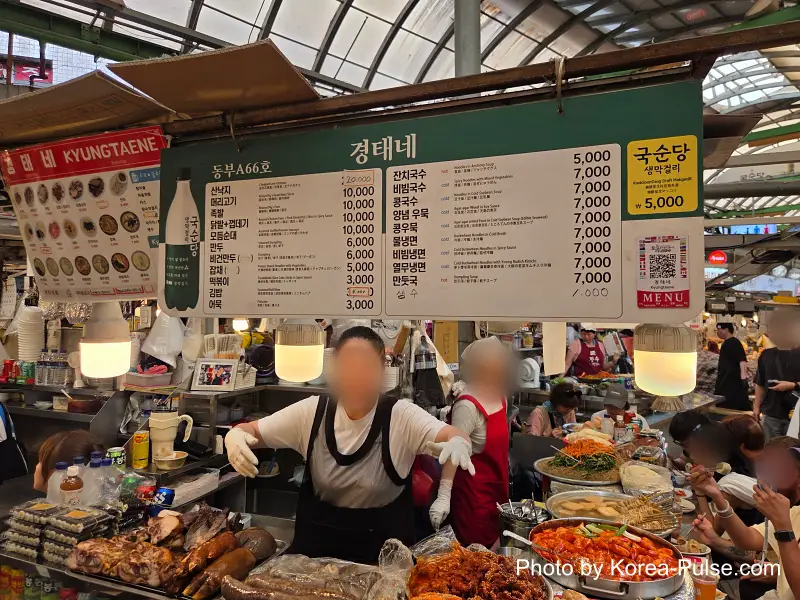
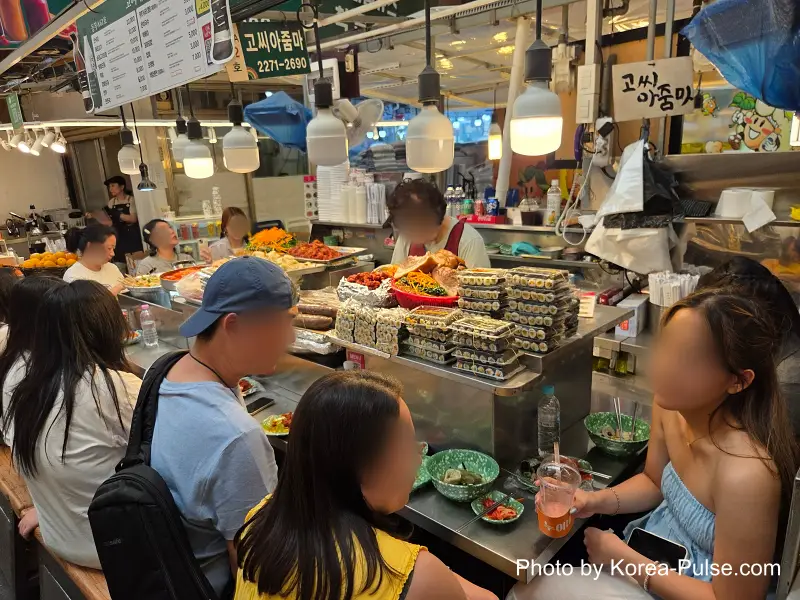
The east-stretching arm of the alley runs surprisingly long — food stalls the entire way, no breaks, no dead ends. Finding an empty seat during peak lunch requires patience or sharp timing. I watched three different groups do slow orbits around the same cluster of stools waiting for someone to finish. Bottom line: this is the best area for variety and people-watching, and the best food at Gwangjang Market for first-timers who want to try a bit of everything.
South Gate 1 Route: Seafood, Noodles & the Cool-Down Lap
The final stretch — center to South Gate 1 — is where the food profile shifts again. The oil-heavy pancake energy gives way to fresh seafood and hand-made noodles. The stalls here feel a little quieter, a little more neighborhood, and a lot more “your grandmother made this for you” in the best possible sense.
The noodle stalls down here are the kind you’d walk past a hundred times and then suddenly stop at. Narrow counter, one or two people working, the menu handwritten on a board: kalguksu (칼국수) — hand-cut wheat noodles in broth; bibimbap (비빔밥); manduguk (만둣국) — dumpling soup; sujebi (수제비) — hand-torn dough soup; naengmyeon (냉면) — cold buckwheat noodles. The kind of lineup that only works if you’re genuinely good at all of it.
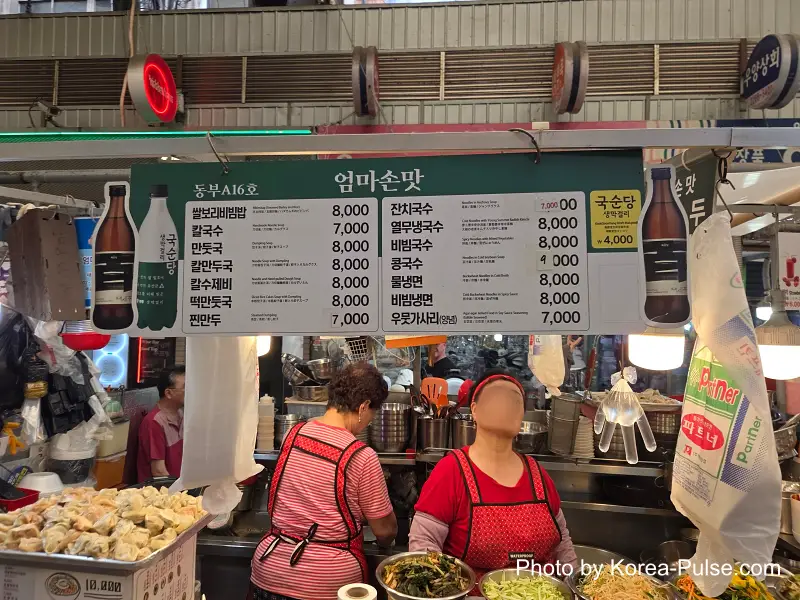
The noodle stalls near South Gate 1 are often less crowded than the central bindaetteok zone and make for a quieter sit-down meal. If you’ve been walking for an hour and need something warm and comforting — kalguksu here will fix you right up.
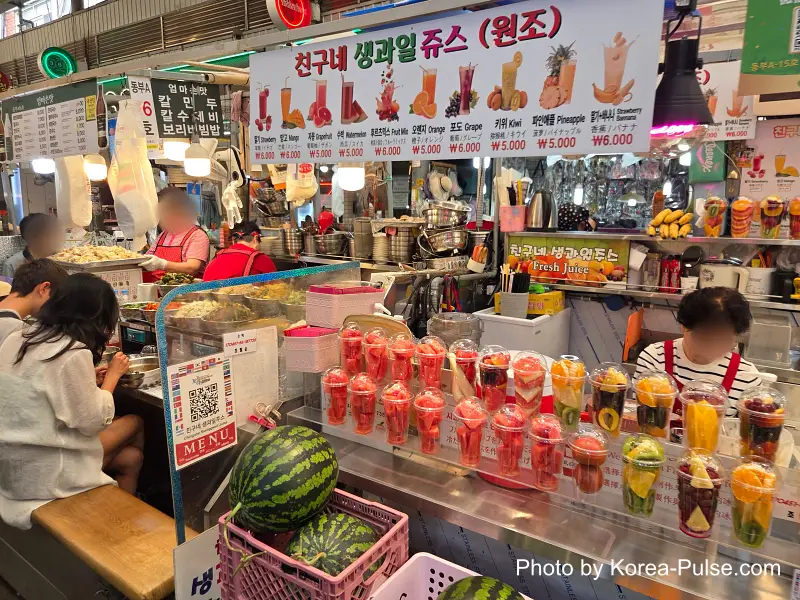
And then, right near the gate exit, the palate cleanser arrives: fresh fruit juice stalls, stacked with whole watermelons, mangoes, and citrus. After an hour of navigating hot oil, soy sauce, and spicy everything, a cold cup of freshly squeezed juice isn’t a snack — it’s a medical necessity.
FAQ: Gwangjang Market Food Alley
The questions people actually ask before they visit.
Gwangjang Market is best known for bindaetteok (mung bean pancakes), mayak gimbap (addictive mini rice rolls), and a wide variety of Korean street food served in its central food alley. It’s one of the oldest traditional markets in Seoul and one of the most-visited food destinations in the country.
Yes — surprisingly so. I visited on a Monday lunchtime and couldn’t find an empty stool without waiting. Weekend crowds are even denser, so a weekday visit is actually the smarter play.
Prices range from ₩5,000 to ₩10,000 depending on size and stall. Most stalls also sell makgeolli (Korean rice wine) to pair with it — and you absolutely should.
Not really. Most stalls have visual menus or the food is literally right in front of you — just point at what’s sizzling. Many vendors are well-practiced with international visitors and will figure it out with you.
It depends on the stall type. Sit-down restaurants and established stalls (육회 raw beef spots, major bindaetteok vendors) generally accept credit cards. Street-side pojangmacha stalls selling tteokbokki, gimbap, and sundae often prefer cash or bank transfer (계좌이체) — look for the account number posted at the front of the stall and transfer directly from your banking app. Many stalls also accept Onnuri Gift Vouchers (온누리상품권) through official channels, both paper and mobile versions. Safe bet: bring ₩30,000–50,000 in cash for a proper food alley session. For more on visiting, check the Korea Tourism Organization’s official guide.
Start at the central junction and walk each spoke: north to Gate 2 for bindaetteok, east for mixed stalls and people-watching, south to Gate 1 for noodles and seafood. Return to center between each leg. The whole loop takes 60–90 minutes if you’re eating along the way.
“The Gwangjang Market food alley doesn’t need a weekend to impress you. Monday lunch, every stall was full, every bench was taken, and every direction smelled incredible.”
If you want authentic Korean street food — bindaetteok, sundae, sannakji, kalguksu, and things you’ll have to point at because you don’t know the name yet — this is the right place. Come hungry. Leave slowly. Stop for juice on the way out.
Planning your visit? Save this route — you’ll want it once you’re inside.
Next up: the queue-worthy stalls of Gwangjang Market. A legendary kkwabaegi (꽈배기) twisted doughnut vendor, the iconic Ilho Coffee (일호커피) — and Garlic Boy (갈릭보이), the garlic bread stall that appeared on MBN’s Cheonha Jebang (천하제빵), got eliminated in round one, and somehow became the most talked-about spot in the market. Worth the wait? We find out in Part 3.