
K-TRAVEL · JULY 2026
Korea Visa Free 2026: 112 Countries, My Santorini Wake-Up Call
and the New Paperless e-Arrival Card
A dad’s real-world checklist for what actually changed in 2026 — and what didn’t.
Every time another breathless headline about Korea Visa Free 2026 shows up in my feed, I want to laugh a little and explain a little more. The real story isn’t a shiny new policy — it’s Korea quietly restoring its 112-country visa waiver list to where it stood before the pandemic, while digitizing almost everything else about how you actually enter the country. Here’s what changed, how to check if your passport is covered, and a checklist that gets you through Incheon without touching a single paper form.
The Cruel Reality of Passport Power I Witnessed at a Santorini Airport
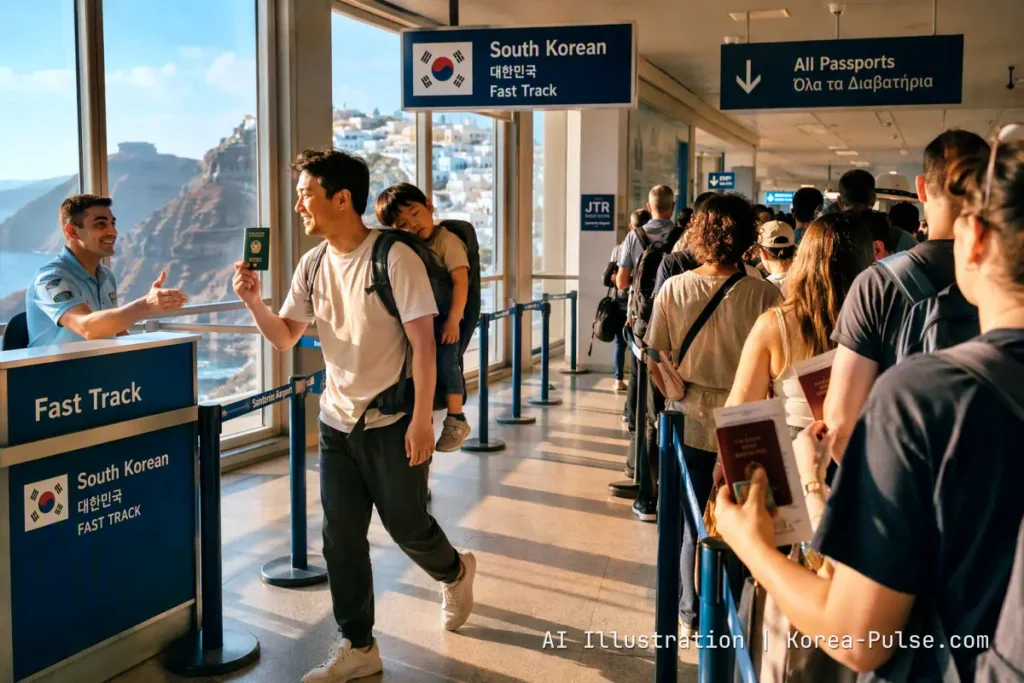
Years ago, while my family was based in the United Kingdom, we flew to Santorini for a short summer break — the Greek island famous for its blue-domed churches and impossibly steep cliffs. The airport was small, the heat was brutal, and the immigration queue for non-EU passports stretched halfway across the terminal. My daughter had fallen asleep on my back, and I remember doing the math on how much longer we’d be standing there.
Then the officer glanced at my passport, smiled, and waved us straight to an almost empty fast-track counter. No extra questions, no visa stamp to check, no fee. I looked back at the line of tired travelers still holding their paperwork and finally understood something I’d never fully appreciated: a visa-free passport doesn’t just save money, it saves your family’s patience at the exact moment you have none left.
That memory resurfaced this year when the Henley Passport Index released its January 2026 rankings. South Korea tied with Japan for second place worldwide, with visa-free or visa-on-arrival access to 188 destinations, trailing only Singapore. It’s genuinely useful to know before you book anything, because it works both ways — it also tells you how far your own passport reaches when you’re the one visiting Korea.
Is My Country Actually on the Korea Visa Free 2026 List?
This is the question nobody’s clickbait headline about Korea Visa Free 2026 actually answers. The waiver covers 112 countries as of mid-2026, but that number has moved around a lot — it sat above 110 before the pandemic, dropped as low as the low 90s during the slow 2023 reopening, and has since climbed back to its pre-pandemic level. If you’ve seen conflicting figures online, that’s why: different articles are frozen at different points in that recovery.
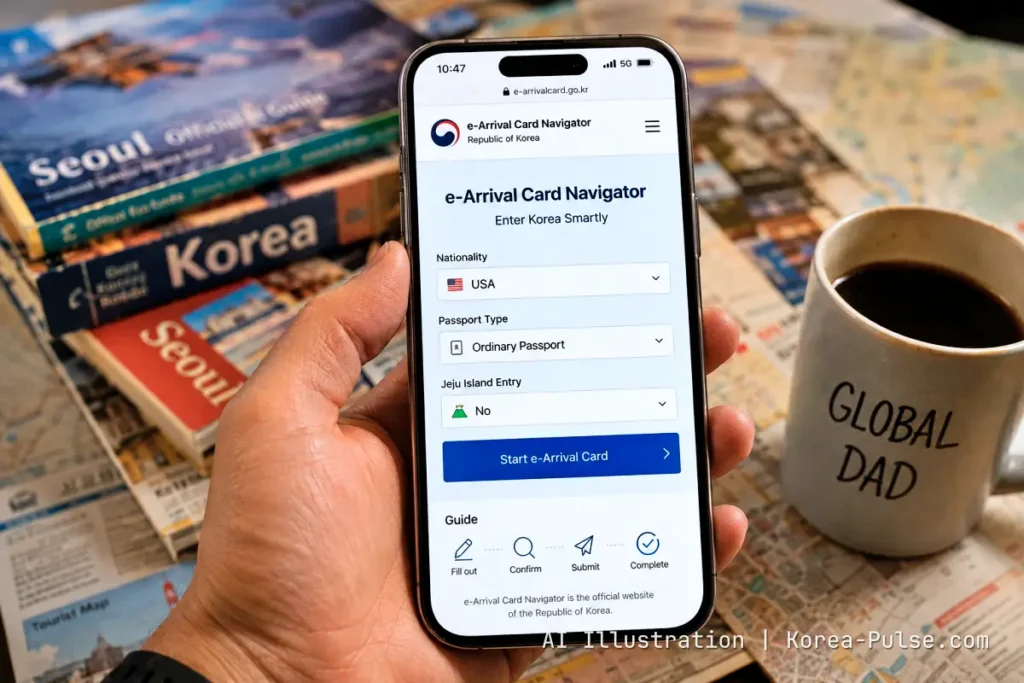
Rather than memorizing a list of 112 countries, use the government’s own e-Arrival Card Navigator. Select your nationality, passport type, and whether you’re heading to Jeju Island, and it tells you in about three seconds whether you need a full visa, a K-ETA, or nothing more than the standard entry form.
If the tool tells you a visa is required, don’t wait until the week before your flight. Start at the official Korea Visa Portal and check your nearest embassy’s processing times, since they vary a lot by country and season.
The Smart 2026 Entry Checklist: From K-ETA to the Paperless e-Arrival Card
Even if your country is on the visa-free list, how you actually get through immigration has changed completely this year. Quick decoder before we start: visa-free means you don’t need a visa, but K-ETA and the e-Arrival Card are two separate pre-arrival forms, and which one applies to you depends on your nationality. As of July 2026, here’s the four-step checklist I’d tell any friend flying into Korea for the first time — this is the part of Korea travel requirements that actually shifted.
Passport & Return Ticket. Most airlines want to see at least six months of validity left on your passport, even though Korean law itself doesn’t set that exact minimum. You’ll also need proof of a return or onward flight, since immigration wants evidence you’re actually leaving within your visa-free window.
Check the K-ETA Exemption. Korea has extended a temporary K-ETA exemption through December 31, 2026 for 22 countries and regions, including the US, UK, Canada, Australia, and most of the EU. If your country isn’t on that shorter list (the full 22-country roster is posted on the official K-ETA Portal), apply there at least 72 hours before departure. It costs 10,000 KRW and gets rejected surprisingly often when the photo doesn’t match the official requirements, so read the photo spec before you upload.
Submit the Paperless e-Arrival Card. This is what actually changed on January 1, 2026: the yellow paper arrival card handed out on the plane has been retired and replaced by a digital form. Unless you hold a valid K-ETA (which covers the same data), you now submit an e-Arrival Card online within 72 hours of arrival, listing passport details, flight number, and a Korean accommodation address. It takes about five minutes, and you get a QR code that immigration scans on arrival — no kiosk queue, no paper, no fumbling for a pen at 35,000 feet.

Quarantine & Customs. The COVID-era Q-Code health declaration is gone. If you have nothing to declare, walk straight through the green customs line — regular duty-free limits apply (roughly $800 in goods, two bottles of alcohol), and nobody’s going to stop you over a bag of snacks from home.
That’s it — four steps, most of them finished before you’ve even boarded, at an Incheon International Airport arrival hall I’ve now walked through more times than I can count for work and family visits. Once you clear immigration, getting from Incheon Airport to Seoul matters just as much as the paperwork you just finished — your two main options are the airport limousine buses (my personal pick, and the one I’ve tested most) and the AREX (공항철도, Airport Railroad Express) train.
Official Guide vs. My Real-World Playbook
Most guidebooks stop at the paperwork. Here’s where I’d actually adjust the standard advice, especially if you’re traveling with kids.
| Official Guidebook Advice | Dad’s Real-World Playbook |
|---|---|
| K-ETA exempt, so no documents needed before boarding | The paper card is gone. You still need to finish the e-Arrival Card online at www.e-arrivalcard.go.kr before you fly, K-ETA exemption or not. |
| Head straight to the transit counter after landing | Lines build fast during peak arrival waves. Reading my Incheon Airport arrival guide beforehand, and knowing your Seoul public transit options in advance, saves real time. |
| Use Google Maps to walk to your hotel | Google’s turn-by-turn walking directions don’t work inside Korea for security reasons. Install Naver Map before you land — my Google Maps vs. Naver Map guide covers the switch. |
| Book a hotel room near the airport or downtown | For families, a serviced residence with a kitchen and a real bedroom door beats a cramped hotel room, especially after a long flight with kids who just want their own space. |

None of this is a knock on standard hotels — plenty of solo travelers are perfectly happy in a compact downtown room, and hotels still win on things like daily housekeeping and truly central locations. But for a family of four coming off a long flight, I’d take the extra square footage every time — especially when the alternative is four people quietly negotiating over one bathroom at six in the morning.
FAQ: Korea Visa Free 2026
Q. What should I do if I land in Korea without submitting the e-Arrival Card in advance?
Head to one of the self-service kiosks near immigration and complete it on the spot. Officers can also retrieve a prior submission by scanning your passport, so a screenshot of your QR code is a backup, not a lifeline — but during peak hours the kiosk line gets long, so submitting online before you fly is much faster.
Q. How long can visa-free travelers stay in Korea in 2026?
Most Western nationalities, including the US, UK, and Australia, get up to 90 days visa-free, though the exact allowance varies by bilateral agreement — the e-Arrival Card Navigator shows your country’s specific limit. Canadian passport holders are the notable exception, with a longer 180-day allowance.
Korea didn’t reinvent its entry rules for 2026 — it just finally caught up on the paperwork.
The 112-country visa waiver behind Korea Visa Free 2026 is the same freedom Korean travelers have enjoyed since before the pandemic, just fully restored. The real 2026 change is procedural: the paper is gone, and a phone is now mandatory equipment for landing here.