
K-FOOD · JULY 2026
K-BBQ Etiquette Without the Anxiety
How to Grill, Share, and Read the Table Like a Local
A Korean dad’s practical guide to the rules that matter, the ones that are fading, and the mistakes nobody will punish you for.
K-BBQ etiquette is less about memorizing rules than noticing who has the tongs, whether the staff are taking over, and how close the meat is to becoming charcoal. Restaurants also handle the grill differently, so this guide explains the useful customs without pretending there is one national script.
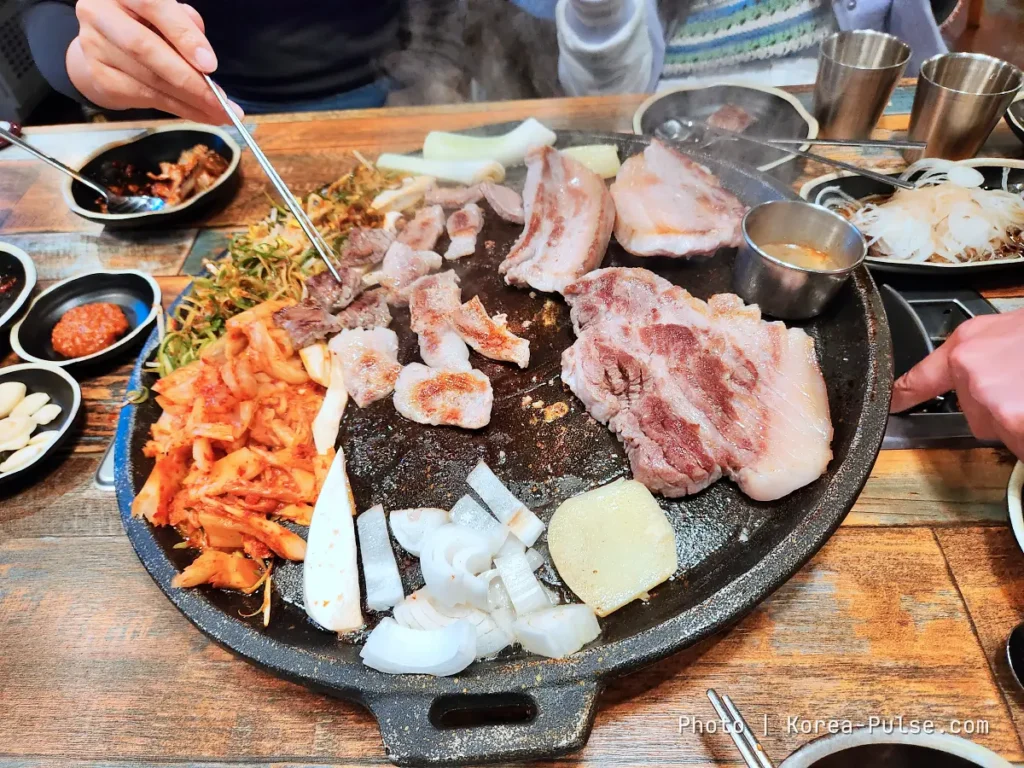
At home, the person doing most of the grilling is usually me. That is partly because I am the dad and partly because a family barbecue needs someone willing to stare at pork belly while everybody else starts eating. The arrangement works well until I mistime a flip. Then my wife and daughter provide immediate performance feedback, free of charge.
Company dinners used to feel more predictable. Ten or fifteen years ago, the youngest employee often ended up beside the grill, quietly cooking for everyone senior. That habit has not vanished, but it has softened. At many tables now, the person who actually enjoys grilling—or is simply best at it—takes the tongs. That change tells you almost everything you need to know: Korean barbecue still has social habits, but the table is becoming less hierarchical and more practical.
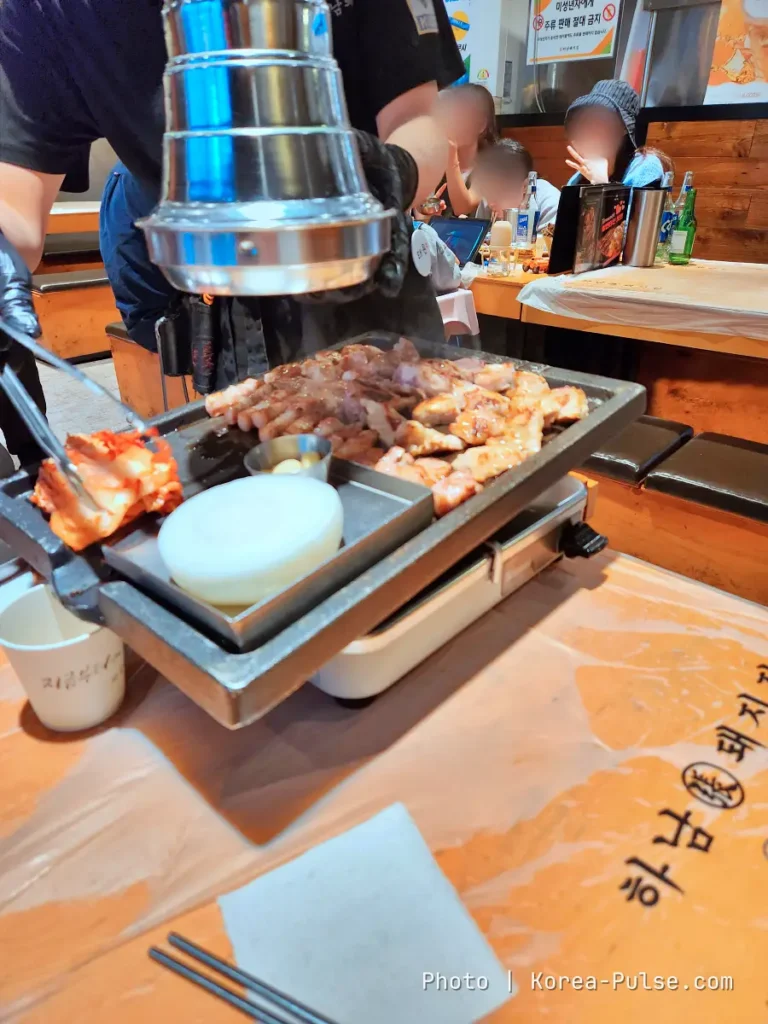
Wait about thirty seconds. If the staff or a Korean companion takes the tongs, let them. If nobody moves, ask, “Should I grill?” or volunteer for one batch. You can help without becoming the unpaid grill operator for the entire night.
K-BBQ Etiquette Starts With Reading the Table
A Korean barbecue restaurant, often called a Korean barbecue or simply a gogi-jip (고깃집, meat restaurant), can operate in several different ways. At one place, staff may grill every piece and tell you exactly when it is ready. At another, they may set the heat, place the first round on the grill, then hand over the job. A cheaper neighborhood restaurant may leave the whole operation to your table.
That is why the most useful first move is not grabbing the tongs. Watch for thirty seconds. Are the staff arranging the meat? Is one person at your table already taking responsibility? Has the grill even reached the right temperature? The official VisitKorea guide also notes that some restaurants cook for guests while others expect diners to grill at the table. There is no single national rule that applies to every restaurant.
If a staff member steps in after you have started, do not take it personally. In most cases, this is routine service rather than a rescue mission. They may know that grill’s hot spots, the ideal timing for a premium cut, or the exact moment a sweet marinade begins to burn. Handing over the tongs is often the smartest decision of the evening.
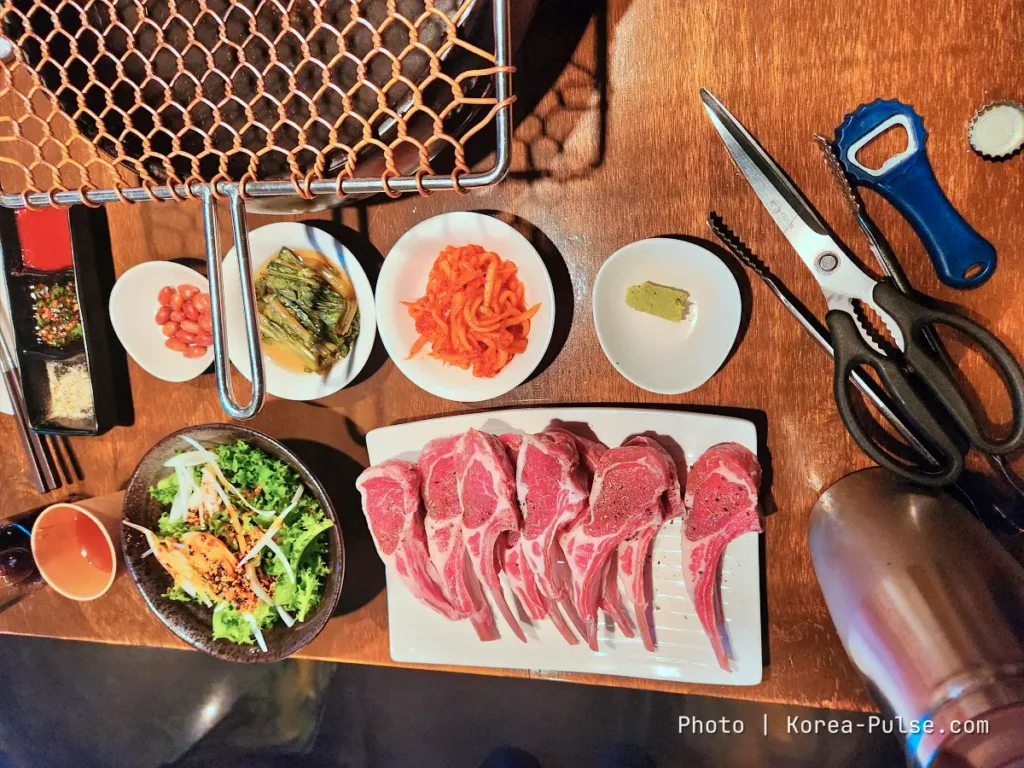
Also look under the table. Many Korean restaurants hide stainless-steel chopsticks, spoons, napkins, and sometimes bottle openers in a side drawer. The large metal hood above the grill is adjustable, although I would move it gently rather than treating it like gym equipment. Pull it closer if smoke is escaping; raise it slightly if it blocks everyone’s view.
How to Grill the Meat Without Overthinking It
The argument about how often to flip meat can become strangely emotional. My practical rule is two or three well-timed turns, not constant nervous flipping. Put the meat down, let one side develop color, turn it, then adjust once more if the thickness or heat demands it. You are grilling dinner, not checking whether the meat is still there every eight seconds.
For thick samgyeopsal (삼겹살, pork belly), let the outside firm up before cutting it with the kitchen scissors. Raw pork belly is slippery and elastic; partially cooked meat is much easier to snip into bite-sized pieces. The scissors are not a novelty prop. They are one of the most useful tools on the Korean barbecue table.
Do not cover every centimeter of the grill just because the plate of raw meat looks ambitious. Crowding makes it harder to see what is ready, and the person grilling ends up conducting traffic instead of eating. Cook in manageable rounds. Move finished pieces to a cooler outer edge, an onion slice, or a designated warming area if the grill has one.
If you ordered both plain and marinated cuts, the plain meat usually goes first when everything shares one grill. Sugar in marinades can scorch and leave bitter residue. Many restaurants solve this by changing the grill plate between rounds, so follow the staff’s lead rather than enforcing a rule they have already designed around.
📁 20240330_184906.webp · ALT: Thick lamb chops searing over charcoal at a Korean barbecue restaurant
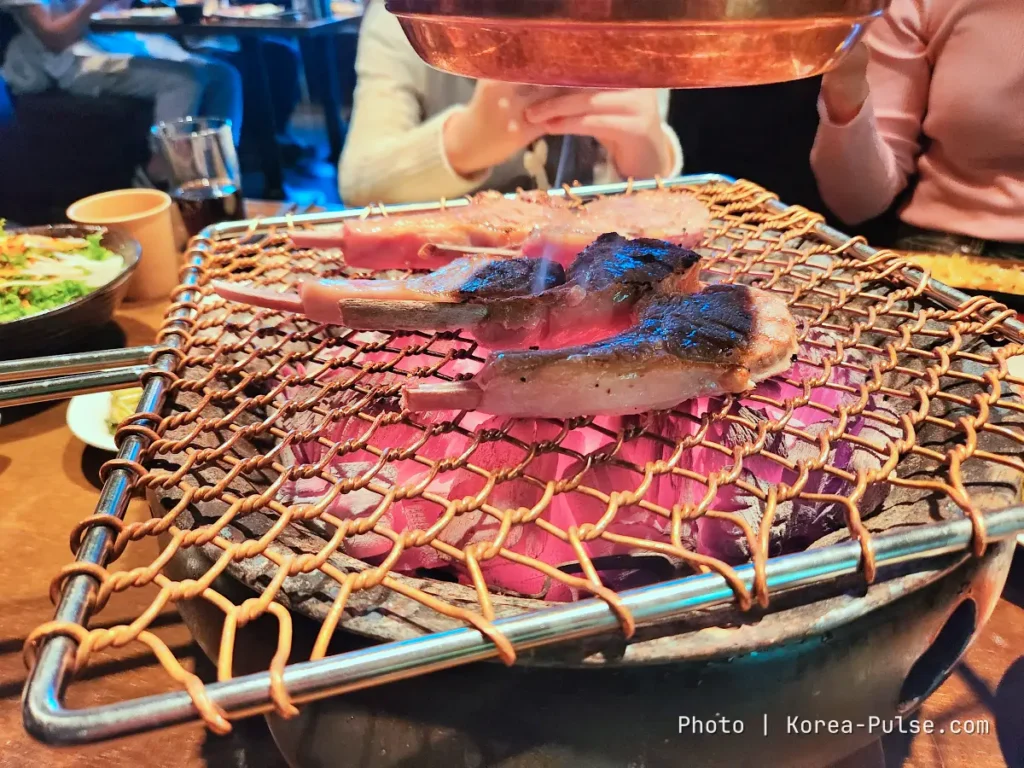
Do not use the same tongs for raw meat and cooked pieces if the restaurant provides separate tools. When only one pair is available, use it to handle the cooking meat and move finished pieces with clean chopsticks or ask the staff for another pair.
The Korean Barbecue Table: Banchan, Sauces, and Ssam
The small dishes surrounding the grill are banchan (반찬). Kimchi may go directly onto the grill, especially beside pork belly. Seasoned scallions add sharpness. Pickled radish cuts through fat. None of these combinations is mandatory, and you do not need to sample everything in the first three minutes as though the table is closing.
The most common sauces are ssamjang (쌈장), a thick fermented soybean-and-chili paste, and gireumjang (기름장), usually sesame oil with salt and sometimes pepper. Plain pork or beef works well with either. Heavily marinated meat often needs no extra sauce at all.
Then comes the ssam (쌈), the leaf wrap that looks simple until somebody builds one the size of a tennis ball. Place lettuce or a perilla leaf in your palm, add one piece of meat, a little sauce, and perhaps garlic, scallion salad, kimchi, or a small spoonful of rice. Fold the edges inward and eat it in one bite when possible—not because anyone is policing you, but because a loaded wrap tends to collapse after the first bite.
If it takes two bites, nobody will care. My own engineering rule is simpler: if the lettuce needs structural reinforcement, I have added too much.
Who Should Hold the Tongs? The Culture Is Changing
At a family meal, the answer may be obvious. In my family, Dad grills. Dad also receives the complaints if the pork is dry, which keeps the system accountable. Another family may hand the job to the mother, an older child, or whoever is least distracted by the side dishes. This is family logistics, not a formal hierarchy.
Office dinners carry more history. VisitKorea describes samgyeopsal as a popular choice for company get-togethers, and anyone who worked in a Korean office years ago will remember how easily small jobs fell to the youngest person. Grilling, pouring drinks, distributing utensils, and calling the server could all become part of the unofficial junior-employee package.
That expectation is weaker than it used to be. Age and rank still matter at some formal gatherings, but many teams now let the confident griller cook. Sometimes people rotate. Sometimes the restaurant staff handle everything. The polite approach is to contribute without assuming that youth, gender, or job title automatically assigns the tongs.
📁 1637504210559-2.webp · ALT: Family sharing food across a Korean barbecue table
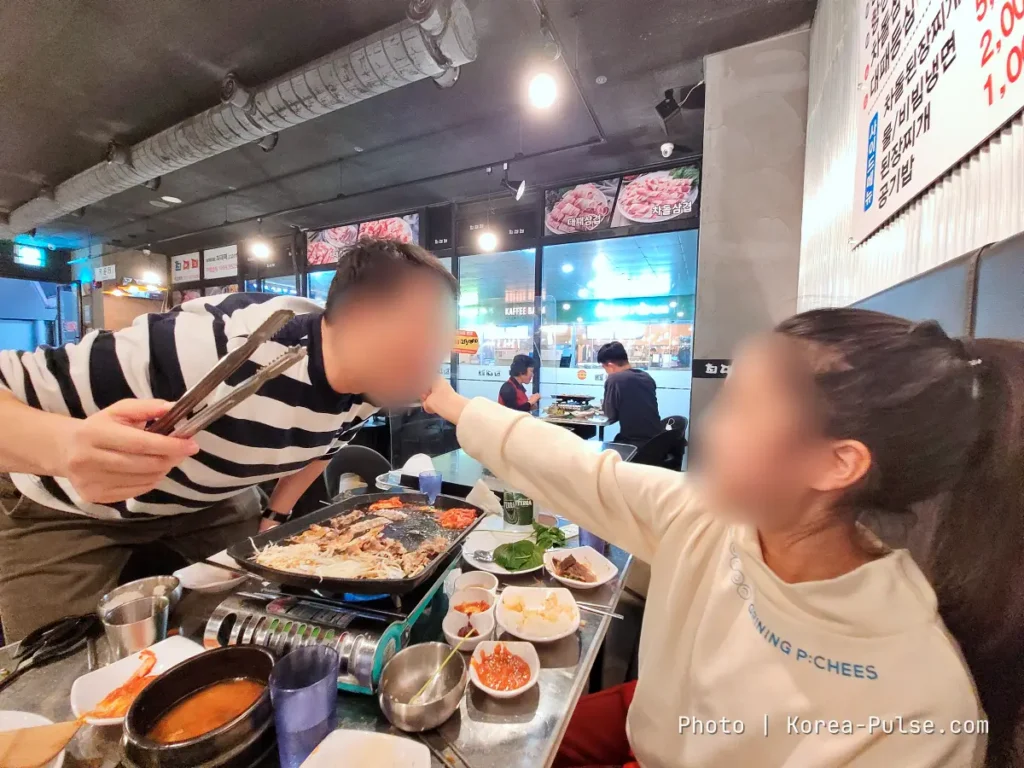
One small courtesy still helps: do not let the cook fall an entire round behind. Put a finished piece on their plate, take over for a few minutes, or at least notice that they have been feeding everyone except themselves. Good K-BBQ etiquette is often less about tradition than basic table awareness.
Drinks and Elders: Formal Rules, Casual Reality
Traditional drinking etiquette becomes more visible when an older person or senior colleague is present. Receiving or pouring a drink with two hands is respectful, and younger people may turn slightly away when drinking in a formal elder-junior setting. The Korean Culture and Information Service documents these customs, but the formality depends heavily on the table: friends of the same age may pour casually, while a work dinner may begin formally and relax after the first glass.
You are also allowed to refuse alcohol. A brief “I don’t drink” or “I’ll have water” is enough in most modern settings. You do not need to invent medication, a morning marathon, or a complicated international treaty. Respect should work in both directions.
At a formal table, use both hands for the first pour and watch what everyone else does. At a casual table, mirror the group. Nobody expects a visitor to perform every traditional gesture perfectly.
When the Grill Is Empty, Dinner May Not Be Over
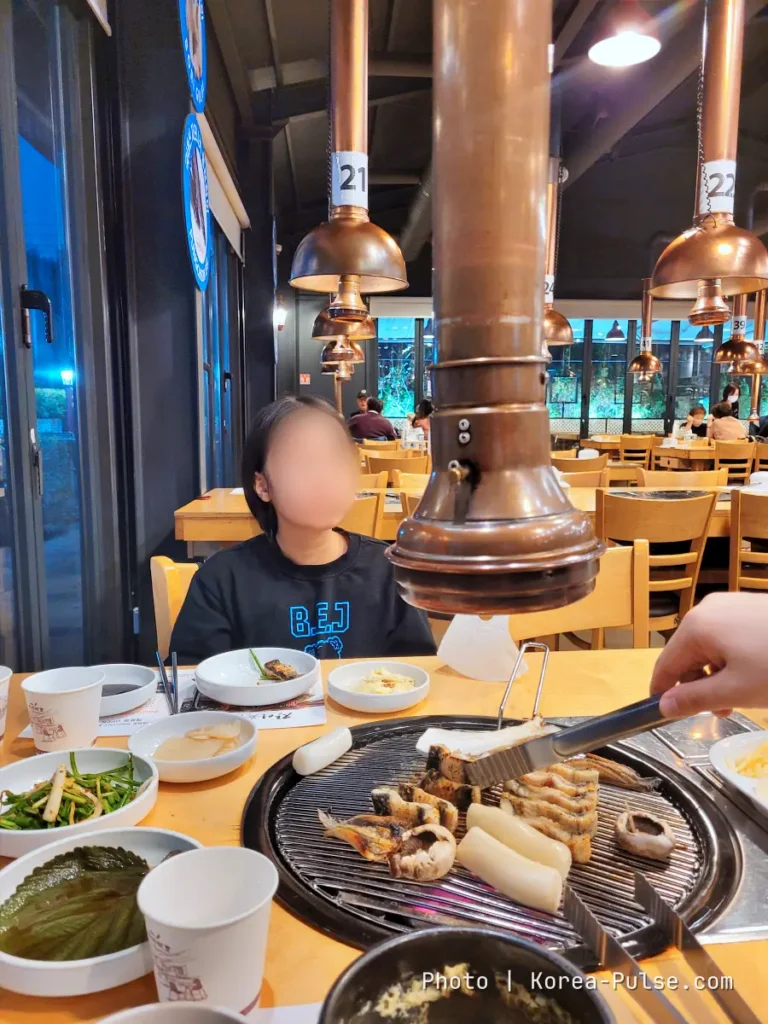
Meat is often followed by what the menu simply calls siksa (식사, meal). Depending on the restaurant, that may mean doenjang-jjigae (된장찌개, soybean paste stew) with rice, naengmyeon (냉면, cold noodles), or fried rice prepared on the same hot plate.
This is not compulsory, especially after several rounds of meat. But it explains why your Korean companions may study the menu again when you thought everyone was finished. Cold noodles are refreshing after fatty pork; soybean paste stew brings rice and something hot to the table; fried rice absorbs the flavors left on the grill. Koreans sometimes jokingly call this “dessert,” which is a useful reminder that dessert does not always need sugar.
📁 20211104_180132.webp · ALT: Korean barbecue meal with grilled pork, rice cakes, mushrooms and side dishes
FAQ: K-BBQ Etiquette for First-Timers
Q. Will the restaurant staff cook the meat for me?
Sometimes. Premium restaurants are more likely to provide full grilling service, while many casual places leave some or all of the cooking to diners. Wait briefly and follow the staff’s lead before touching the meat.
Q. How many portions should two people order?
There is no universal number. Check the minimum order and the grams listed for each portion; many restaurants ask for at least two portions initially, but serving sizes vary. Start with the required minimum and add more after seeing the actual plate.
Q. Is it rude to refuse alcohol or eat a ssam in two bites?
No. Politely declining alcohol is normal, and a two-bite ssam is mainly a structural problem rather than an etiquette violation. The goal is to share the meal comfortably, not pass a manners examination.
Watch the table, flip with purpose, and keep the lettuce wrap within the limits of basic engineering.
You do not need to perform Korean-ness at a barbecue restaurant. Help when help is useful, let the staff lead when they step in, and make sure the person grilling gets to eat while the meat is still hot.