K-FOOD · 2026
Gwangjang Market Seoul
The Complete Entry Guide — Part 1
History, subway routes, and a gate-by-gate breakdown so you land exactly where you want to be.
If you’ve spent more than five minutes researching street food in Seoul, you already know the name. Gwangjang Market (광장시장) is the undisputed ground zero of loud, crowded, and unmistakably alive Korean comfort food. But here’s what nobody tells you until you’re already lost inside: it’s a century-old market with multiple gates — and entering the wrong one can drop you far from the food alley, deep inside a textile warehouse.
As a dad who has navigated this market both solo and with hangry teenagers in tow, I can tell you that a game plan makes all the difference. Part 1 of our Gwangjang Market Seoul series covers everything before you eat: the history, the transit options, and a gate-by-gate entry guide so you land exactly where you want to be.
🍳 Straight to the food alley? → Jongno 5-ga Station Exit 8 → North Gate 2 (북2문). About 1 minute on foot.
🌿 Best first-time experience? → Euljiro 4-ga Station Exit 4 → walk along Cheonggyecheon → South Gate 1 (남1문). About 7 minutes, worth every one.
⚠️ Avoid on your first visit: Don’t enter via the West Gate (서문) if you’re here for food — you’ll walk through 10 minutes of textile stalls before hitting the food rows.
Why Gwangjang Market? 120 Years of Seoul’s Real Kitchen
Before Netflix discovered it, before the food bloggers arrived, and long before the international tour groups — Gwangjang Market Seoul was simply where Seoul came to eat, shop, and survive. Founded in 1905, it holds the title of Korea’s first permanent market founded with private Korean capital.
The story of how it started matters. In 1905, during a period of increasing Japanese influence before formal colonial rule began in 1910, Korean merchants and investors pooled private capital to create a more independent Korean-owned commercial hub during a period of heavy economic control. The market’s name came directly from the two bridges it sat between: Gwanggyo (廣橋) and Janggyo (長橋) — the first characters of each bridge combined to form 광장(廣藏). The name also carries the meaning of gathering and storing things widely. Over a century later, it still fits perfectly.
For the first several decades, Gwangjang Market Seoul was primarily a wholesale textile and dry goods market. The food culture came later — and it came organically. Wholesale merchants working the narrow corridors from dawn needed to eat. Street vendors set up stalls. Stalls became permanent. Permanent became legendary. The same traditional dishes that fueled those early merchants now draw visitors from Tokyo, London, and São Paulo.
Gwangjang got its biggest global moment when Anthony Bourdain featured it on Parts Unknown (2015), followed by Netflix’s Street Food: Asia (2019). Both spotlights sent international visitor numbers surging. The market has adapted — English menus are now common near the main food alley — but the food itself hasn’t changed. The same grandmother-run stalls, the same recipes passed down for decades.
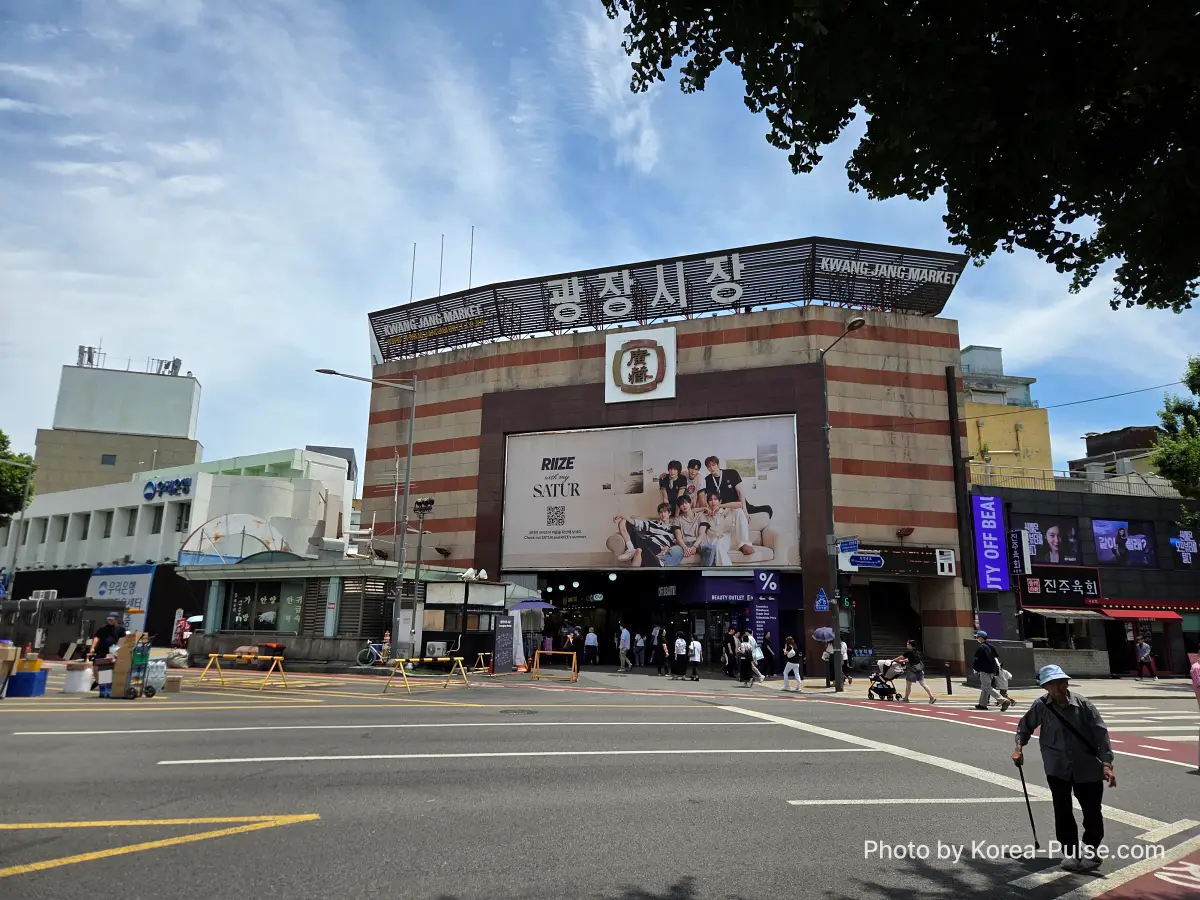
Getting There Three Stations, Three Different Approaches
Gwangjang Market Seoul sits in the heart of central Seoul, straddling the old Jongno corridor and the Cheonggyecheon stream. Three subway stations serve it — and the one you pick shapes your first impression of the place entirely.
| Station & Exit | Walk to Market | Best For | Vibe |
|---|---|---|---|
| Jongno 5-ga (종로5가) · Exit 7 or 8 · Line 1 | ~1 min | Direct food alley access via North Gate 2 | 🔥 Fast & busy |
| Euljiro 4-ga (을지로4가) · Exit 4 · Line 2 or 5 | ~7 min | Scenic Cheonggyecheon approach via South Gate 1 | 🌿 My favourite |
| Jongno 3-ga (종로3가) · Exit 12 · Line 1/3/5 | ~10 min | West Gate approach through the textile section | 🚶 Relaxed & local |
Route 1: The Fast-Track — Jongno 5-ga, Exit 8
If you’re starving and want zero preamble, take Line 1 to Jongno 5-ga Station and come out of Exit 8 (Exit 7 also works — both land you on the same block). Walk straight for about a minute and you’ll hit North Gate 2 (북2문) — the northern portal that drops you directly into the food alley. This is the most popular tourist entry point, and you’ll know it immediately from the queues forming right at the threshold.
Coming from Hongdae, Sinchon, or anywhere on Line 2? Transfer to Line 1 at City Hall Station. From Myeongdong (Line 4), transfer at Dongdaemun History & Culture Park. New to the Seoul subway? Check the step-by-step Seoul subway ticket guide before you head out.
Route 2: The Scenic Route — Euljiro 4-ga, Exit 4
This is my personal favourite, and the one I always recommend to first-timers who aren’t in a rush. Take Line 2 or Line 5 to Euljiro 4-ga Station and exit at Exit 4. From there, walk south toward the Cheonggyecheon stream — you’ll see it within about two minutes.
Cross the footbridge over the stream and you’re looking straight at South Gate 1 (남1문). The walk takes about seven minutes total, but it earns its time. Crossing Cheonggyecheon before entering the market gives you a tonal reset: from the quiet of the urban waterway to the controlled chaos of the food alley. It’s one of those rare Seoul moments where the approach is as good as the destination. The market then swallows you whole.
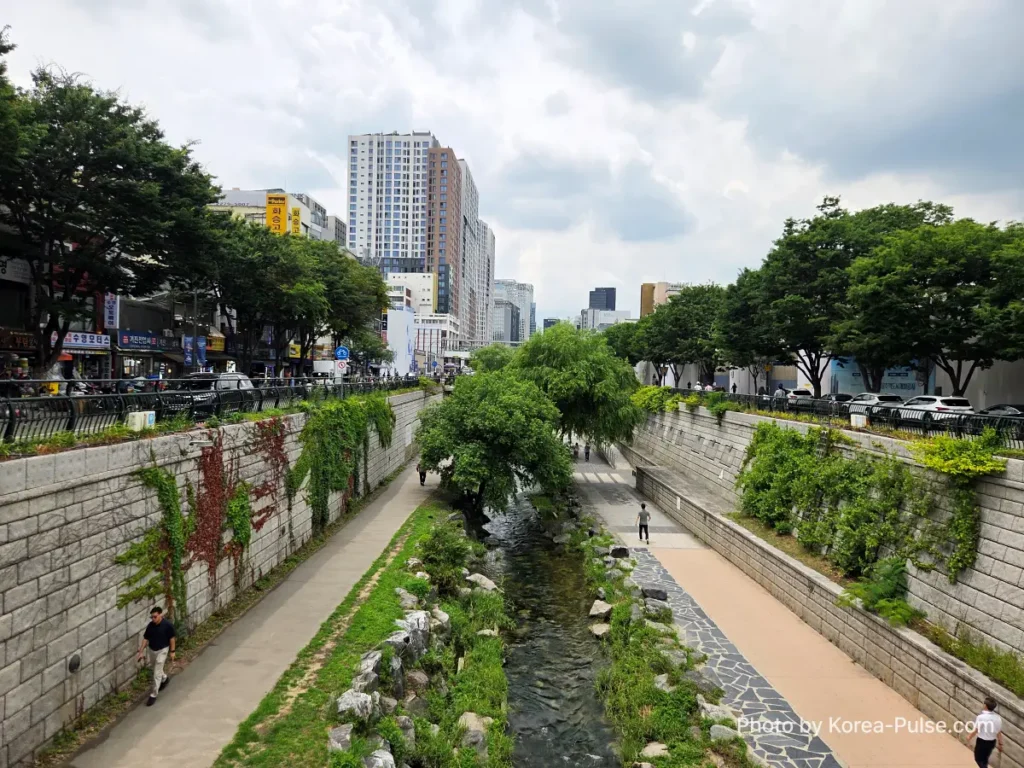
Cheonggyecheon is a 5.8km urban stream that cuts through the heart of downtown Seoul. It was buried under concrete and an elevated highway for decades before a landmark restoration project completed in 2005 brought it back as a public park and walkway. Today it’s one of Seoul’s best free attractions — especially on a hot day when the shade and water give you a break from the city heat.
Route 3: The Local Approach — Jongno 3-ga, Exit 12
For a slower, less-tourist-heavy start, take Line 1, 3, or 5 to Jongno 3-ga Station and walk from Exit 12. This route takes about ten minutes and brings you in from the west, toward the West Gate (서문) or West Gate 2 (서2문). You’ll pass through the textile and traditional goods sections first — which, once you know that’s what you’re walking through, is actually a great warm-up lap. Just don’t mistake it for the food area and give up.
The Map Your English-Language Gate Guide
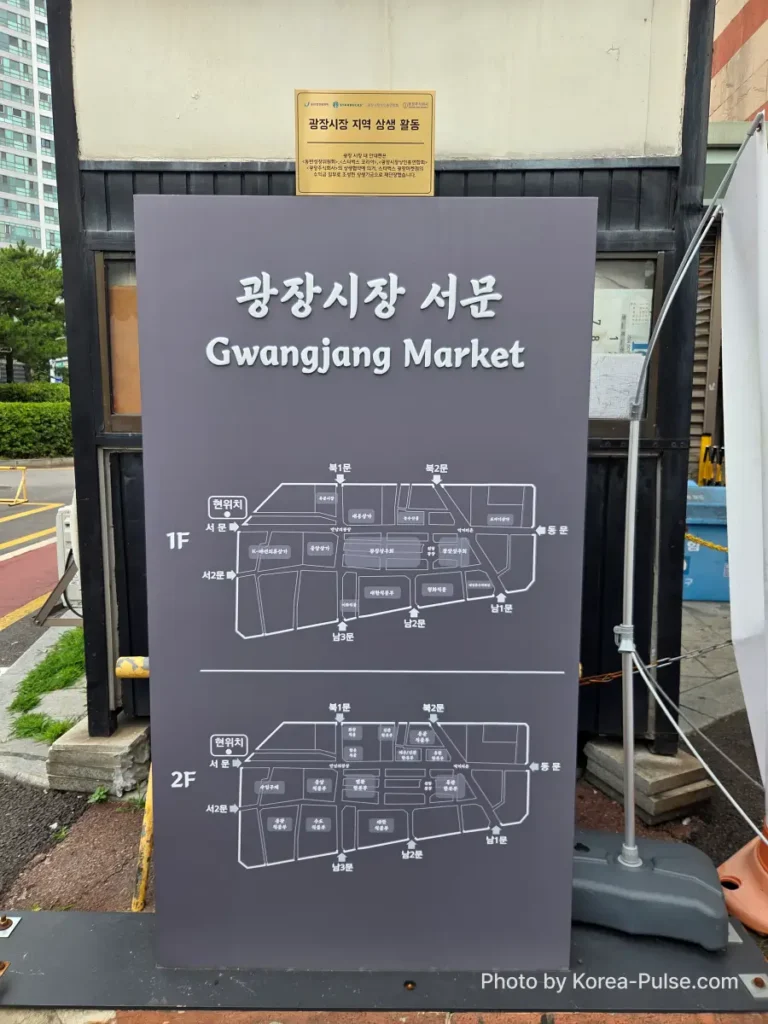
The official maps posted at the Gwangjang Market Seoul entrances are comprehensive and well-designed — but they’re entirely in Korean. I couldn’t find a usable English version anywhere online, so I made one. Here’s the 1F layout with all key gates marked:
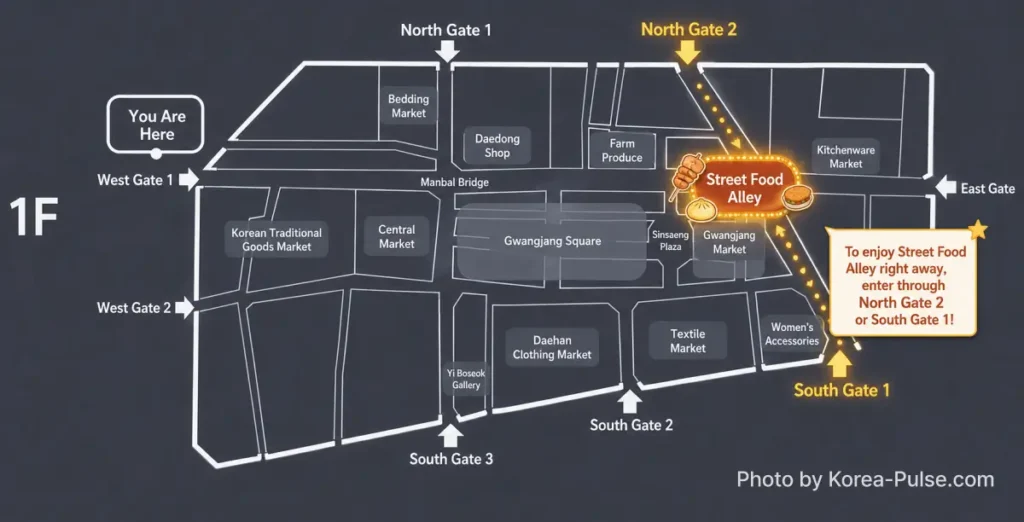
And this is what the official board actually looks like outside the West Gate — thorough, accurate, and completely inaccessible if you don’t read Korean. That’s exactly why the map above exists:
Lock the location on Google Maps before you leave — and download the area offline if you’re worried about data:
Gate by Gate Choose Your Entry Point
Gwangjang Market Seoul has multiple gates on all four sides. The one you choose determines what you see first — and whether your first ten minutes feel exciting or frustrating. Here’s the gate-by-gate breakdown:
North Gate 2 (북2문) — Fastest Access to Food Alley
This is the entry point for the hungry and impatient. Walking through North Gate 2 puts you at the northern end of the main food alley within seconds. The smell hits first: sesame oil, sizzling batter, something unidentifiable but deeply inviting. You’ll likely see lines forming right at the entrance — that’s normal, and it’s a good sign. Some of the market’s most famous stalls are positioned at this northern threshold.
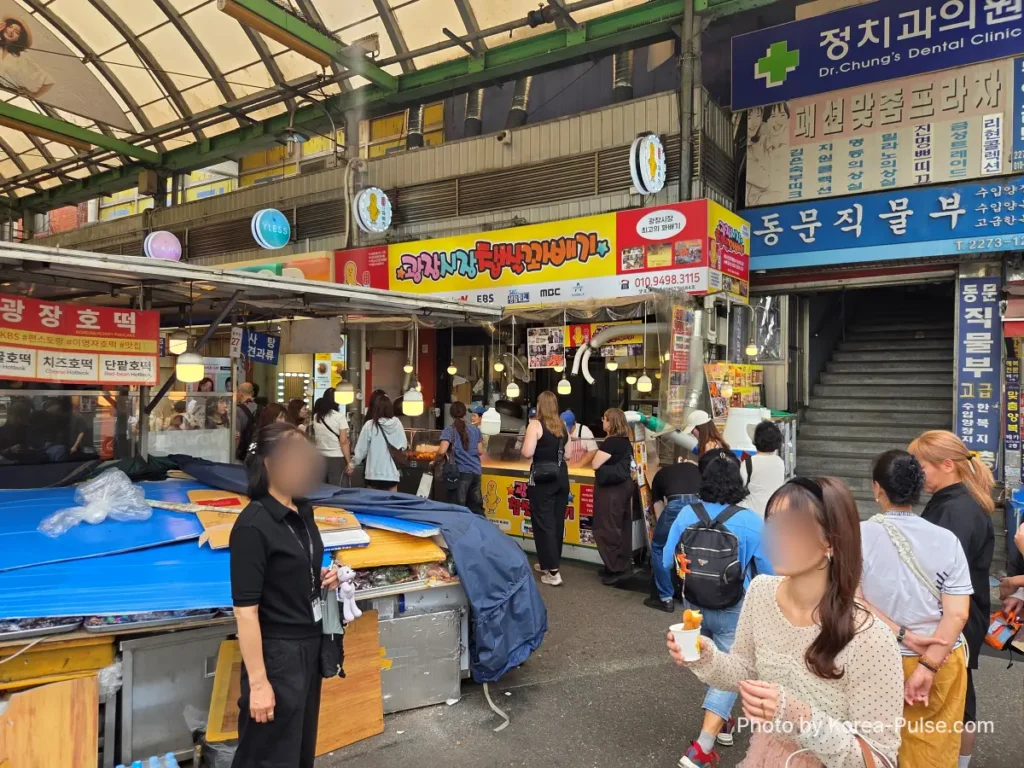
Don’t panic and join the very first queue you see inside North Gate 2. Scout the full length of the alley first — 20 to 30 metres further in, you’ll find equally good vendors with shorter waits. The stalls right at the entrance are famous, but they’re not your only option.
South Gate 1 (남1문) — Best First-Time Experience
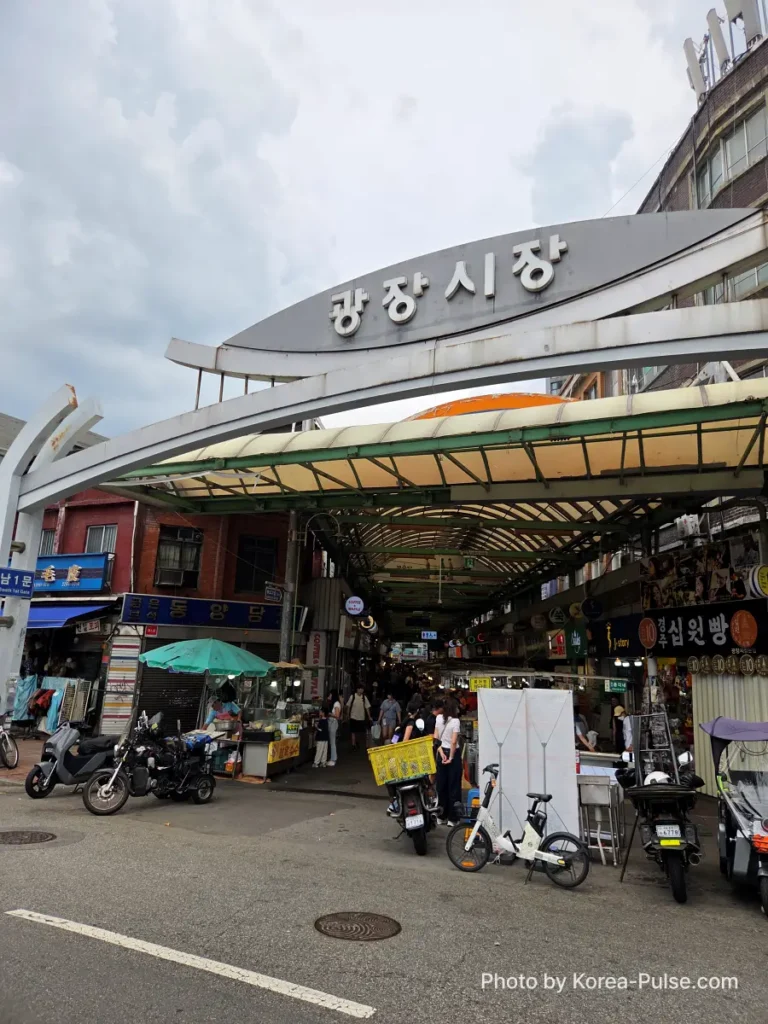
South Gate 1 is the mirror image of North Gate 2 — the southern entry to the same food alley. If you’re arriving from Euljiro 4-ga via the Cheonggyecheon route, this is where you’ll emerge. The 광장시장 sign arching over the entrance is unmissable, and the energy inside is immediate: loud, warm, and delicious. The aisle is narrow enough that your backpack will brush someone if you’re not paying attention — which is, honestly, part of the experience.
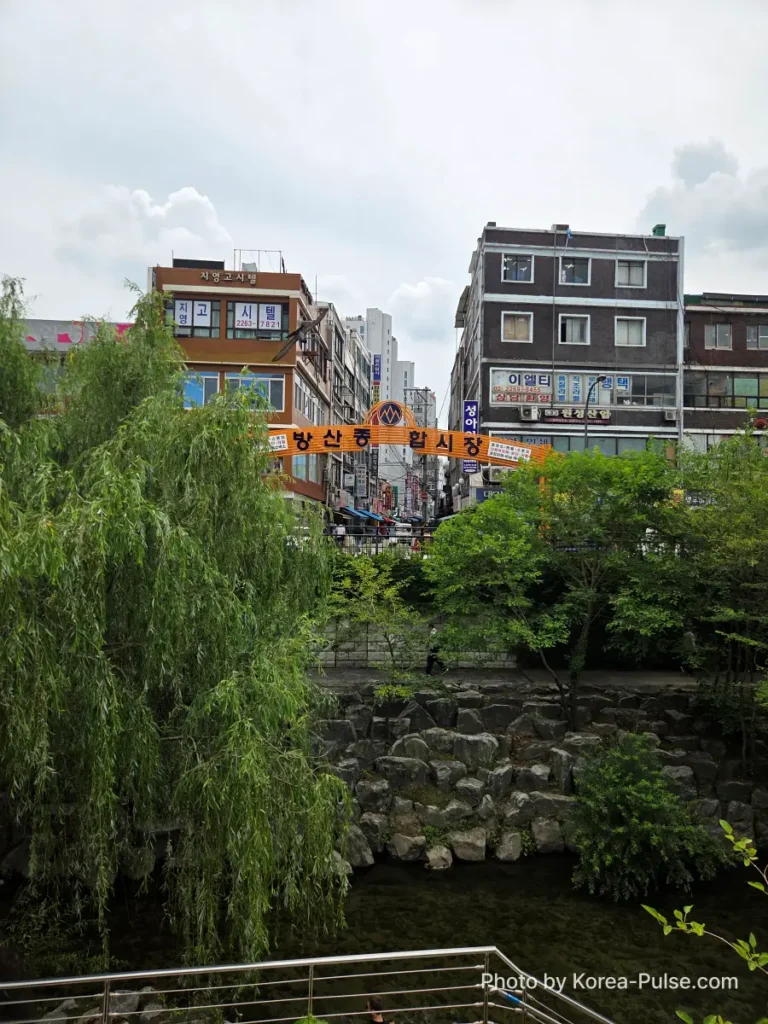
Bangsan Market (방산시장) is directly across the Cheonggyecheon stream from South Gate 1. It’s a wholesale market primarily dealing in paper goods, printed materials, wallpaper, packaging supplies, and interior materials — around 250 shops across the complex. It’s also well known for a dedicated bakery supplies alley selling professional baking equipment, cake moulds, and confectionery tools. Not a typical tourist stop, but if you’re into design, printing, or food crafts, it’s a genuinely interesting detour before lunch at Gwangjang.
West Gate (서문) & West Gate 2 (서2문) — The Local’s Entrance
The Main West Gate (서문) is the largest and most architecturally prominent entrance — a wide, high-ceilinged covered arcade that draws you into the market’s core. Walking this avenue takes you through traditional goods, banchan (side dish) stalls, and clothing before you eventually hit the food rows. We once entered from this side on a weekday evening — half the stalls were dark, and it felt like we’d walked into the wrong building. If your goal is food, first-timers should head to North Gate 2 or South Gate 1 instead.
West Gate 2 (서2문) is a quieter, narrower secondary entrance a short walk south. A handful of kimbap and snack stalls sit just inside, but it’s not the main food hub. Useful on busy weekends as a crowd-bypass shortcut — locals know it, most tourists don’t.
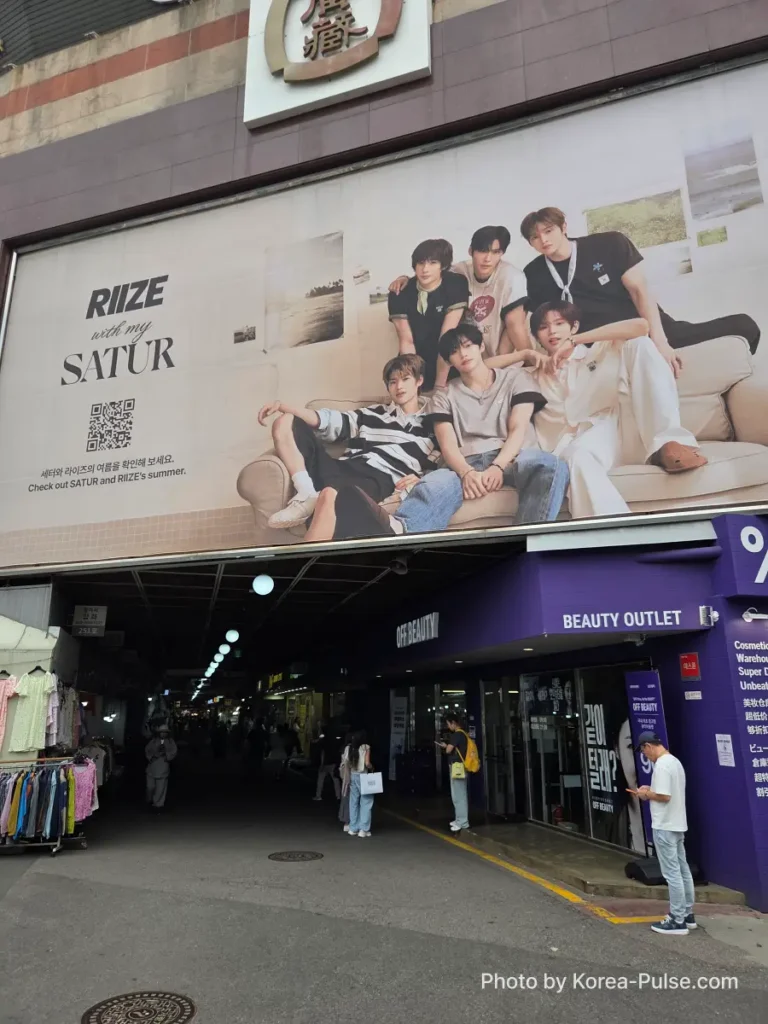
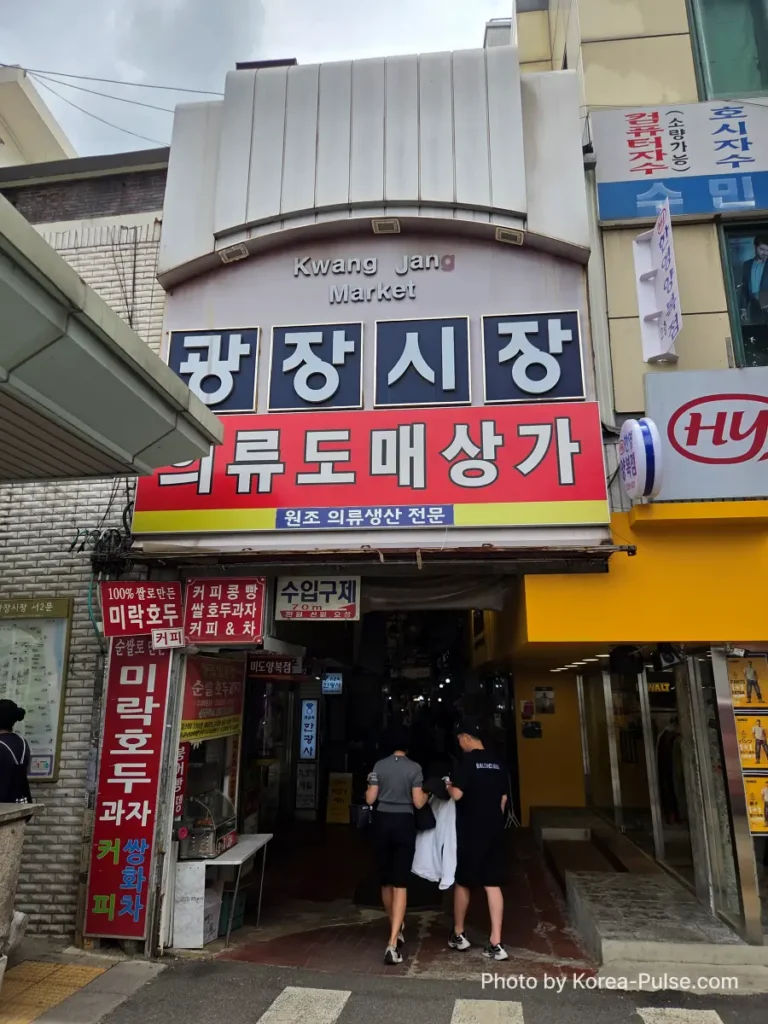
The textile and clothing sections operate primarily Monday to Saturday during daytime hours (roughly 07:00–18:00). If you arrive on a Sunday or in the evening, many of these stalls will be closed — but the food alley keeps running. The two halves of the market run on very different schedules. Don’t judge the market by the quiet side.
If You Get Lost Three Things That Always Work
Gwangjang Market Seoul is big enough that disorientation is possible, especially inside where every corridor looks similar. If you lose your bearings:
1. Look for 광장시장 gate signs — each one lists the gate number and has a small floor map underneath.
2. Follow the North Gate 2 / South Gate 1 signs — these are the most consistently posted in the food alley area.
3. Follow the crowd and the smell. Seriously. The food alley generates both in volume.
FAQ: Gwangjang Market Seoul
The questions I get asked before every first visit — answered straight.
Yes. No admission charge at any gate. You pay only for what you eat or buy. Budget ₩10,000–20,000 per person for a solid food alley meal.
It varies. Larger, more tourist-facing stalls increasingly accept card and app payments (Kakao Pay, Samsung Pay). The smaller and older the stall, the more likely it’s cash-only. Bring ₩30,000–50,000 in cash to be safe.
Honestly — challenging. The food alley is heavily meat and seafood-focused. Bindaetteok (mung bean pancakes, no meat) and some kimbap varieties are your best bets. The textile and goods sections are fully vegetarian-friendly.
Weekday lunch (11:30–13:30) for manageable crowds. Weekday evening (17:00–19:00) for full atmosphere without peak weekend crush. Saturday evenings are the busiest — either plan around it or embrace the chaos fully.
For first-time visitors to Seoul: absolutely yes. Gwangjang Market Seoul is one of the most concentrated, authentic street food experiences in the city — and the market’s history adds a layer that the newer food halls can’t replicate. Come on a weekday, enter through North Gate 2 or South Gate 1, and bring cash.
Coming Up Next Part 2: What to Actually Eat
You now know the history, the subway routes, and exactly which gate gets you to the food fastest. The navigation problem is solved.
In Part 2 of the Gwangjang Market Seoul series, we go inside the food alley. The essential dishes — bindaetteok, yukhoe, mayak kimbap, sundae — with real pricing, honest takes on which stalls are worth the queue, and the ordering etiquette that makes the whole thing less intimidating. The hangry teenager advisory will be in full effect.
Part 2: Gwangjang Market Food Alley Guide — what to eat, which stalls to queue for, and what to skip.
“The gate you choose shapes your first ten minutes. After that, Gwangjang takes over.”
Korea’s oldest market doesn’t need much of an introduction. But Gwangjang Market Seoul does need a map. Now you have one.