
K-TRAVEL · June 2026
Coin Laundry in Korea
The Local’s Complete Guide to 빨래방
Wash, dry, and even clean your sneakers — for under ₩15,000. Here’s exactly how.
Our washing machine died on a Tuesday. By Thursday evening, we were sitting in an air-conditioned coin laundry, sipping iced Mega Coffee, watching our clothes spin — and I was genuinely having a good time. Korea will surprise you like that.
start to finish
(wash + dry, large load)
365 days a year
Let me set the scene. Our ancient home washing machine finally gave up the ghost — no dramatic farewell, just a slow, dignified refusal to spin. New machine ordered, installation date: three days away. Three days of a family’s worth of laundry building up. Enter: the Korean 코인빨래방 (coin laundry).
Now, if you’re a traveler visiting Korea, you might never face a broken washing machine. But you will face the moment — around Day 6 or 7 of your trip — when you realize your suitcase smells like a combination of Korean BBQ smoke, subway air, and ambition. Hotel laundry services will happily take ₩15,000 per shirt to fix this. Or, you could do what locals do: walk five minutes, spend ₩12,000 total, and have everything washed and bone-dry in under 90 minutes. I know which one I’d choose.
This is my real, on-the-ground account of using a modern coin laundry in Korea — the Easy Wash (이지워시) chain — from figuring out the machines to the KakaoTalk notification that pinged us mid-lunch to say our laundry was done. Everything you need to know, in the order you’ll actually need it.
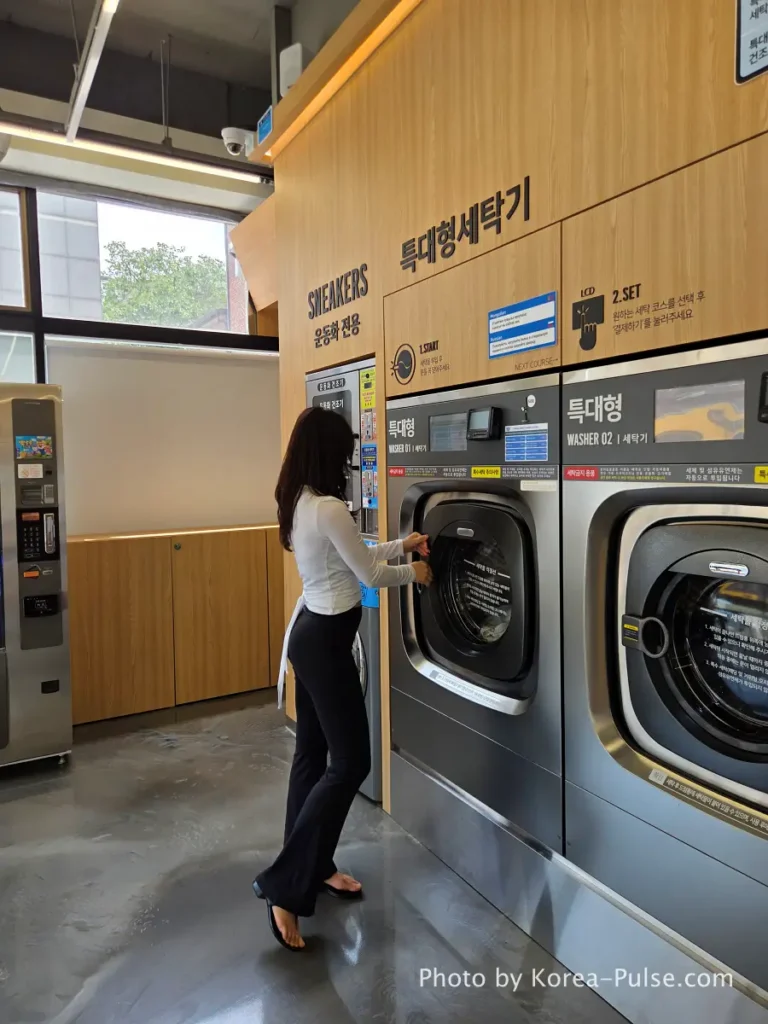
What Is a Korean Coin Laundry — and Why Should Travelers Care?
The 코인빨래방 (coin laundry / self-service laundromat) — what most travelers search for as a coin laundry in Korea — is one of those things that exists in many countries but has been perfected here. You’ll find them in Japan, the US, Australia — but the Korean version, particularly the newer franchise chains, has evolved into something genuinely impressive: fully unmanned, spotlessly clean, card-accepting, app-connected, and open around the clock.
In 2026, chains like Easy Wash (이지워시), Cleantopia, and Laundry 24 have turned what used to be a slightly grim coin-slot experience into something you’d almost describe as… pleasant? Industrial-grade machines, well-lit interiors, proper air conditioning. Several now send you KakaoTalk alerts when your cycle ends, so you can go have lunch and come back to dry clothes like an adult with a functioning life.
Most Korean apartments — and many Airbnbs and guesthouses — have washing machines but no dryer. Koreans traditionally air-dry on racks, which works fine in winter but takes forever in the humid Korean summer. The coin laundry’s commercial dryer is the only realistic way to get clothes genuinely dry in under an hour. This alone is worth the trip.
One thing that immediately caught my eye: the instruction panel on the wall listed steps in Korean, Mongolian, and Russian — but not English. The coin slot panel had English price labels, which is something, but the actual procedure was written for Central Asian migrant workers rather than Western tourists. Don’t panic. The machines are intuitive enough that the language barrier is more amusing than obstructive, and I’ll walk you through every step below.
How to Find a Coin Laundry Near You in Seoul
One of the best things about using a coin laundry in Korea is the sheer density of them — they are everywhere. Seriously. In Seoul, you are almost certainly within a 5–10 minute walk of at least one. The fastest way to find the closest one:
Open Naver Maps or Kakao Maps and search: 코인빨래방 or simply 빨래방. Google Maps works but tends to miss smaller local shops. For franchise quality and consistency, search 이지워시 (Easy Wash) or 클린토피아 (Cleantopia) directly.
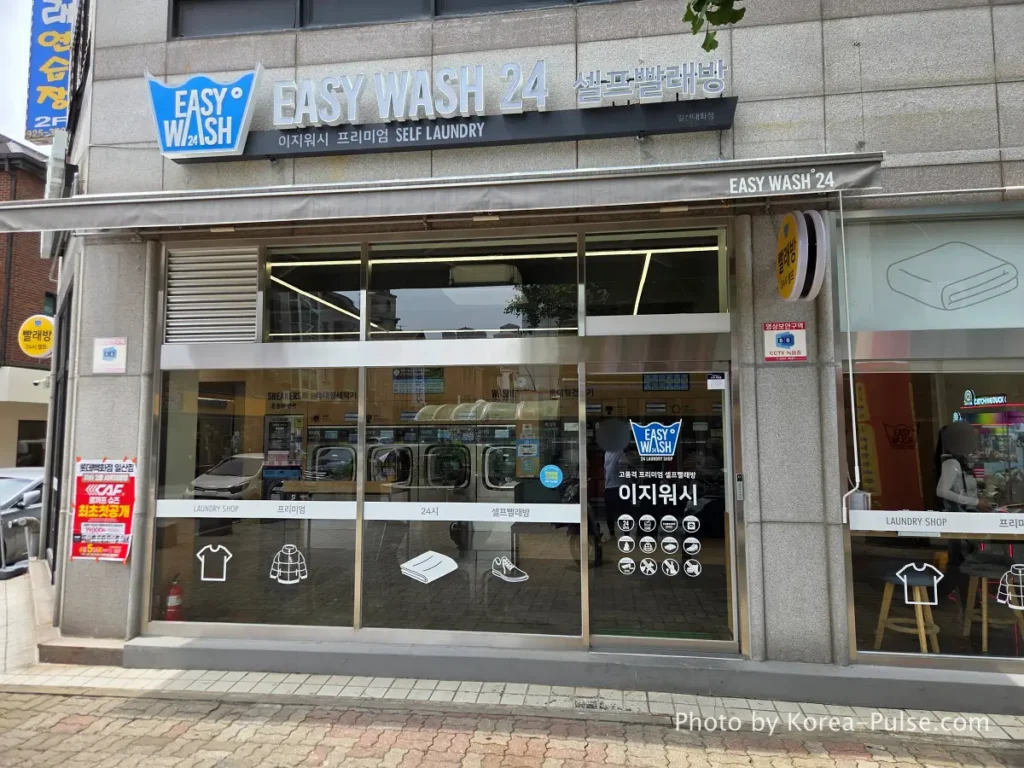
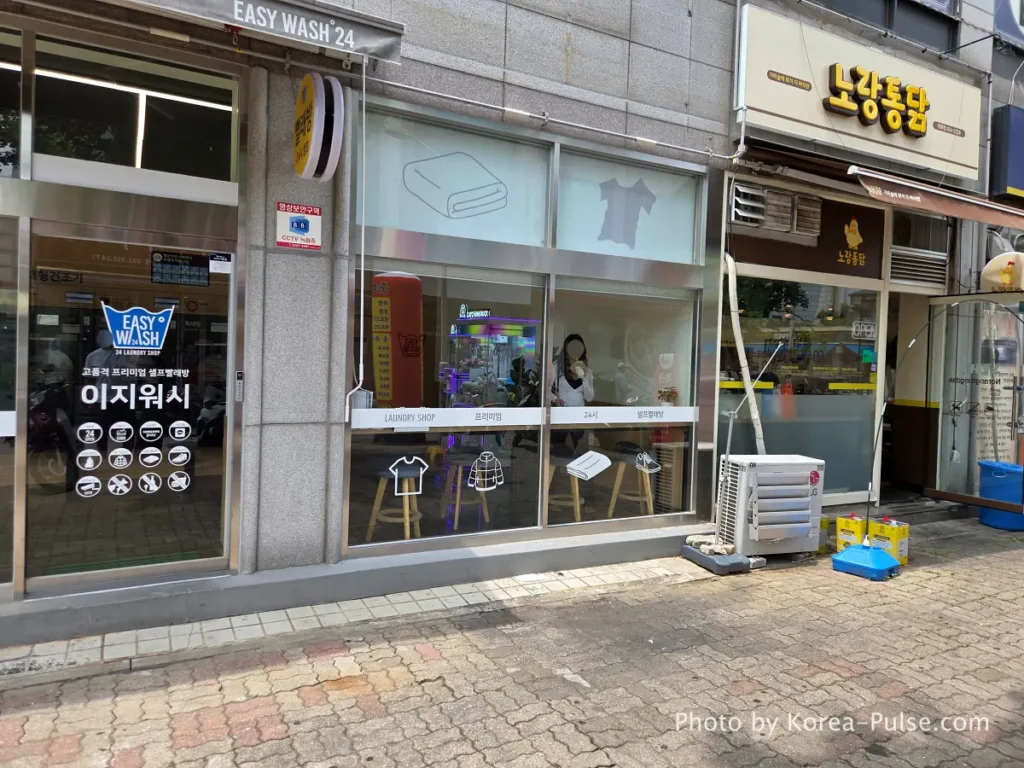
Inside: What to Expect When You Walk In
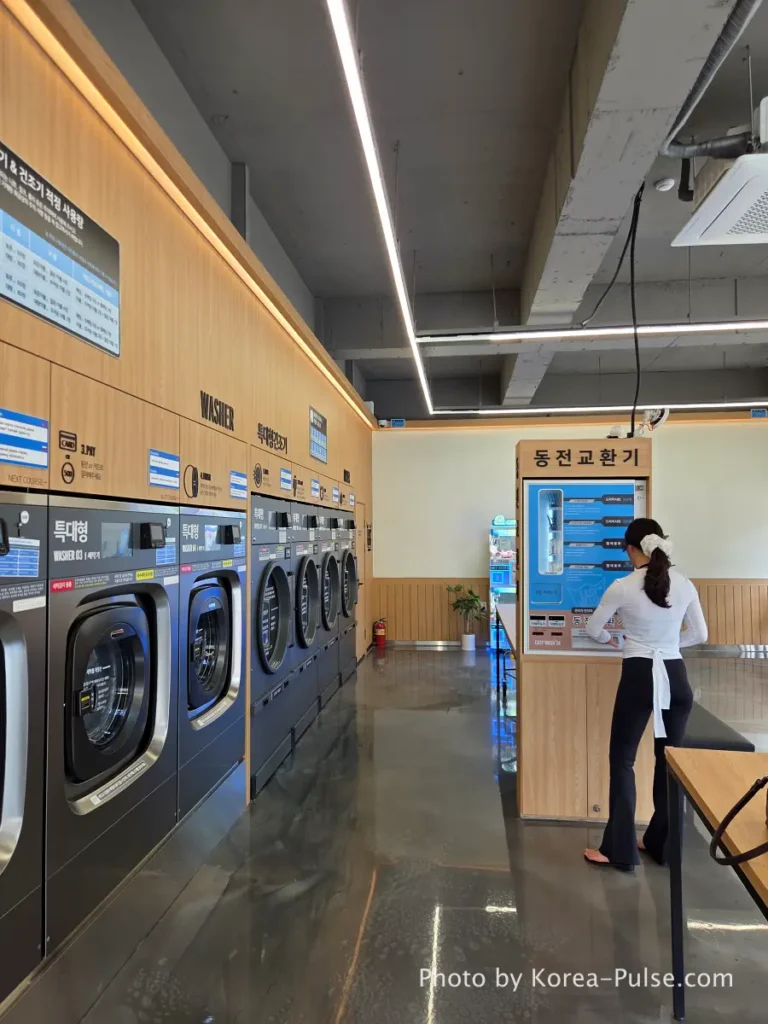
The Easy Wash we visited had two adjacent storefronts — one for large-load machines, one for the sneaker station. The interior was bright, air-conditioned, and completely unmanned. No staff, no attendant, no one to ask for help and no one judging your mountain of laundry. Just you, the machines, and a very confident set of on-screen instructions.
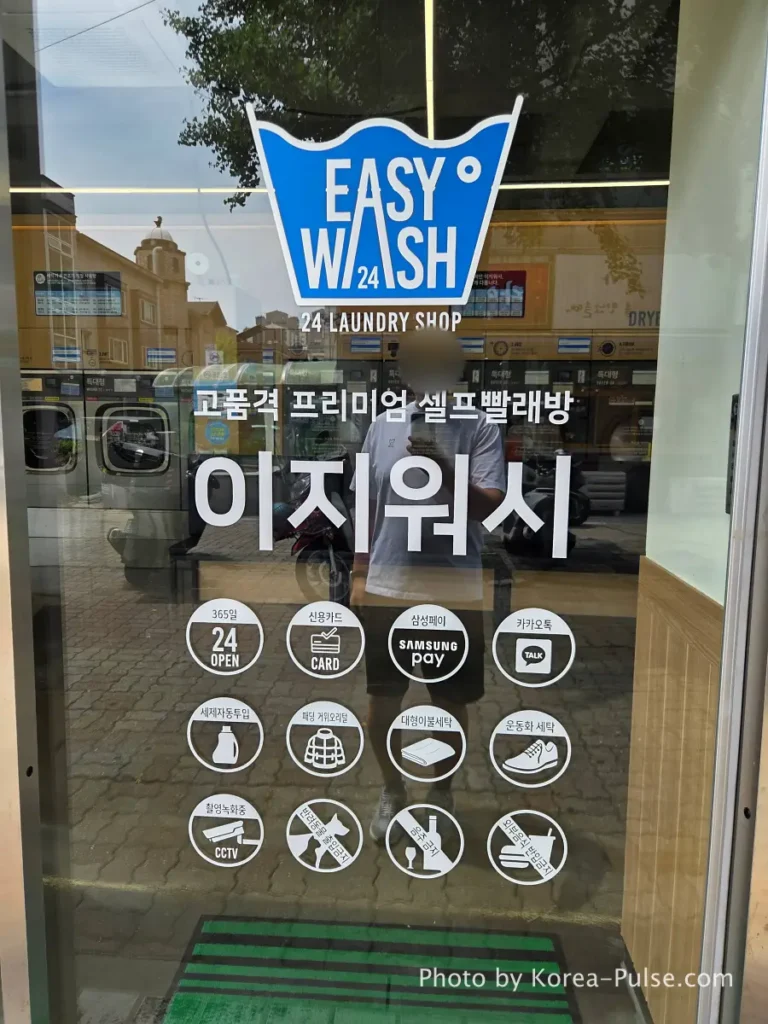
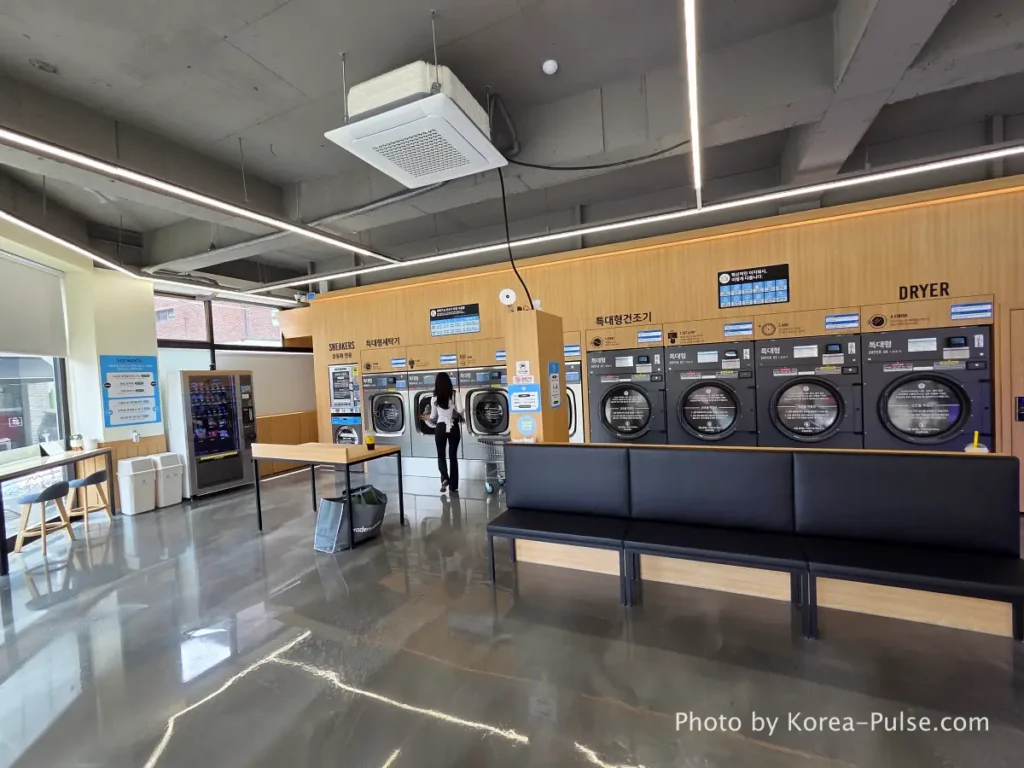
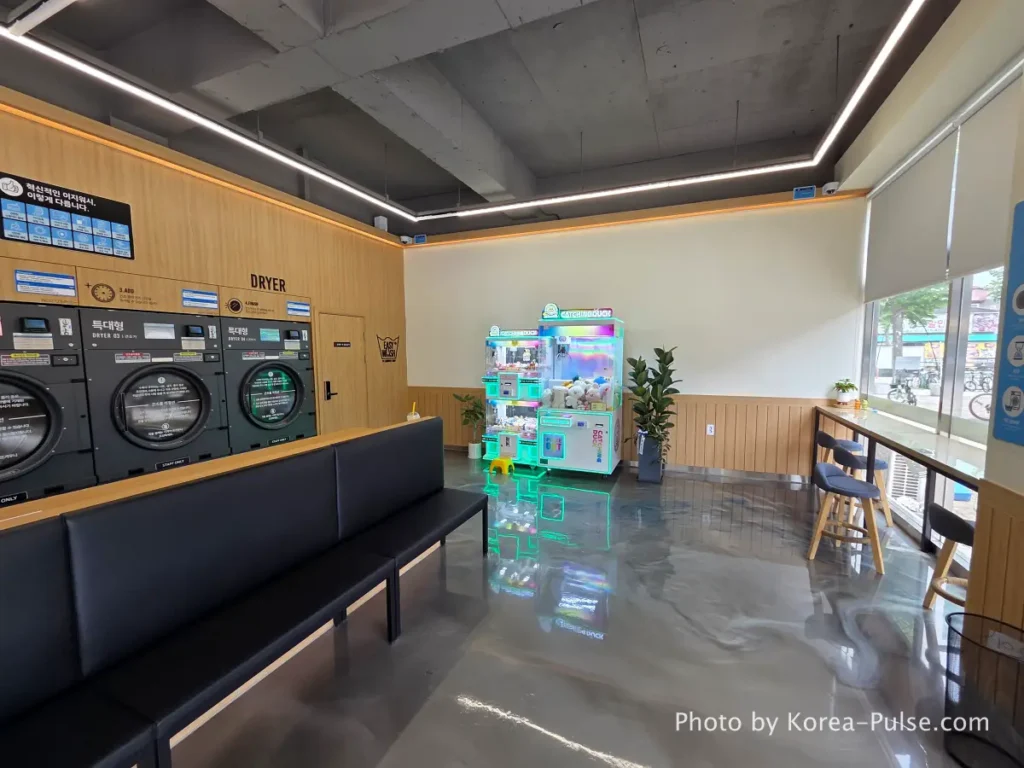
The seating was genuinely comfortable — black cushioned chairs, the kind that suggest someone actually thought about this. There was a gacha capsule toy machine tucked in the corner. Free Wi-Fi. The air conditioning was properly cold. And the ambient sound of rhythmically spinning drums is, it turns out, remarkably soothing. I didn’t hate waiting here. I actually found it calming in a very specific, slightly embarrassing way.
The 4-Step Process: How to Actually Use the Machine
The process sounds complicated when you don’t know the language. It really isn’t. Here is every step, in plain English, exactly as it appeared on the wall — minus the Mongolian and Russian translations:
The detail that genuinely impressed me: you don’t bring detergent. The machine automatically dispenses the correct amount of detergent and fabric softener the moment payment goes through. Load, select, pay — that’s the entire process. The machine handles the rest.
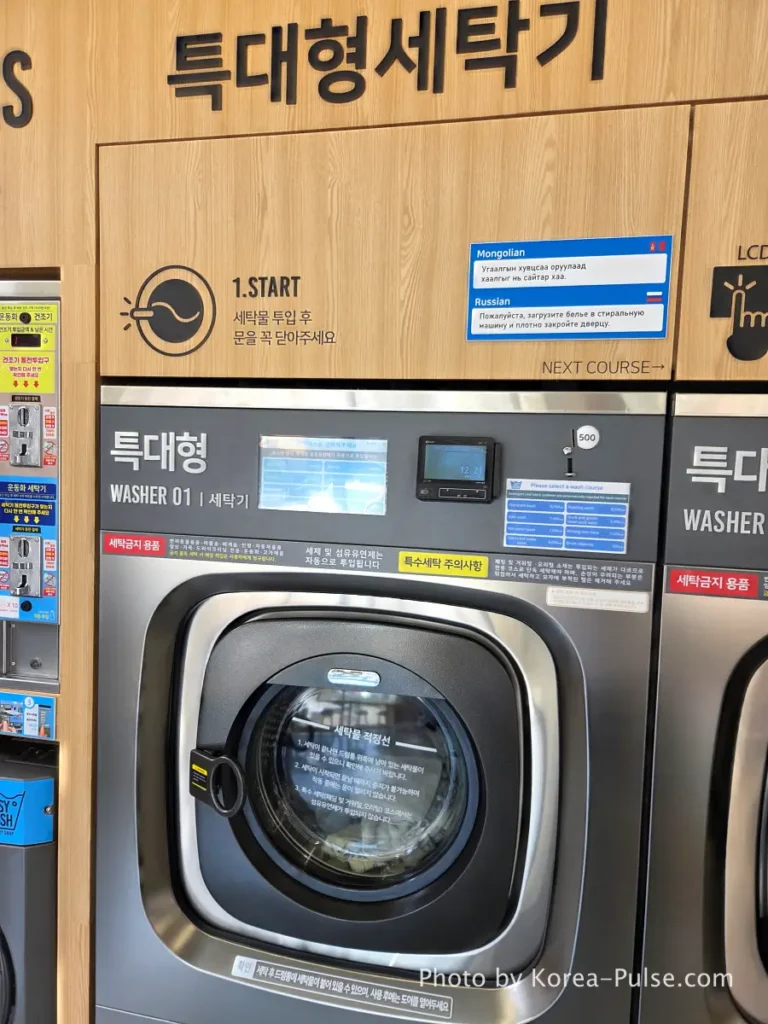
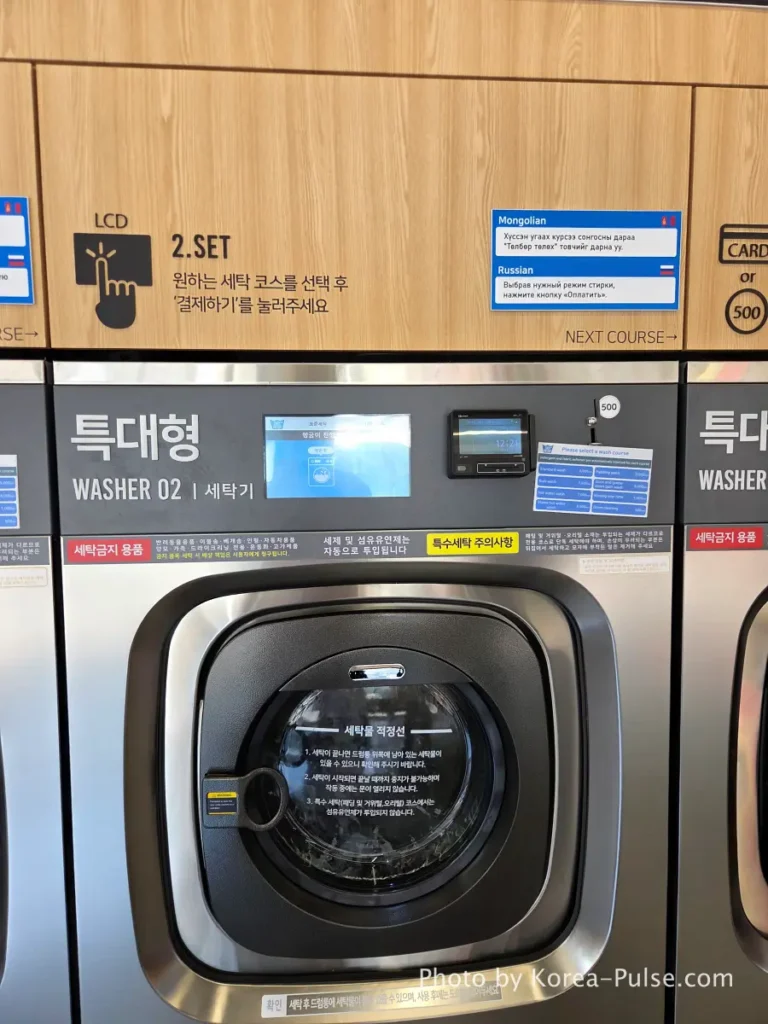
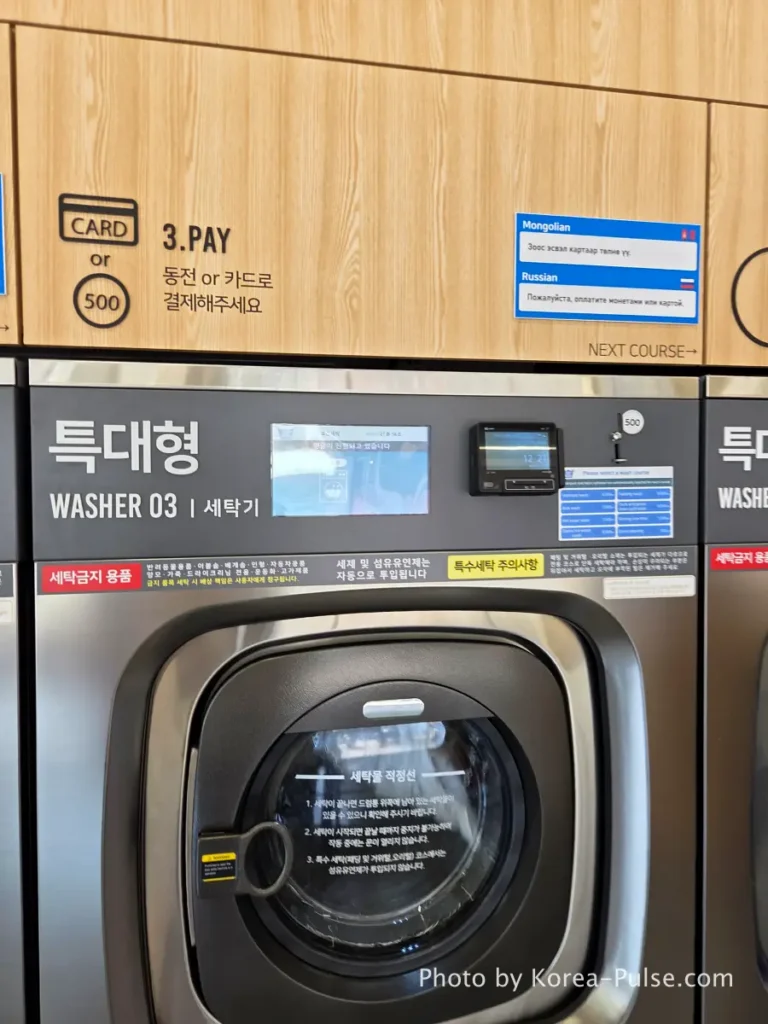
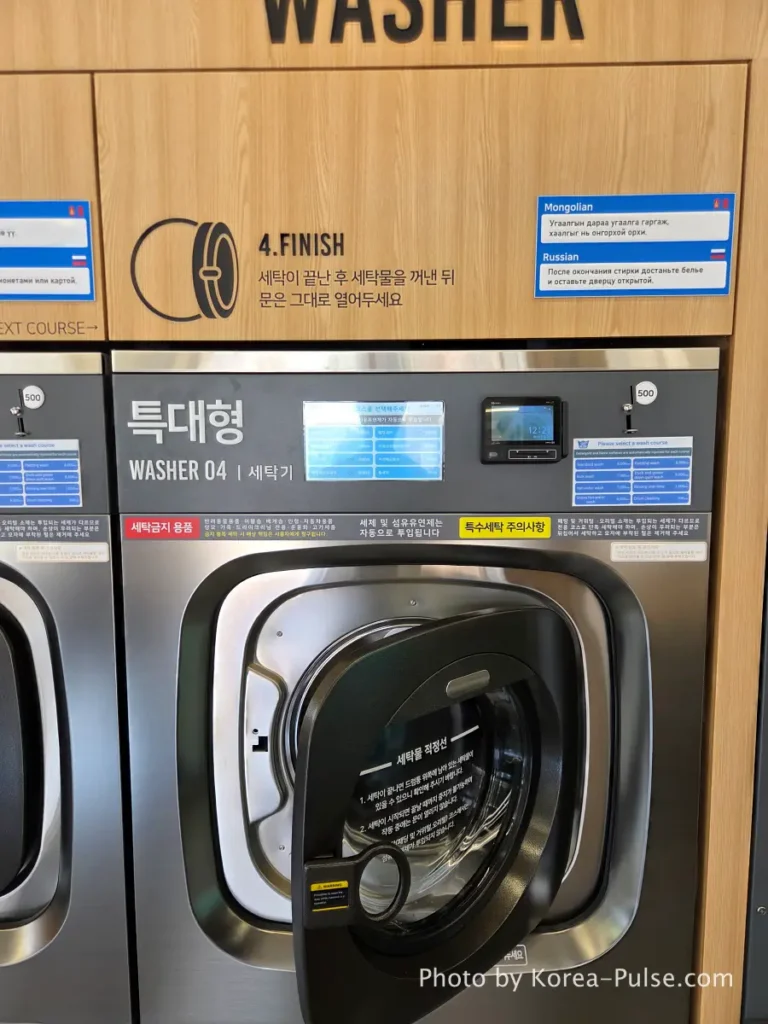
The main washers accept credit card and Samsung Pay. However, the sneaker washing station was coins-only at this location. Always check before you assume. Keep a handful of 500-won coins on hand for anything the card reader won’t cover.
Complete Price Guide: Every Cycle and What It Costs
Pricing at a coin laundry in Korea is standardized enough that the numbers below will hold across most franchise locations. Here is the full breakdown from the Easy Wash we visited, current as of June 2026. Prices are displayed on the machines — some in English, most in Korean only:
| Wash Type | Korean | Duration | Price (KRW) |
|---|---|---|---|
| Standard Wash | 표준세탁 | 30 min | ₩6,000 |
| Large Load Wash | 대형세탁 | 35 min | ₩7,000 |
| Hot Water Wash | 온수세탁 | 30 min | ₩7,000 |
| Padded Jacket Wash | 패딩세탁 | 35 min | ₩8,000 |
| Goose / Duck Down Blanket | 거위·오리털 이불세탁 | 35 min | ₩8,000 |
| Extra Rinse + Spin | 추가 헹굼탈수 | 10 min | ₩1,000 |
| Drum Self-Clean | 통세척 | 5 min | ₩500 |
| Standard Drying | 기본 건조 | 30 min | ₩6,000 |
For a typical travel scenario — a week’s worth of clothes, one large load — you’re looking at ₩6,000 wash + ₩6,000 dry = ₩12,000 total (roughly $8.50 USD). Compare that to ₩15,000–₩25,000 per item at hotel laundry. The math is not subtle.
The prices above are from Easy Wash, a modern franchise chain. Smaller independent 빨래방 around Seoul can be noticeably cheaper — I’ve used places where a standard wash was ₩4,000 and sneaker wash ₩5,000. The trade-off is almost always the same: no card reader, no Samsung Pay, coins only. For most Koreans today, that’s actually the friction point — we’ve moved so far toward tap-and-go payments that hunting for 500-won coins feels like time travel. If you have coins ready and don’t need the card convenience, the cheaper spots do the same job perfectly well.
The Sneaker Station: Korea’s Best-Kept Laundry Secret
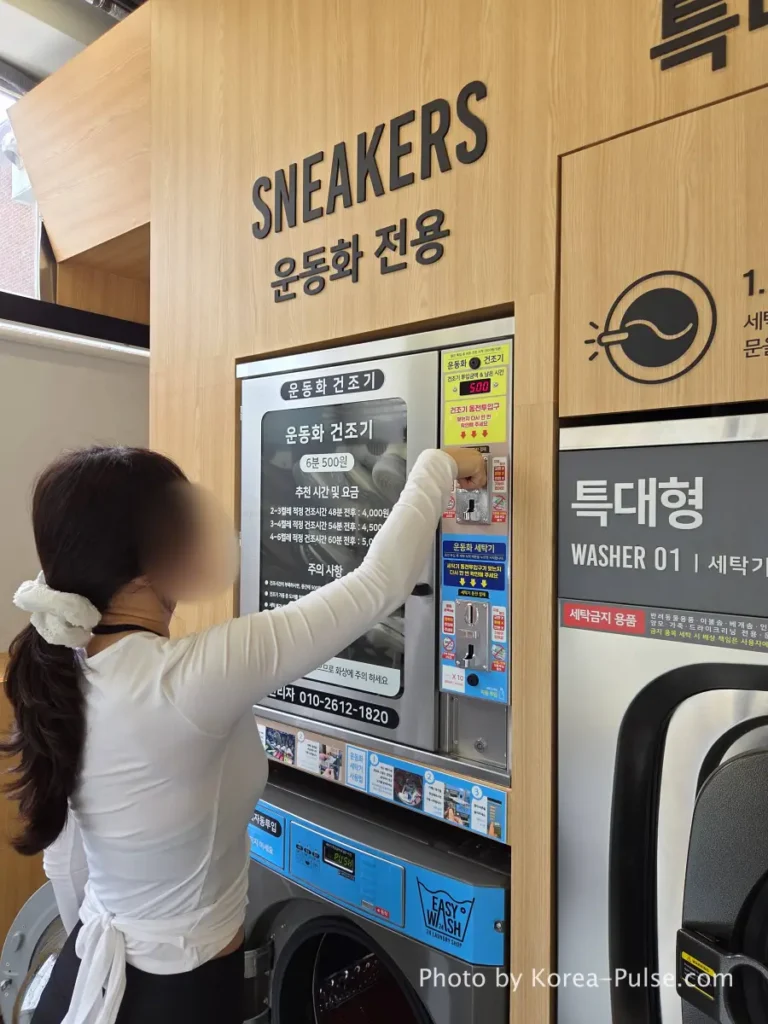
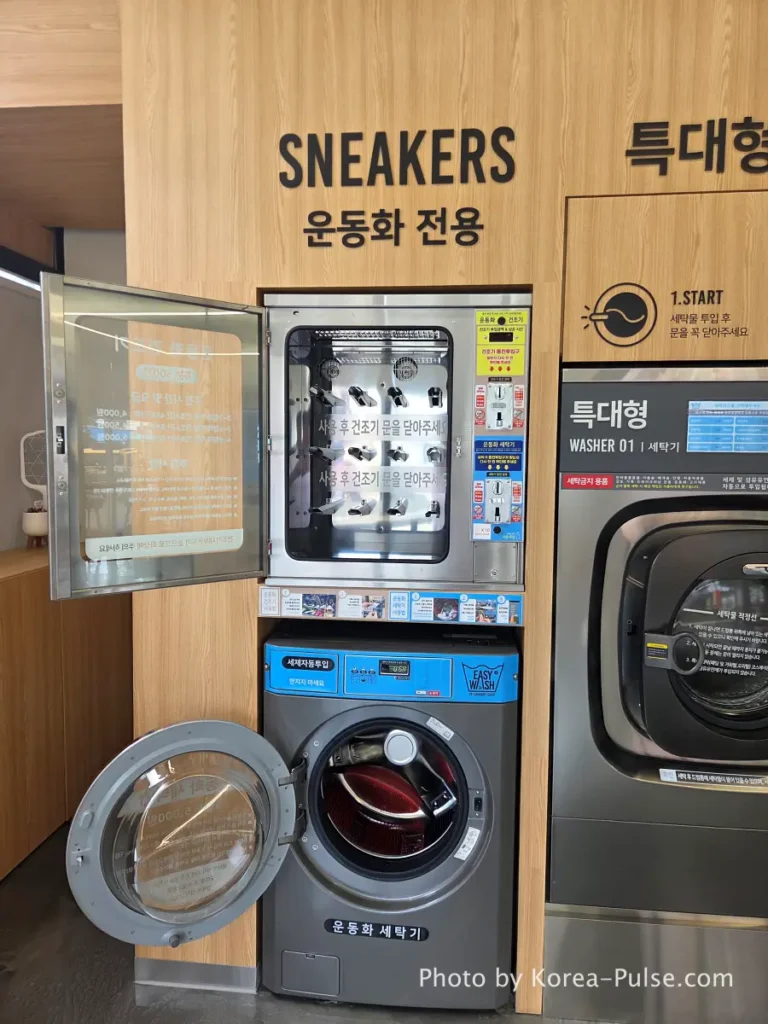
Here’s the feature that genuinely surprised me, even as someone who lives here. Adjacent to the clothing machines, in its own dedicated section, was a 운동화 전용 세탁/건조기 (sneaker-exclusive wash and dry station). The setup: a washer on the bottom, a dryer with internal hanging rods on top — purpose-built for shoes, nothing else.
Even Koreans with perfectly good washing machines at home come to these stations specifically for sneakers. Washing shoes in a home machine is a commitment involving drum balance warnings and one very unhappy appliance. This machine is built for exactly this job. It handles up to 5–6 pairs in a single cycle for around ₩5,000 — under a dollar a pair.
For travelers: Seoul involves serious walking. Palaces, markets, hiking trails, Myeongdong, Hongdae — your sneakers absorb a week of all of that. The sneaker station is how you give them back their dignity before your flight home.
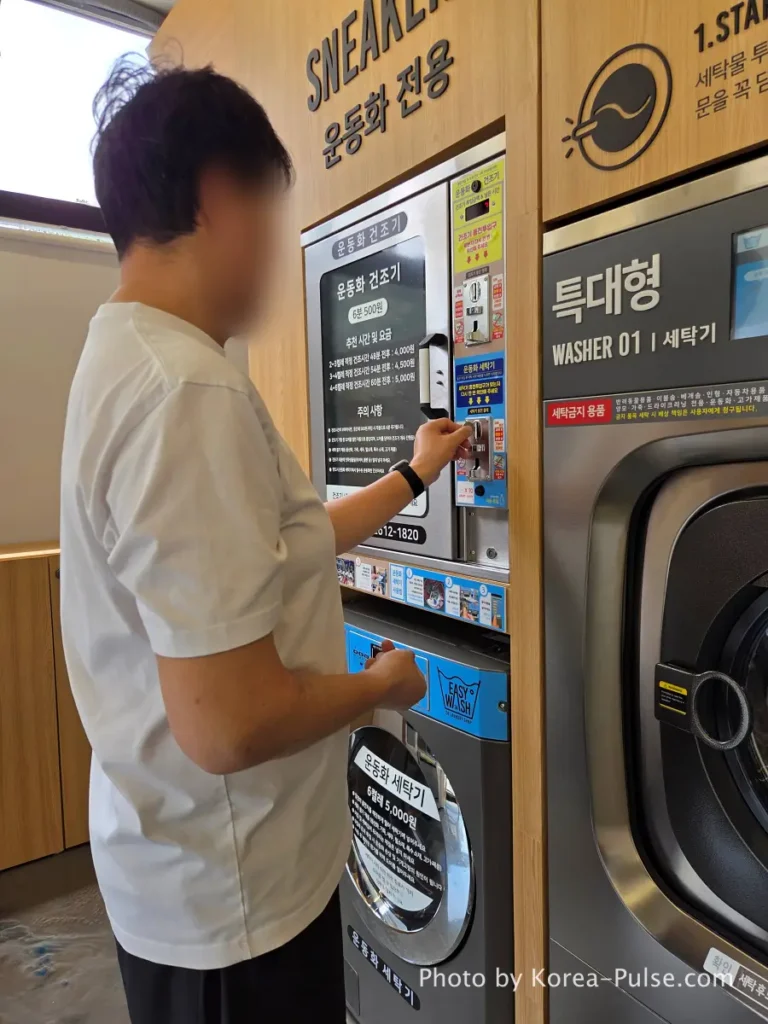
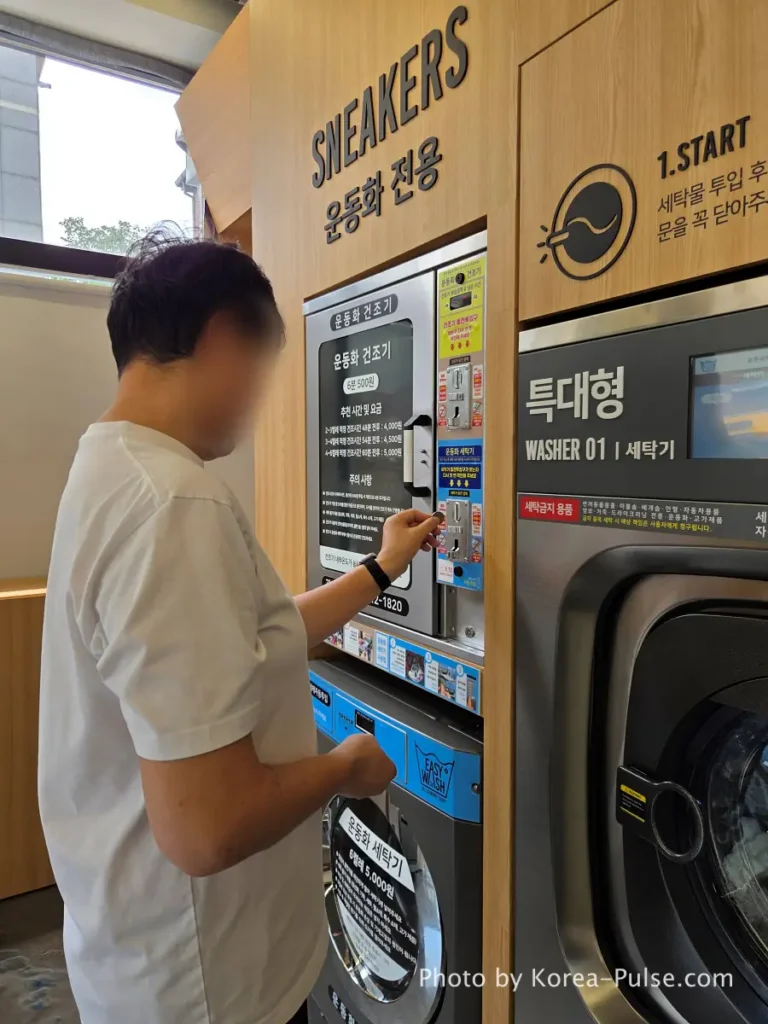
Unlike the main washers, the sneaker station at Easy Wash was coins only — no card reader. Use the 동전교환기 (coin changer machine) near the entrance to break a 10,000 KRW note into 500-won coins. One note gives you 20 coins — more than enough for a full sneaker wash and dry. Coin changers typically do not accept 50,000 KRW bills. Break large notes at a convenience store first.
Sneaker Drying, Lunch Out, and the KakaoTalk Trick
Once the sneaker wash cycle finished, it was time to move to the dryer — the top unit of the same station, with internal hanging rods for each shoe. My wife handled this part while I was across the room photographing the main commercial dryers like a very enthusiastic appliance journalist.
Meanwhile, I sorted out the thing that makes modern Korean coin laundries genuinely smart: the KakaoTalk (카카오톡) notification system. At the kiosk, enter your Korean phone number, and when your cycle finishes the machine sends you a message. You don’t need to sit there watching a drum rotate for 30 minutes. You can actually leave.
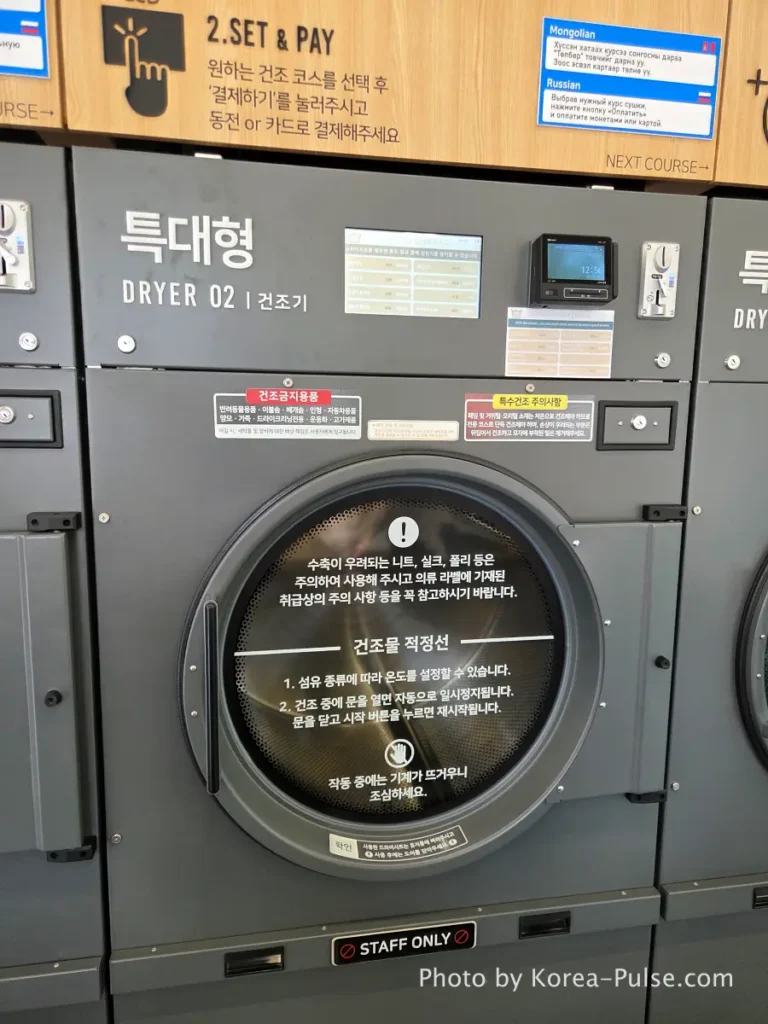
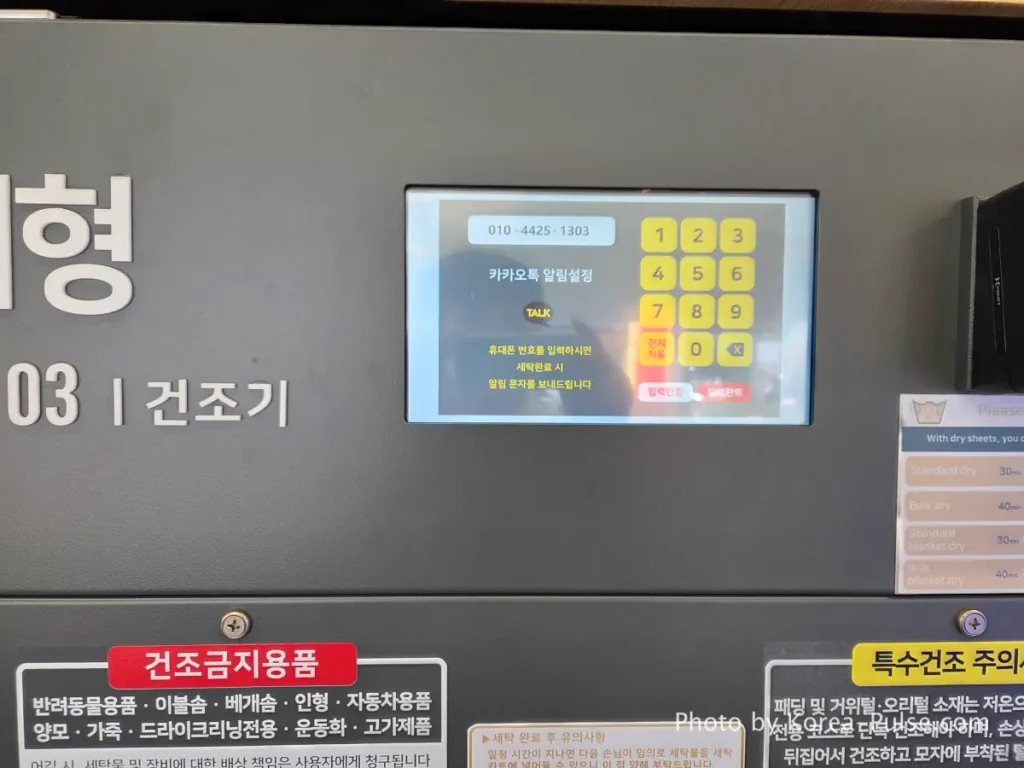
So we left. Found a nearby Korean restaurant, had a proper sit-down lunch — soup, rice, banchan, the full spread. Midway through, the phone buzzed. KakaoTalk, from the laundry machine: clothes done. We finished the meal at a completely unhurried pace, walked back, and everything was waiting exactly as promised.
No Korean SIM? No KakaoTalk set up? A local eSIM with a Korean number works for the notification system. Without one — set a phone timer for 30 minutes and come back. The machines are patient. Your clothes will still be there. They’re not going anywhere.
Mission Complete: Picking Up and Heading Home
After lunch, the clothes were warm, soft, and genuinely dry — not the “technically not wet but spiritually still damp” result that rack-drying produces. Then the second KakaoTalk arrived: sneaker dryer done. We walked over to the sneaker station and found the shoes exactly as hoped — clean, dry, smelling of nothing at all, which after a week of Seoul streets is basically a miracle.
Total elapsed time from walking in to walking out with clean everything: just under 90 minutes. Total actual effort: maybe 10 minutes across the whole visit. The rest was lunch and a short walk. For a family’s full laundry load plus sneakers, we spent under ₩15,000. The broken washing machine had, inadvertently, given us one of the more efficient afternoons we’d had in weeks.
Everything Else You Need to Know Before You Go
A few things I wish someone had told me before my first coin laundry in Korea run:
Bring a laundry bag. Carrying loose clothes down the street is technically possible but spiritually deflating. Convenience stores sell mesh bags for ₩1,000–₩2,000.
Break bills before you go. Even at card-accepting locations, the sneaker station needs coins. Grab change at a GS25 or CU on the way.
Don’t overfill. These drums are large, but loading them past 80% capacity affects wash quality. Resist the urge.
Leave the door open. When you unload, leave the drum door slightly ajar. It’s the unwritten rule of every Korean laundromat. Just do it.
| Payment Type | Main Washers | Sneaker Station | Main Dryers |
|---|---|---|---|
| Credit Card | ✅ Yes | ❌ Coins only | ✅ Yes |
| Samsung Pay / Naver Pay | ✅ Yes | ❌ Coins only | ✅ Yes |
| 500-won Coins | ✅ Yes | ✅ Required | ✅ Yes |
| KakaoTalk Notification | ✅ Available | ❌ N/A | ✅ Available |
One More Step: Finishing the Dry at Home
The coin laundry dryer does an excellent job — but for sneakers, I always do one final air-dry pass at home. Not because the machine failed. It didn’t. But shoes hold moisture in layers that a single dryer cycle doesn’t fully reach — the inner lining, the tongue, the toe box padding. Standing them upright at home for a couple of hours after they come out warm from the dryer finishes the job properly. And honestly? It’s also good for your feet. Shoes that go straight from the dryer into daily use before they’ve fully aired out can trap residual warmth and moisture — exactly the environment you don’t want.
There’s also something quietly satisfying about coming home to a row of clean sneakers lined up by the wall. Our haul from that afternoon: five pairs, all different — Adidas, Saucony, high-tops, trainers — standing at attention under the hallway light. After a week of Seoul streets, they looked almost embarrassingly clean.
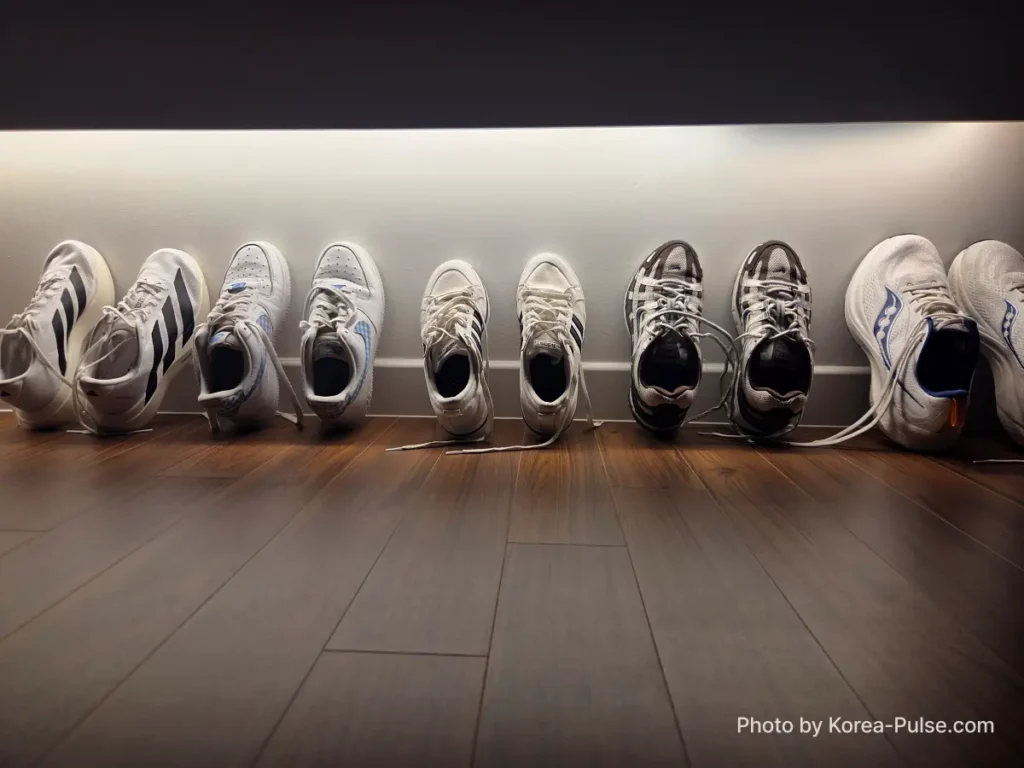
After picking up from the coin laundry dryer, stand sneakers upright with the tongue pulled open and leave them in a ventilated spot for 2–3 hours. No direct sunlight — UV can yellow white soles over time. If you have a small fan nearby, point it loosely in their direction. The 빨래방 gets you 90% there. This last step gets you to 100%.
More practical Korea living and travel guides:
Clean clothes, dry sneakers, a hot lunch, and ₩15,000. Korea’s coin laundry is the unglamorous travel hack nobody’s Instagram-ing — but everyone should know.
I came in because my washing machine broke. I left with a new appreciation for how efficiently Korea has solved a problem that most of the world still fumbles through with coin-hunting and perpetually damp clothes. If you’re traveling here for more than a week — or if, like me, your domestic appliances have developed a sense of dramatic timing — the 빨래방 is your friend. Twenty-four hours a day, 365 days a year, cleaner than expected, smarter than necessary. It’ll be there when you need it.
Search 코인빨래방 on Naver Maps or Kakao Maps. For reliable quality, look for Easy Wash (이지워시), Cleantopia (클린토피아), or Laundry 24 franchise locations. Budget: ₩6,000–₩8,000 wash · ₩6,000 dry · ₩5,000 sneakers. Full household load including shoes: under ₩15,000.