K-BEAUTY · 2026
The Olive Young US Store Has Arrived
Here’s What’s Actually Going On
It’s not a pop-up. It’s not a test. And the plan behind it is bigger than the press release lets on.
If you missed the Olive Young Korea Ultimate Guide — the story of how a green-signed Korean beauty chain became a cultural institution — that’s a good place to start. But if you’re here for the US expansion strategy, you’re in exactly the right place.
last year (record)
K-beauty zones (fall 2026)
in Bloomington, CA
If you read my guide to Olive Young in Korea, you already know how this store works: you walk in for one thing and emerge twenty-five minutes later carrying a green bag you didn’t plan for. Well, the Olive Young US store just made that experience available on American soil — and by all indications, most American shoppers have no idea what’s about to happen to their evenings.
On May 29, 2026, Olive Young Pasadena opens at 58 West Colorado Boulevard — the first official Olive Young US store to ever exist. This is not a pop-up. This is not a “test.” This is a fully committed, infrastructure-backed, Sephora-partnered, fulfillment-center-powered entry into the world’s largest beauty market. And behind the cheerful green signage is a strategic architecture that deserves a proper look.
Why Olive Young Pasadena Is Next to the Apple Store. On Purpose.
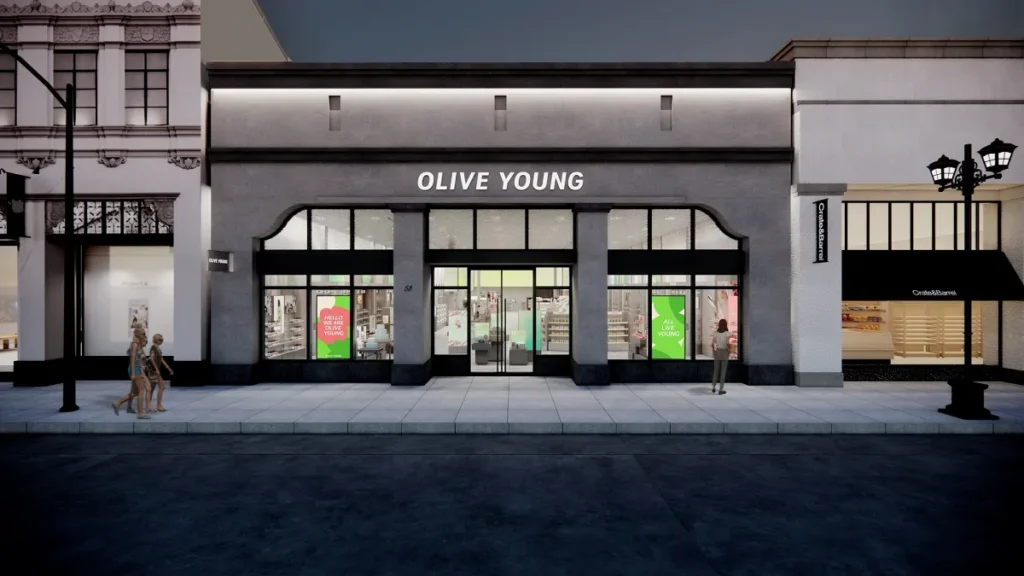
The address is 58 West Colorado Boulevard, Pasadena, California — Old Town, prime pedestrian territory, the kind of walkable shopping street that’s increasingly rare in American retail. The previous tenant was Foot Locker. The current neighbor is Apple.
That last detail is doing a lot of work. In US commercial real estate, the space adjacent to an Apple Store is the retail equivalent of front-row seats. You pay for it — and in American prime retail, “paying for it” means a Triple Net (NNN) lease, where the tenant covers not just rent but property taxes, insurance, and building maintenance on top. For a flagship this size, in a district this desirable, annual fixed costs can reach into the billions of KRW.
“Standing next to Apple tells every affluent Pasadena resident, every K-beauty tourist, and every journalist covering this launch exactly what kind of brand Olive Young intends to be.”
Breaking even through store sales alone would require extraordinary volume. Olive Young knows this. Their calculation is different: the rent is the marketing budget. The physical location is a billboard that also sells things — permanently positioned next to the most aspirational retail brand on the planet.
This exact global branding blueprint was meticulously trialed at their number one branch in Seoul, which you can explore in the deep dive on Olive Young Myeongdong Town: Inside the K-Beauty Mecca.
Pasadena’s Old Town sits 11 miles northeast of downtown LA, anchored by Caltech and a high concentration of high-income residents who actually walk to shop. There’s a strong Asian-American community here that’s been ordering Korean skincare online for years. When the Olive Young US store opens its doors, it isn’t introducing itself to strangers — it’s finally showing up in person for people who already know the brand intimately.
The Olive Young Sephora Deal: Inside Hundreds of Stores, Without Owning Any of Them
Here’s what separates this US launch from every previous K-beauty retail attempt in America: Olive Young US is not betting everything on its own stores.
The Olive Young Pasadena flagship, and a handful of other California locations — Westfield Century City, Torrance’s Del Amo Fashion Center — serve as high-visibility brand experiences. But the real distribution play is happening inside someone else’s real estate entirely.
Dedicated K-beauty zone inside Sephora — the Olive Young Sephora partnership in action.
Olive Young has partnered with Sephora to place dedicated K-beauty curation zones inside hundreds of Sephora stores across North America. Olive Young selects and curates the brands. Sephora owns the leases, employs the staff, and carries the overhead. This is reportedly the first time in Sephora’s history that a single external retail brand has been handed a dedicated category zone at this scale.
The industry term for this is “asset-light.” You scale without owning the assets. The Olive Young Sephora partnership means K-beauty discovery now lives inside America’s most powerful beauty retailer, coast to coast, without Olive Young signing a single additional lease.
| — | Sephora × Olive Young | Olive Young Own Stores |
|---|---|---|
| Number of locations | 650 in US & Canada (fall 2026) | 1 open now, 4 more planned in CA 2026 |
| Who pays the rent | Sephora | Olive Young |
| Purpose | Volume distribution | Brand experience & discovery |
| Inventory risk | Minimal — Sephora handles | Olive Young bears directly |
| Expansion speed | Already activated | One lease at a time |
Bibigo Dumplings Were Phase One. Olive Young US Is the Finale.
To understand why the Olive Young US store matters beyond the beauty industry, you have to look at its parent company: CJ Group. Because Pasadena is the third act of a play that’s been running quietly in American culture for nearly a decade.
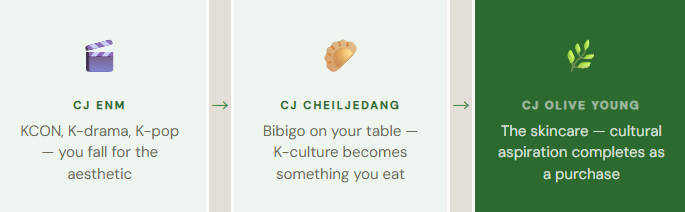
CJ ENM plants the seed through content. KCON draws tens of thousands of Western fans into rooms buzzing with Korean culture every year. CJ CheilJedang’s Bibigo brand now holds over 40% of the US dumpling market, with frozen kimbap growing at 130%+ annually. Korean culture has already arrived on the dinner table.
By the time the Olive Young US store opens its doors in Pasadena, a significant chunk of its potential customers have been cooking Korean food at home and watching Korean content for years. The brand isn’t introducing K-beauty from scratch — it’s completing a journey that was already well underway.
No amount of Sephora’s capital can buy what CJ Group has built. It took a decade to build. And it’s the one structural advantage that no American competitor can replicate — because the cultural credibility came first, organically, through content and food. The Olive Young US store is simply the beauty chapter of a story that’s been running since KCON.
How Olive Young US Is Built to Actually Deliver — Literally
The cultural groundwork is one thing. But a K-beauty store in America lives or dies on logistics — and this is where Olive Young US has done its homework quietly and thoroughly.
Before a single shelf was stocked at the Olive Young Pasadena store, the company activated a 3,600㎡ fulfillment center in Bloomington, California in March 2026. That warehouse is what makes the US-specific e-commerce platform genuinely viable for American shoppers.
The mechanics are deliberate. Visit the global site from a US IP address and you’re automatically redirected to the local Olive Young US platform via geo-fencing. Points and review history accumulated on the old global platform migrate over seamlessly. The influencer affiliate system has been replaced with Rakuten US, connecting to the micro-creator ecosystem that actually drives beauty purchases in North America.
The full intended loop: walk into Olive Young Pasadena, get your skin analyzed by an AI diagnostic device, try products you’d never have found otherwise, scan a QR code, complete the order on the Olive Young US platform. Ships from Bloomington. Arrives in days, not the weeks that international shipping used to require.
That QR code is the entire point of the Olive Young US store. The physical location exists to create the relationship. Bloomington handles the rest. This is retail as acquisition channel — not retail as profit center.
The Korean Sunscreen Problem, the FDA, and Why US Prices Are Higher
The Korean Sunscreen Wall
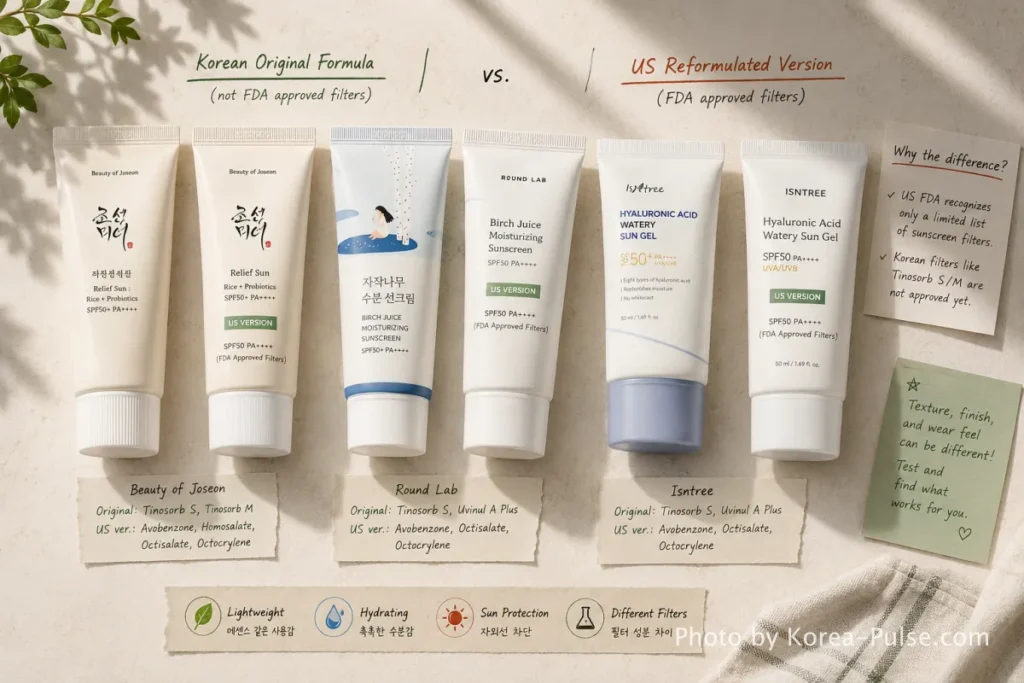
The products that arguably built Olive Young’s global reputation among skincare enthusiasts — those featherweight, essence-like Korean sunscreen formulas — are, in the eyes of US law, not cosmetics. The FDA classifies sunscreen as an OTC drug, regulated by an approved UV filter list that hasn’t been meaningfully updated in decades. The specific chemical filters that give Korean sunscreens their legendary skin-like texture — Tinosorb S, Tinosorb M, and others — are simply not on that list.
To sell sunscreen in the US, you use FDA-approved filters. Those filters tend to produce heavier, more occlusive textures. The reformulated versions appearing in the Olive Young US store are not the same products that made K-SPF famous on social media. Reddit’s skincare communities have already done the ingredient comparisons and are not being polite about it. For fans who discovered Korean sunscreen specifically because of its legendary finish, this is a genuine problem — not a minor caveat.
This isn’t Olive Young’s fault. The FDA sunscreen approval process is genuinely slow — several Korean UV filters have been pending US approval for years. But it does mean that one of the most compelling reasons to shop at an Olive Young US store over a competitor is currently legally unavailable in its original form.
The Price Gap
The second issue is pricing. Products that retail for around ₩20,000 (roughly $15) in Korea are appearing on Olive Young US in the $32–38 range — Sephora mid-prestige territory. The math is explainable: NNN lease costs, US logistics overhead, import margins. Understanding why it happened doesn’t make it easier to accept, especially for loyal fans who’ve been ordering internationally for years at Korean prices.
“If I’m paying Sephora prices, I expect Sephora-level products. And if I want the original Korean formula, I already know where to order it.” — Representative sentiment from r/SkincareAddiction, paraphrased.
Alternatives like YesStyle, Stylevana, and Beauty Box Korea still deliver original Korean formulas — including the Korean sunscreen formulations that FDA rules out of US stores — at significantly lower prices with a longer wait. The Olive Young US store is betting that speed, in-person experience, and curation are worth the premium. That’s a reasonable bet. Whether the current customer base agrees is the real test.
How the Olive Young US Store Fits Into the K-Beauty Market in America
Those friction points aside, the bigger picture is worth stepping back to see. The real question isn’t whether the Olive Young US store is perfect at launch — it’s whether the position it’s claiming in the American market is one that anyone else can take.
The US beauty retail market has two dominant poles: Sephora (prestige, luxury, curated brands) and Ulta Beauty (mass market, drugstore crossover, volume). Neither is primarily in the business of discovery. That gap is exactly where Olive Young US is positioning itself.
| — | Sephora | Ulta Beauty | Olive Young US |
|---|---|---|---|
| Brand philosophy | Established prestige & luxury | Mass market + masstige volume | Korean indie brand discovery & curation |
| Core customer | High-income luxury shopper | Value-conscious broad demographic | Ingredient-aware global MZ consumer |
| Trend speed | Slow — major brand approval cycles | Slow — volume-first model | Fast — real-time Korean market data |
| K-beauty role | Passive — stocks what sells | Passive — stocks what sells | Active — builds the category |
Sephora curates what’s already proven. Ulta stocks what moves at volume. The Olive Young US store is built to do something neither does: surface emerging Korean indie brands before they go viral in the West, backed by 27 years of Korean market data that no American retailer possesses. That proprietary curation muscle — knowing which ingredient trend is about to break through, which unknown brand is the next Beauty of Joseon — is genuinely hard to replicate.
Is the Olive Young US Store Going to Last?
Yes. With caveats.
Korean beauty exports hit a record $11.4 billion last year. The US just overtook China as Korea’s largest beauty export destination. American shoppers spent $2 billion on K-beauty products in a single twelve-month period. These numbers aren’t describing a trend anymore — they’re describing a structural shift in how American consumers relate to skincare. The Olive Young US store is the physical manifestation of that shift.
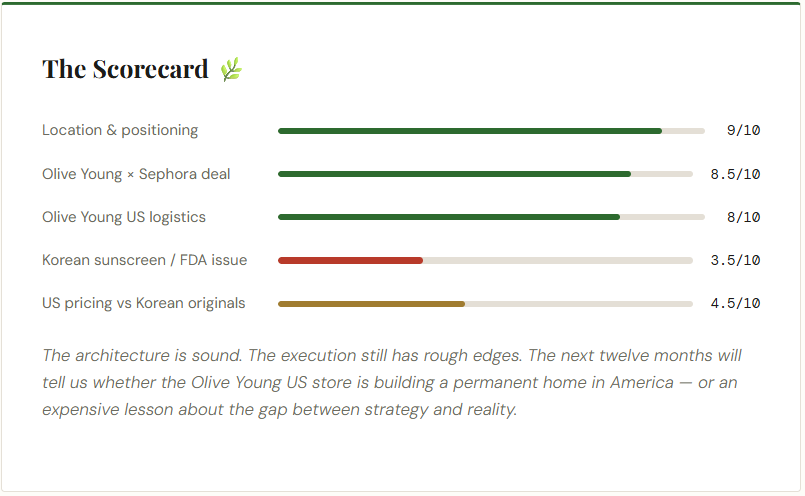
The strategy is coherent. The Apple Store adjacency, the Olive Young Sephora partnership, the Bloomington fulfillment center, the geo-fenced Olive Young US platform — this is a more complete launch architecture than anything K-beauty in America has attempted before. It’s built to last, not to generate a press cycle.
The FDA sunscreen problem and the pricing gap are real. They’re also both solvable: the FDA situation requires patience and lobbying; the pricing structure can be adjusted as the US infrastructure matures. Neither is fatal. Both need to be addressed if the Olive Young US store wants to retain the loyal cross-border fans who already know exactly what the Korean originals feel like.
“The evening walk has arrived in California. The automatic doors will open. And yes — the green bag will be waiting.”
Am I going to walk through those Pasadena doors the first chance I get? Obviously yes. Will I also maintain a backup order pipeline for my original-formula Korean sunscreen for the foreseeable future? Also yes. I’m not going to pretend otherwise. Some things, it turns out, are inevitable on both sides of the Pacific.