
K-TRAVEL · May 2026
Dongdaegu to Andong Train:
Riding Korea’s Classic Mugunghwa
From a bakery in a department store basement to a century-old station town — all for ₩7,800.
This is Part 2 of our family Korea rail series. If you missed Part 1 — our KTX ride from Seoul Station down to Dongdaegu with companion seats — that’s a great place to start. But if you’re already standing on a Dongdaegu platform wondering what train to take, you’re in exactly the right place.
Dongdaegu → Andong
Train 1777 (17:46→19:08)
departures per day
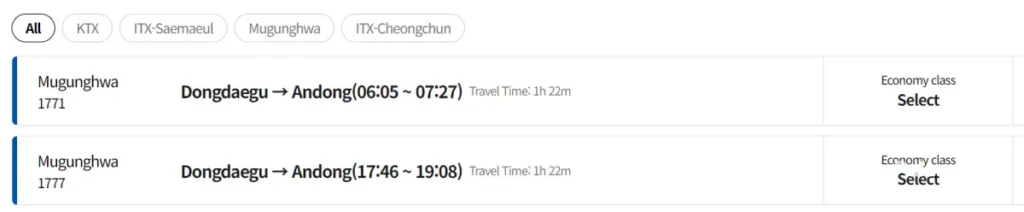
One thing to flag before you book: direct Mugunghwa departures on the Dongdaegu–Andong route run only twice a day — the early bird at 06:05 (Train 1771, arriving 07:27) and the late afternoon at 17:46 (Train 1777, arriving 19:08). Miss either window and you’re on a bus. Check the LetsKorail website before you commit to a plan. Before we get to the train itself, though, I need to talk about what happened before we even reached the platform — because Dongdaegu Station sits at the center of one of the most well-integrated transport complexes in the country, and we had time to kill.
Gentz Bakery: The Trap in the Basement
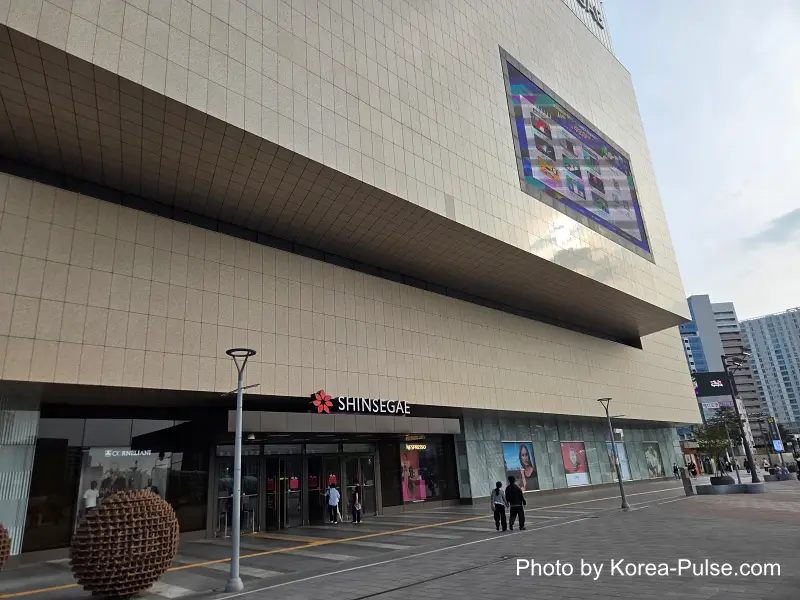
Right next to Dongdaegu Station stands the Shinsegae Department Store, and in its basement food court lives Gentz Bakery — established 2002, legendary among locals, and absolutely heaving on a weekend afternoon. I felt genuinely self-conscious lifting my phone to take a photo. The crowd was that thick.
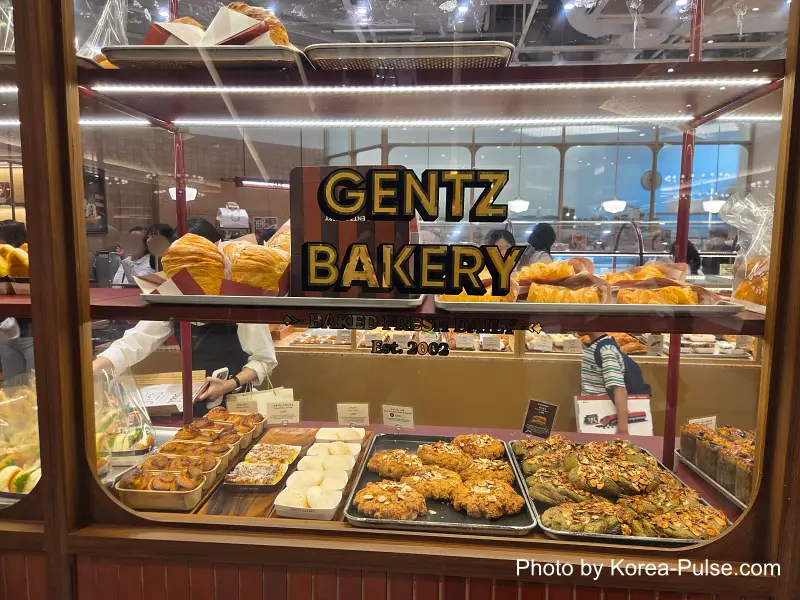
I managed a photo of the display case — layers of croissants, almond pastries, seed-topped rolls — but capturing the chaos of the crowd behind me was another matter. Next time I’m budgeting an extra 30 minutes just for this bakery. Consider yourself warned.
The Shinsegae Department Store basement (B1) at Dongdaegu Station has a full food court and gourmet alley covering Korean, Japanese, and international cuisine. The 8th and 9th floors also have restaurants with great views. If you’re transiting through Daegu with time to spare, this is the best food stop in the building — not the fast food chains in the station itself.
The Complex That Changed Daegu
The Shinsegae isn’t just a department store that happened to land next to a train station. The two were built as a single integrated project — one of the most ambitious transport developments in Korean regional history.
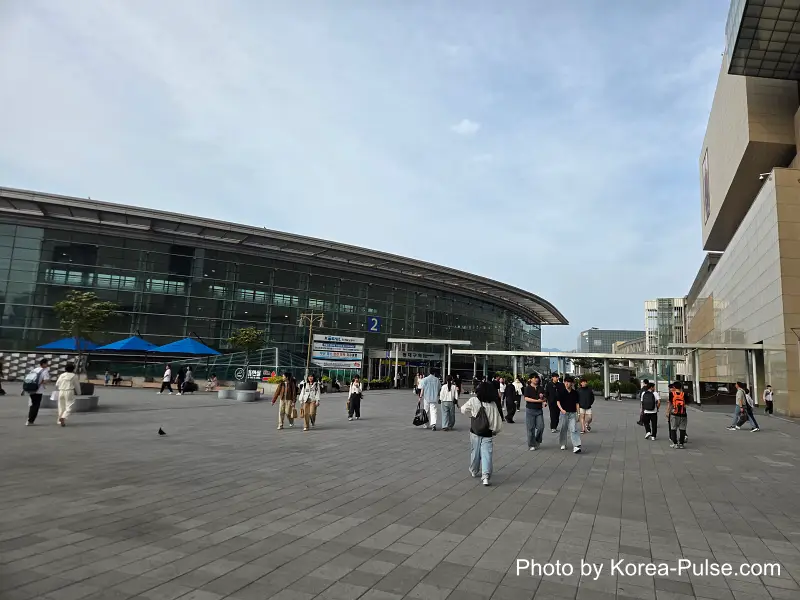
When I was growing up, getting around Gyeongsang-do meant buses — specifically, the old Dongbu (East) Bus Terminal, which was the go-to hub for regional travel long before KTX existed. The terminal was scattered across four separate buildings in the area, which made it simultaneously confusing, charming, and deeply inconvenient.
On December 12, 2016, the Dongdaegu Station Complex Transfer Center officially opened, absorbing the old Dongbu Bus Terminal and the Daegu Express Bus Terminal into one unified hub. Three days later, Shinsegae Department Store opened its doors — its first return to Daegu in 40 years after withdrawing in 1976. The total investment: a staggering ₩880 billion. Under one roof, you now have KTX, SRT, ITX, Mugunghwa, express buses, intercity buses, subway Line 1, city buses, and Shinsegae. Daegu International Airport is reachable in about 10–15 minutes by taxi. It is, by any measure, one of the most functional transit hubs in the country.
Back Inside the Station: The Queue That Never Ends
Back inside the station concourse, the energy is different from Seoul Station — less business-trip frenetic, more weekend-excursion buzz. And there, predictably, was the reason for at least half of it.
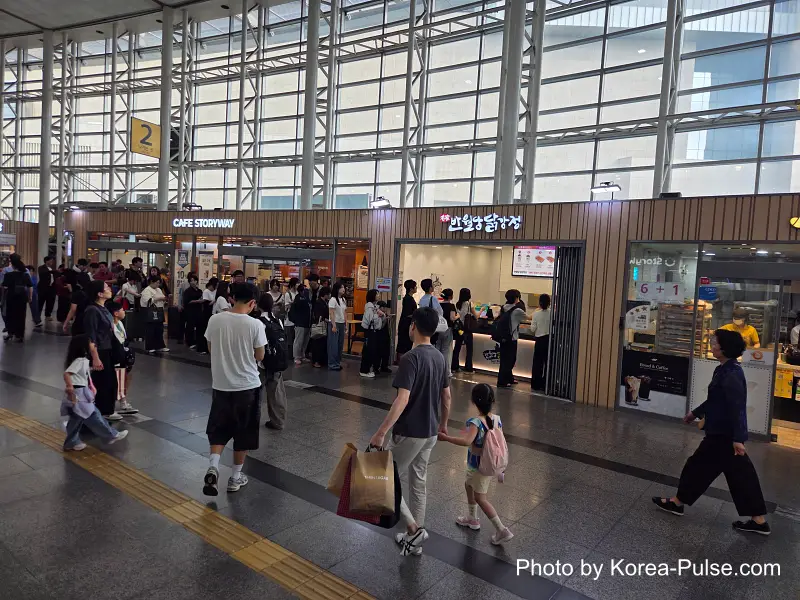
Banwoldang Dakgangjeong (반월당 닭강정) — I’ve mentioned it in previous posts, and here it is again, doing exactly what it always does: drawing a line of people that wraps past the neighboring Cafe Storyway. It’s fried chicken glazed in a sweet-spicy sauce, served alongside tteokbokki (rice cakes in chili), and it smells incredible from twenty meters away.

My family briefly dispersed — middle schooler chasing a different food smell, spouse somewhere involving a convenience store — so I seized the moment for a close-up shot. Those thick, chewy rice cakes glistening in sauce next to the crispy chicken chunks. I did not buy any, which was the correct logistical decision and a decision I immediately second-guessed for the next hour on the train.
Platform Time: The Board, The Corridor
At 17:39, I checked the departure board. Our train — Mugunghwa No. 1777, bound for Donghae via Andong — was leaving at 17:46 from Platform 1. Seven minutes. Not panicking, but definitely not lingering.
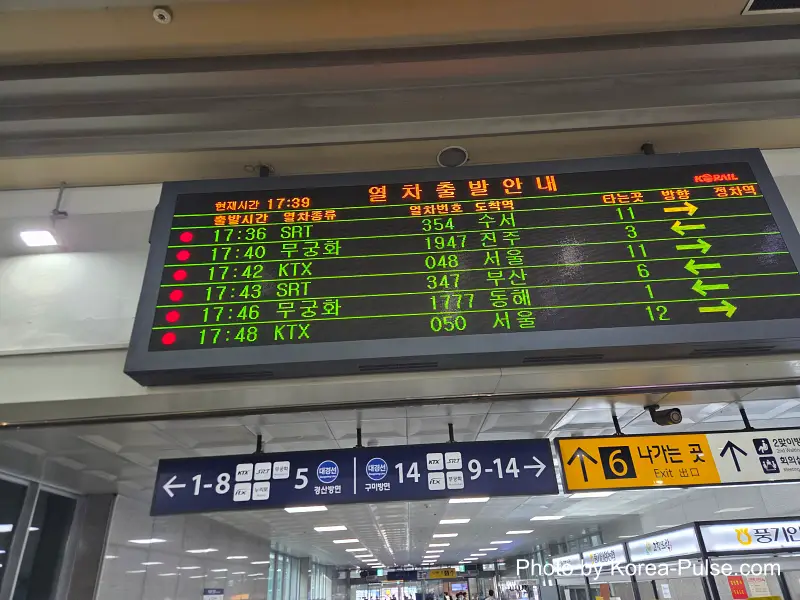
The board shows the full picture: SRT departures, KTX to Seoul and Busan, and our Mugunghwa threading between them toward the east coast. The English version cycles through automatically every few seconds — though if you’re short on time, the Korean layout is faster to scan once you know what to look for (departure time on the left, train type next, then destination and platform number on the right).
Dongdaegu Station’s departure boards display: departure time · train type · train number · final destination · platform number. Platforms 1–8 handle KTX and general trains from the main building. Platform access is via escalators or elevators — follow the numbered platform signs from the concourse level. The English version cycles every few seconds, which can feel slow if your departure is imminent.
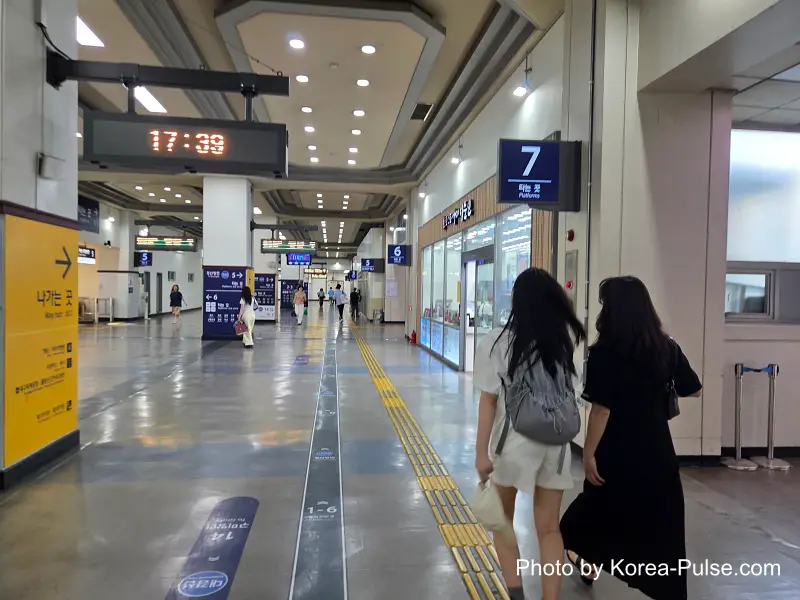
If you’ve read my previous Seoul Station post, you’ll recognize this layout: an elevated concourse with food options running above the main hall, before descending to the platforms. Dongdaegu’s version is slightly smaller, but the logic is identical. Platform 1 is the first turn off the main corridor — a short walk, no drama.
Boarding the Mugunghwa: Vintage Velvet and Real Legroom
The contrast with the KTX hits you the second you step through the doors. The seats are a different era: navy blue fabric, white headrest covers printed with the Korail logo, overhead luggage racks running the length of the carriage. It feels like being inside a well-maintained time capsule.
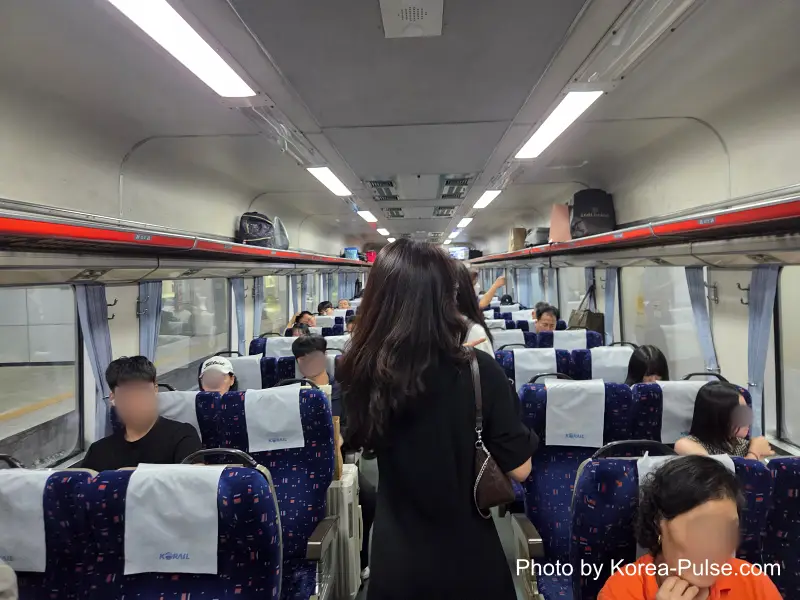
We were in Car 2 (2호차), Seat 68. The Mugunghwa uses a 2+2 seating configuration — wider than the KTX’s more compact arrangement — and the seats recline properly. Aisles are wide enough for a family to move comfortably, overhead racks handle full-size luggage without issue, and the toilets are at each end of the car. Good news for anyone traveling with kids.
Wi-Fi is a different story. On older rolling stock like this set, there’s nothing — not on the walls, not in the seats. Newer refurbished Mugunghwa cars do carry complimentary Wi-Fi and 220V power outlets, but this is still inconsistent across the fleet and not something to rely on. Charge your devices before boarding, download something to watch, and treat the landscape as the entertainment.
The Mugunghwa name — taken from Korea’s national flower, the Rose of Sharon (무궁화) — was formalized in 1984 when Korail restructured its intercity train tiers. Before KTX arrived in 2004, the hierarchy ran: Saemaeul (fastest, most expensive) → Mugunghwa → Tongil → Bidulgi (slowest, most local). The Saemaeul took around 4 hours Seoul to Dongdaegu; the Mugunghwa took around 6 hours. These days, Mugunghwa trains operate at up to 150 km/h and remain the backbone of regional rail on lines that high-speed trains don’t serve — like the Jungang Line through to Andong.
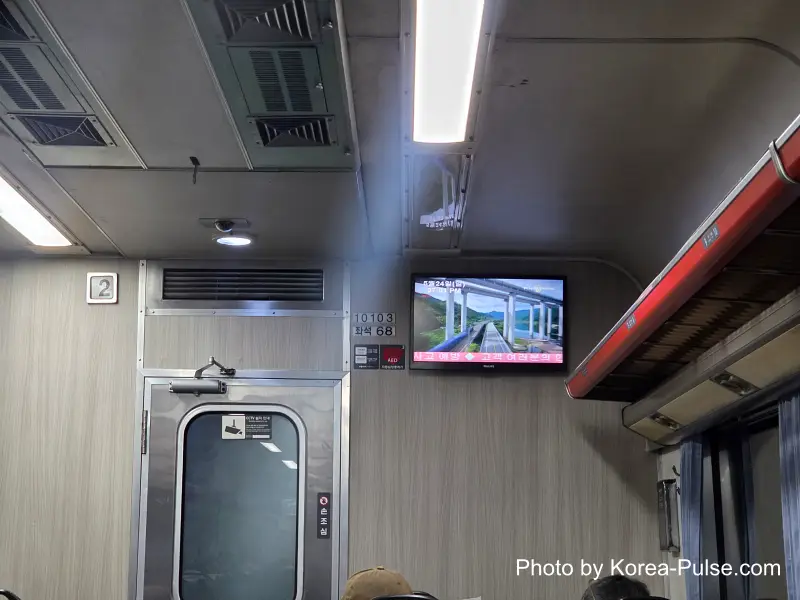
Each car has an overhead TV monitor displaying journey information and content — including a speed readout that cycles in periodically. I was specifically watching for it to snap a photo. Instead, the screen cut to scenic railway footage just as I pressed the shutter. The Mugunghwa’s typical operating speed on this stretch is around 100–120 km/h, with a maximum of up to 150 km/h on the most upgraded sections of the Jungang Line.
Andong Station: Arrived Ahead of Schedule
The scheduled journey time is 1 hour 22 minutes. On this particular Saturday evening, we rolled into Andong right on the timetable at 19:08. Train 1777 is apparently a reliable one.
And here’s something worth knowing before you arrive: this isn’t the Andong Station you’ve seen in old photographs or heard about in Korean trot songs. The famous “Andong Yeok-eseo” (안동역에서) — the beloved ballad by singer Jin Sung about waiting at Andong Station on the first snowy day — was set at the old station in Eunheung-dong (운흥동), right in the city center, surrounded by the traditional market, Homeplus, and the bustle of downtown Andong. That station closed in December 2020 after 90 years of service. The one we arrived at is the new station, opened the same month, next to Andong Bus Terminal — 5.5 kilometers northwest of where the song was written.
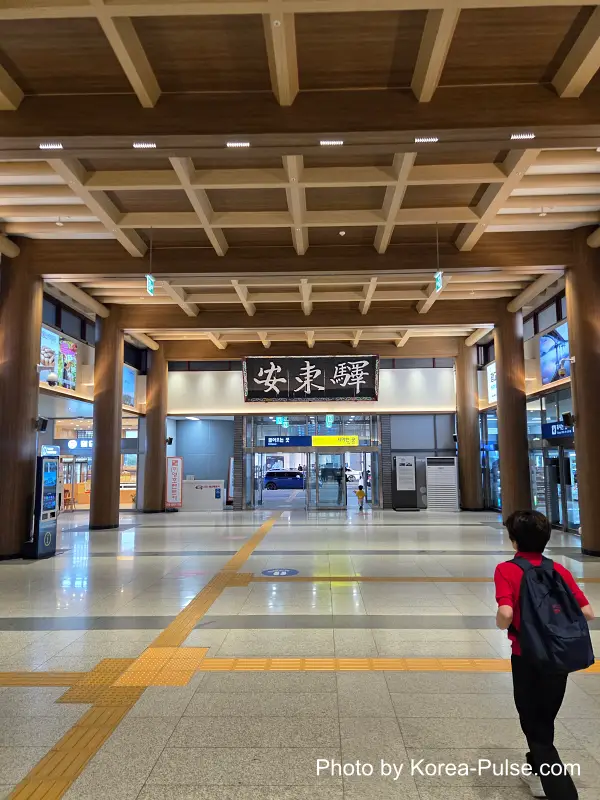
The new station is a quiet, dignified place. The main hall has a wooden lattice ceiling and a large traditional calligraphy sign reading 安東驛 — Andong Station in hanja, carried over from the old building. The design draws from Andong’s most iconic traditional architecture: the entrance pillars and ceiling echo the patterns of Imcheonggak and Mandaeru, Joseon-era structures the city is justifiably proud of. It feels intentional — a city with deep Confucian roots, and a station that knows it. We met up with my wife’s family that evening, and the next morning we’d be taking the ITX Maeum north to Cheongnyangni (that’s a story for Part 3).
Andong is one of Korea’s most culturally significant cities — home to Hahoe Folk Village (UNESCO World Heritage Site), the Andong Mask Dance Festival (held annually in autumn), and Korea’s most famous jjimdak (braised chicken). It’s an excellent base for a day trip or overnight from Daegu or Gyeongju, and the Dongdaegu to Andong train is by far the most relaxed way to get there.
Dongdaegu to Andong Train: The Numbers
| Detail | Mugunghwa (Dongdaegu → Andong) |
|---|---|
| Fare (Standard) | Around ₩7,800 KRW (~$5.80 USD) — subject to minor variation |
| Scheduled duration | ~1 hour 22 minutes (Train 1777: 17:46 → 19:08) |
| Daily frequency | Approx. 2 direct Mugunghwa departures per day — check timetable before planning |
| Train line | Jungang Line (중앙선) |
| Seating | 2+2 configuration, fabric seats, reclining, wide aisles |
| Typical operating speed | 100–120 km/h (up to 150 km/h on upgraded sections) |
| On-board amenities | Overhead TV, luggage racks, toilets. Wi-Fi and power outlets on newer rolling stock only — inconsistent, don’t rely on it. |
| Ticket booking | Korail Talk app · LetsKorail website (letskorail.com) · Station ticket machines (English supported) · Station counter |
| KORAIL PASS compatible? | Yes — Mugunghwa and KTX are included. SRT is not covered by the KORAIL PASS (SRT is operated separately by SR). |
Korail has been progressively replacing Mugunghwa services with the newer ITX Maeum on the Jungang Line. If you’re booking ahead, check whether your specific departure is listed as 무궁화 (Mugunghwa) or ITX 마음 (ITX Maeum) — the ITX Maeum is faster, slightly pricier (typically ₩13,000–₩16,000 on this route), and has better amenities. Both serve Andong. Neither requires a passport — just a valid ticket and your seat number.
FAQ: Dongdaegu to Andong Train
The practical questions — answered straight.
Depends what you’re optimizing for. The express bus from Dongdaegu Terminal is actually slightly faster (around 70–80 minutes) and runs more frequently. The fare is similar, around ₩8,000–₩10,000. The Mugunghwa train, on the other hand, is cheaper, more comfortable for families with luggage, and rolls through the Nakdong River valley scenery that the highway misses entirely. If you’re in a rush and flexibility matters, bus wins. If you’re traveling with kids, bags, or just want to arrive relaxed — take the train.
Yes. The Korail Talk app and the LetsKorail website (letskorail.com) both support English, Chinese, and Japanese. You can book up to a month in advance, and tickets display as a QR code on your phone — no printing required. Station machines also support English. Walk-up tickets are usually available except on major Korean holidays (Chuseok, Lunar New Year). Given that only ~2 direct trains run per day, booking ahead is strongly recommended.
Treat it as a no-Wi-Fi ride and you won’t be disappointed. Older sets — like the one in these photos — have neither Wi-Fi nor power outlets. Some newer refurbished cars have both, but availability is inconsistent and not something to count on. Charge everything before you board, download what you need, and enjoy the scenery instead.
No passport check at the platform or on the train. You need your ticket (digital or printed) and your seat number. Conductors walk through each car to verify tickets, so have it ready.
Yes — Mugunghwa and KTX services are both included in the KORAIL PASS. Note that SRT is not — it’s operated separately by SR and requires its own booking. If you’re doing a regional loop through Gyeongbuk (Andong, Yeongju, Gyeongju), the KORAIL PASS makes strong financial sense.
This is genuinely important. The current Andong Station (opened December 17, 2020) is in Songhyeon-dong (송현동), right next to Andong Bus Terminal — about 5.5km northwest of the old city center. This is the station for all trains: Mugunghwa, ITX Maeum, and KTX-Eum.
The old Andong Station in Eunheung-dong (운흥동) — the one in the trot song, surrounded by the traditional market and Homeplus — closed in 2020 and is now a cultural heritage venue called Jungang Line 1942 Andong Station (중앙선 1942 안동역). It is no longer an operating rail station.
Critical tip: if you ask for the “안동역 (Andong Station)” city bus, you may end up at the old closed station in the city center. To reach the operating station, ask for “안동터미널 (Andong Terminal)” — the new station is right beside it.
The Verdict
“₩7,800 and 82 minutes. You’re not saving time — you’re spending it well.”
The Dongdaegu to Andong train won’t impress anyone with its Wi-Fi or its seats. But it rolls through the Nakdong River valley and into the foothills of North Gyeongsang Province on a route that high-speed trains don’t touch. It’s affordable, punctual, family-friendly, and the kind of travel that actually feels like going somewhere. Just check the timetable first — with only about two direct departures a day, this one requires a little planning. I’d ride it again without hesitation.