
K-TRAVEL · June 2026
Incheon Airport Smartpass:
Your Biometric Cheat Code Out of Korea
Skip the departure queue, grab the duty-free, hit the lounge — and actually enjoy leaving Korea.
Leaving Korea is always bittersweet. The food you’ll miss, the subway you somehow mastered, the Olive Young you basically lived in. But one thing that has never been bittersweet? The departure queue at Incheon International Airport. Until now. Enter the Incheon Airport Smartpass — a biometric pre-registration system that turns the departure hall entry gate from a passport-fumbling bottleneck into a three-second face scan and a green light. I tested it on my recent Bangkok trip, and I am here to tell you: this changes everything.
clearance time
or use Smartpass
supported
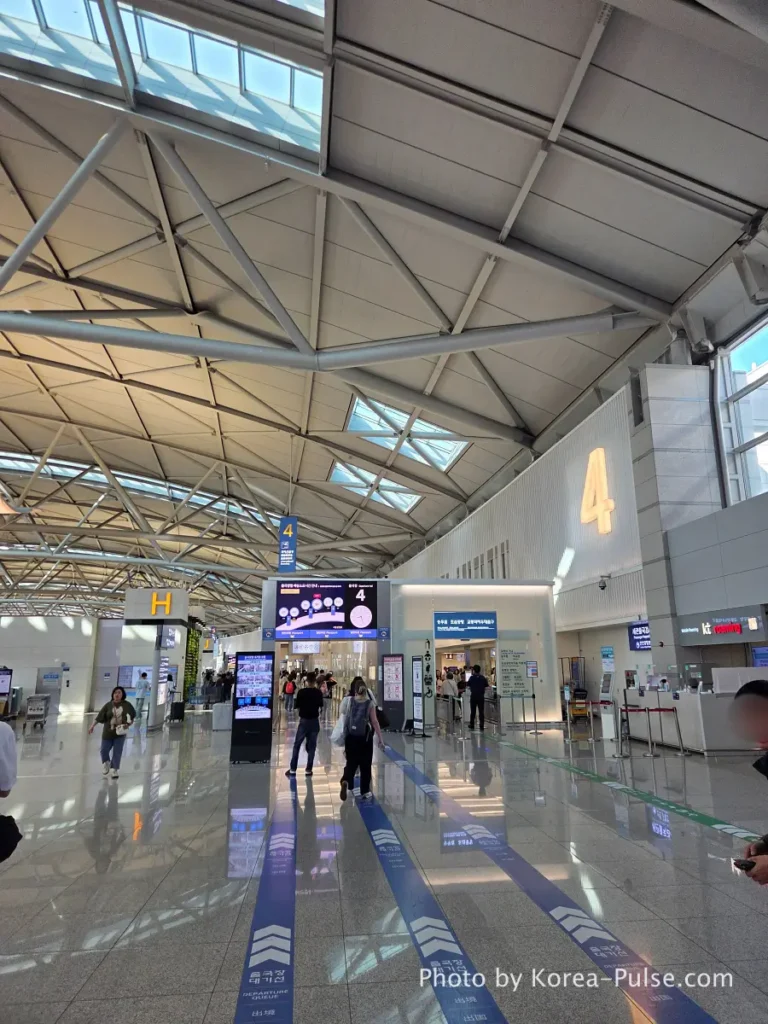
What Is the Incheon Airport Smartpass?
The Incheon Airport Smartpass is a biometric identity system operated by Incheon International Airport Corporation. Before you fly, you link your passport and facial scan to the system — and from that point on, your face becomes your travel document at the departure hall entry gate. No fumbling for a physical passport. No joining a general queue of 200 people. You walk up to the dedicated ICN biometric gate, look at a camera, and it opens. That’s it.
It’s a free fast track for international departures — not just business class or premium card holders. Most international passengers holding a biometric (NFC-chipped) passport can register and use it. (A small number of passport types and special cases may not be supported — check the official page if you’re unsure.)
The step-by-step guide is on the Incheon Airport Smartpass official page — covering app download, passport NFC scan, facial registration, and how to use the gates on departure day. Setup takes about 5 minutes at home.
Is Incheon Airport Smartpass Right for You?
Honest answer: it’s not a game-changer at every hour of every day. But used in the right circumstances, this Seoul airport departure tip genuinely transforms the experience.
Tight connection or late airport arrival
Duty-free pickup + lounge on your plan
Peak travel seasons (holidays, summer)
Quiet travel periods (standard lines move fast)
Non-biometric passport holders
As for how much time you actually save — it depends heavily on when you fly:
| Departure Time / Conditions | Estimated Time Saved |
|---|---|
| Peak hours (morning, holidays) | 15 – 40 minutes |
| Standard busy period | 5 – 15 minutes |
| Quiet off-peak (late night etc.) | 0 – 5 minutes |
My early morning Bangkok flight was solidly in the first category. Registering took five minutes the night before. The return on that investment was immediate.
How to Register: App or Kiosk
My recommendation: do it on the app the night before. It takes five minutes, it works, and you won’t be the person desperately tapping at a kiosk while your coffee goes cold.
Finding the Right Gate: Trust the Signs, Not the Desk
Here’s where my morning got unexpectedly entertaining. After checking in my luggage, I pulled up the official Incheon Airport Smartpass diagram on my phone — the one that clearly shows the dedicated gate assignments for each terminal.
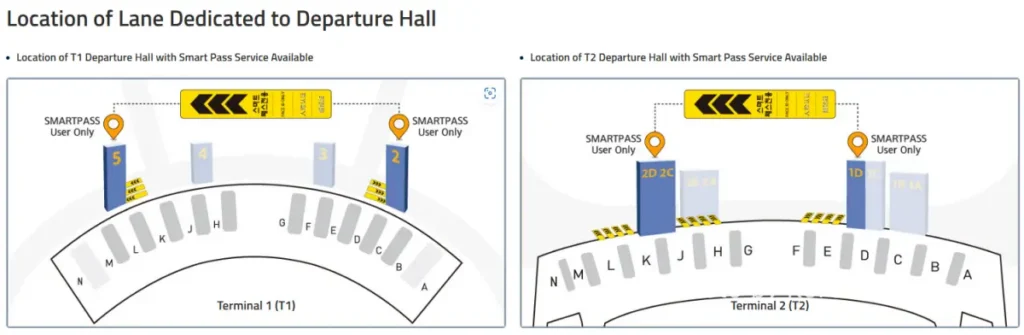
The map is clear: at Terminal 1 (T1), the dedicated Incheon Airport Smartpass lanes are at Departure Gates 2 and 5. At Terminal 2 (T2), they’re at Gates 1D/1C and 2D/2C. (Gate assignments can occasionally change with airport operations — worth a quick check on the official map the morning of your flight, just to be safe.)
So naturally, I still stopped to ask an information desk officer. “Gate 4,” he said, with full confidence.
I walked to Gate 4. Bright blue queue lines on the floor. A growing crowd of ordinary, non-biometric, passport-fumbling humans. Something was off. I grabbed a security guard by the entrance. “Smartpass?” I asked. He pointed down the hall. “Gate 5.”
Do not ask the information desk which gate to use for Smartpass. Screenshot the gate map above and navigate directly. At T1, head to Gate 5 (or Gate 2 on the opposite end). You’ll see a clear “Smartpass User Only” sign in yellow when you get there — the signage at the gate itself is unambiguous.
The Face-Pass Moment: Completely Empty Lane
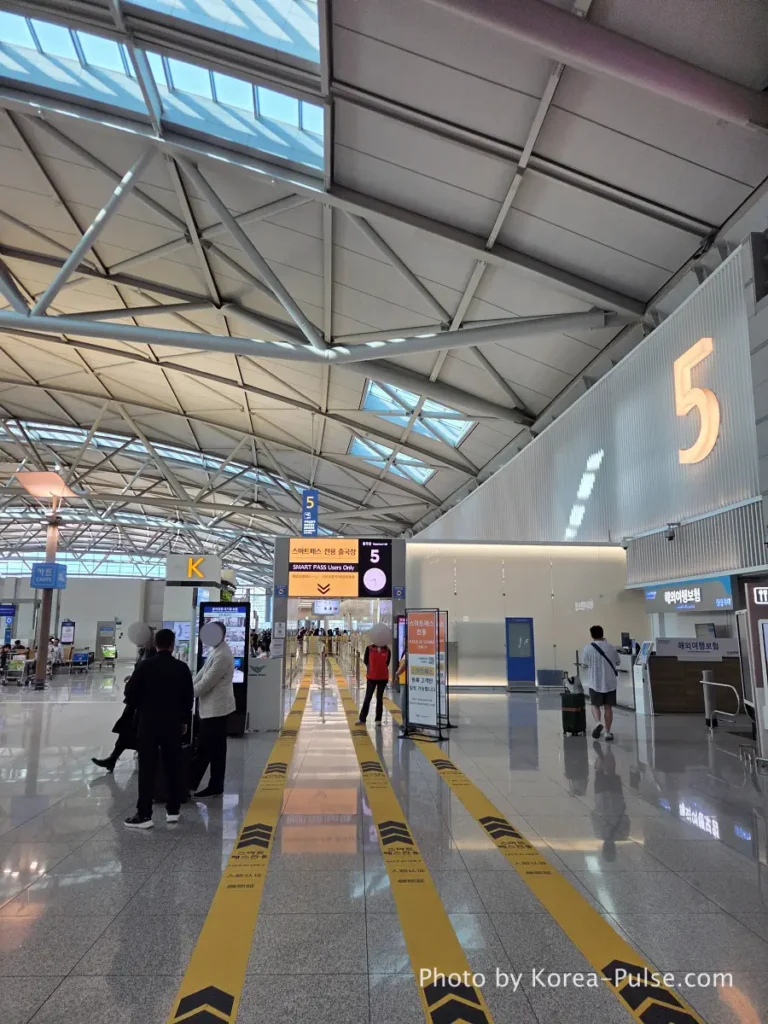
Gate 5. Dedicated Incheon Airport Smartpass lane. Completely. Empty.
On the other side of the hall? A standard departure queue snaking back nicely. On my side? Me, alone, walking up to a camera screen in an otherwise silent corridor. I looked at the screen. Green light. The gate opened. I walked through.
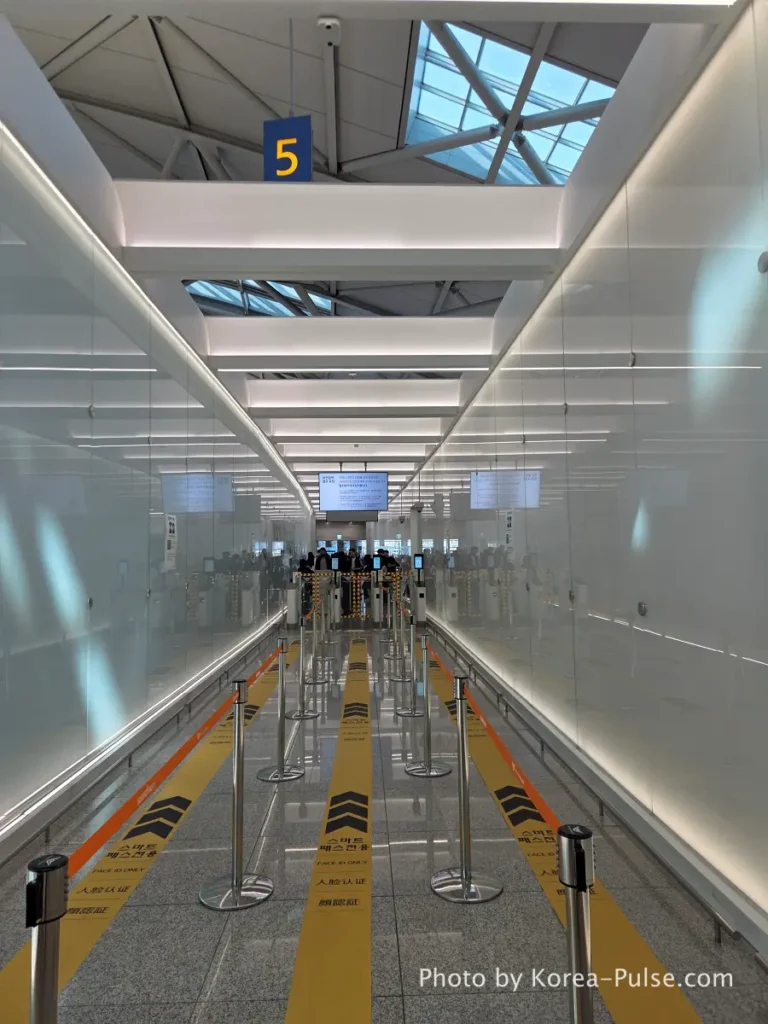
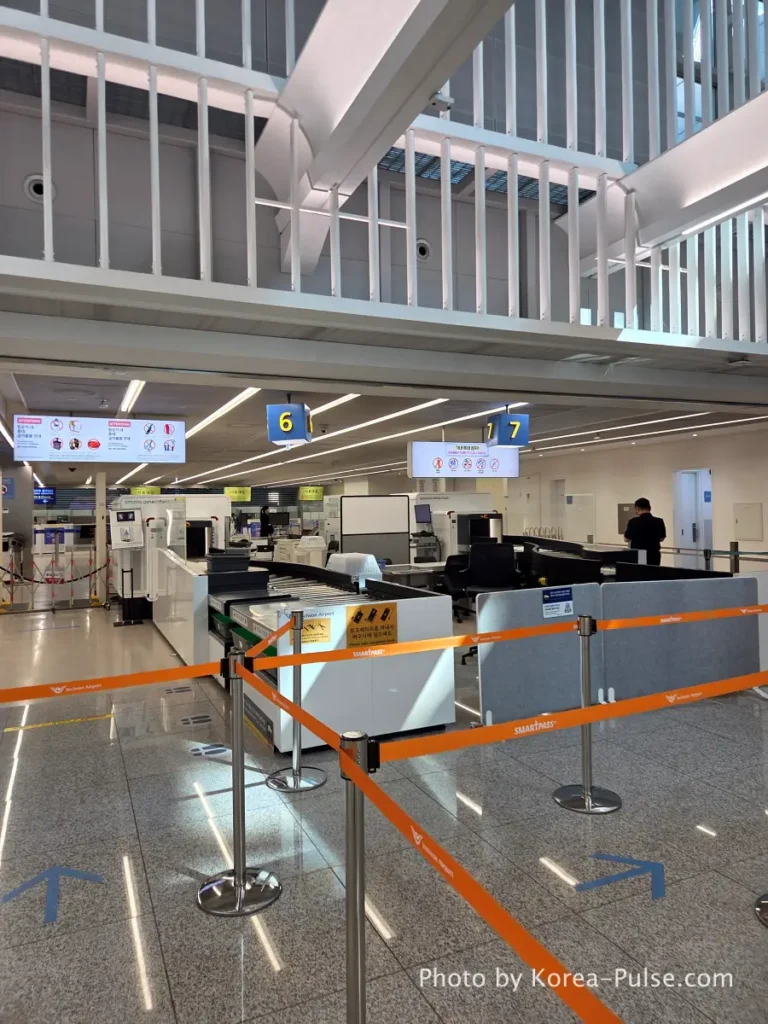
Right after the biometric gate comes the standard baggage and security screening checkpoint — X-ray conveyors, metal detector, the works. This part is the same for everyone; Smartpass doesn’t skip it. But at 8am with an early departure, nobody was there either. Bag down, walked through, bag back up — airside in what felt like three minutes total from approaching Gate 5. The whole departure clearance was done before my coffee had time to cool.
The Incheon Airport Smartpass fast track covers the departure hall entry gate only — the face scan replaces the passport check at that initial barrier. Security screening (X-ray, metal detector) still follows, as normal. Your physical passport is also still required at the boarding gate. That said, many airlines are progressively expanding biometric boarding too, so this may get even smoother over time.
Airside: The Moving Walkways and the Duty-Free Hunt
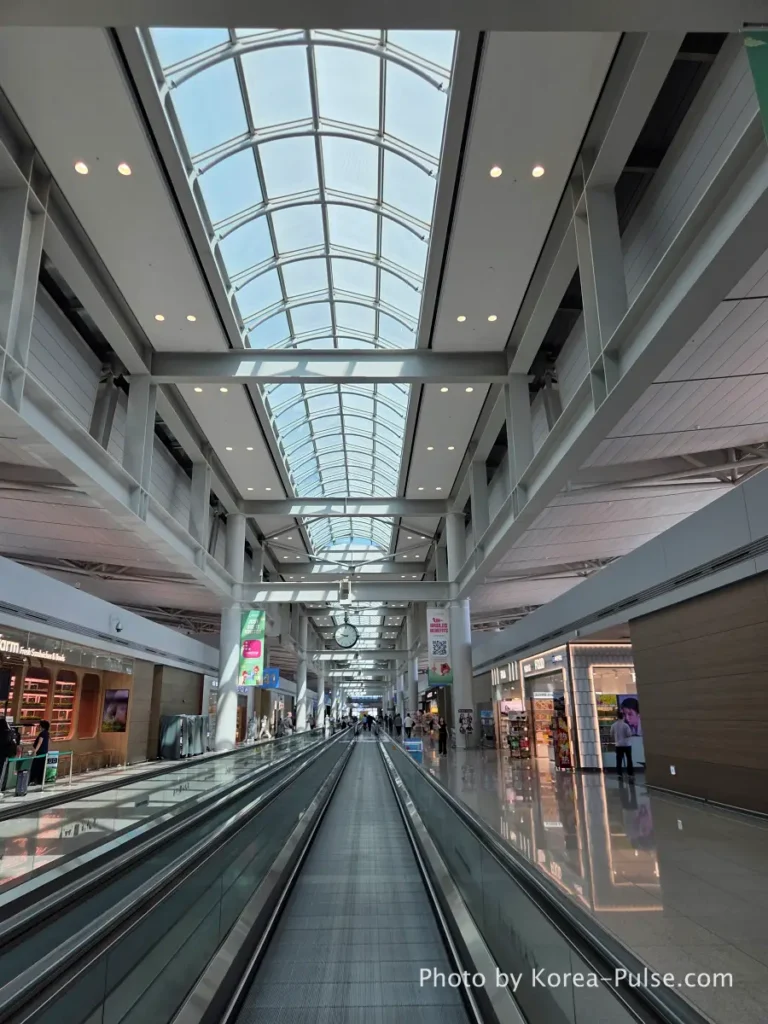
Once you clear security, Incheon’s airside corridor opens up — and it really is a sight. The terminal runs long and wide, with towering glass ceilings that flood the space with natural light. Moving walkways carry you smoothly toward the gates. It’s the kind of airport that makes you forget you were slightly stressed ten minutes ago.
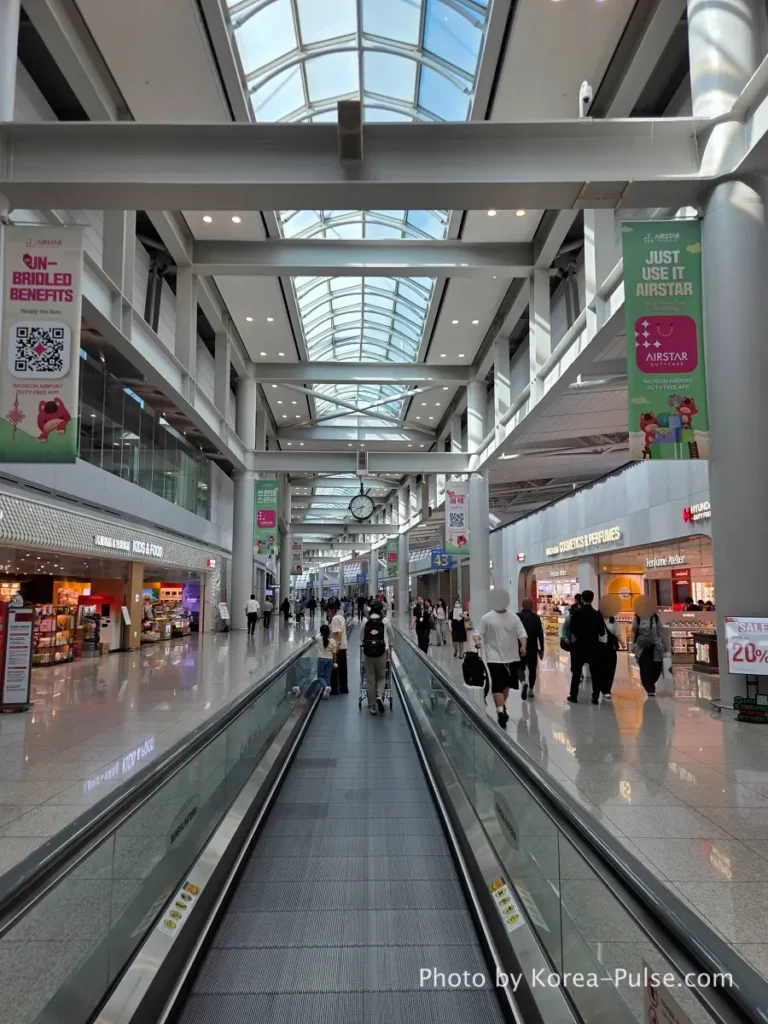
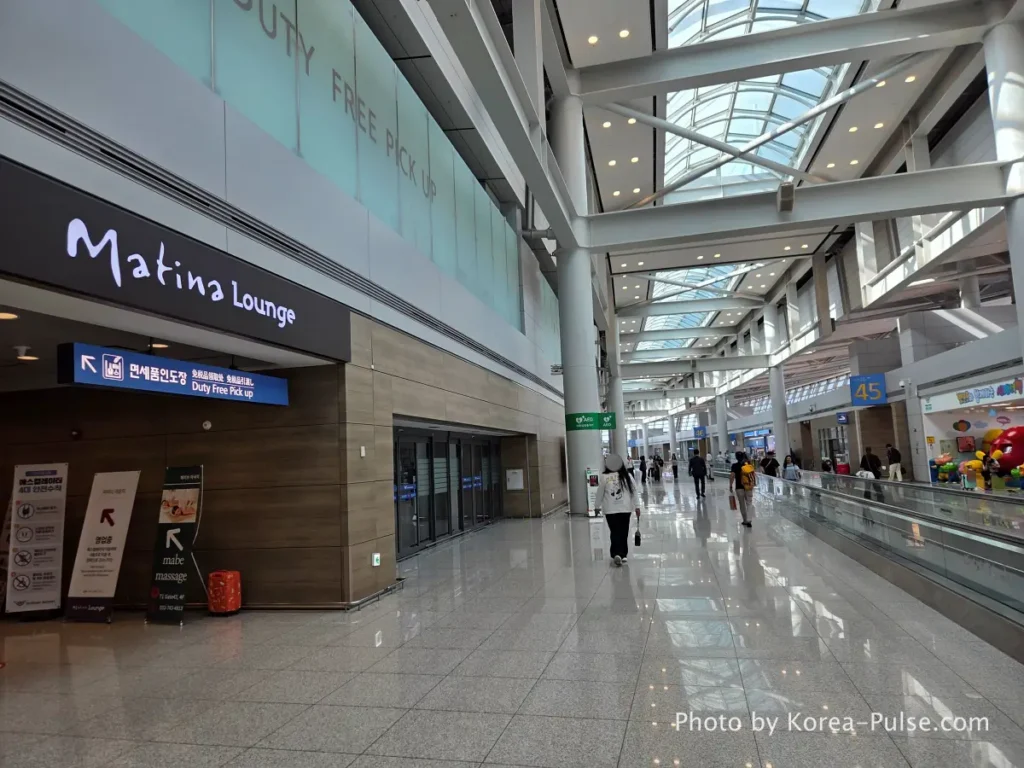
If you have pre-ordered duty-free items, your destination in T1 is the area around Gate 43–45. This is the hub zone: the duty-free pick-up counters (면세품 인도장) are up on the 4th floor here, alongside the main lounges. Take the escalator up, find the smart kiosk, slide in your passport, and collect your number ticket.
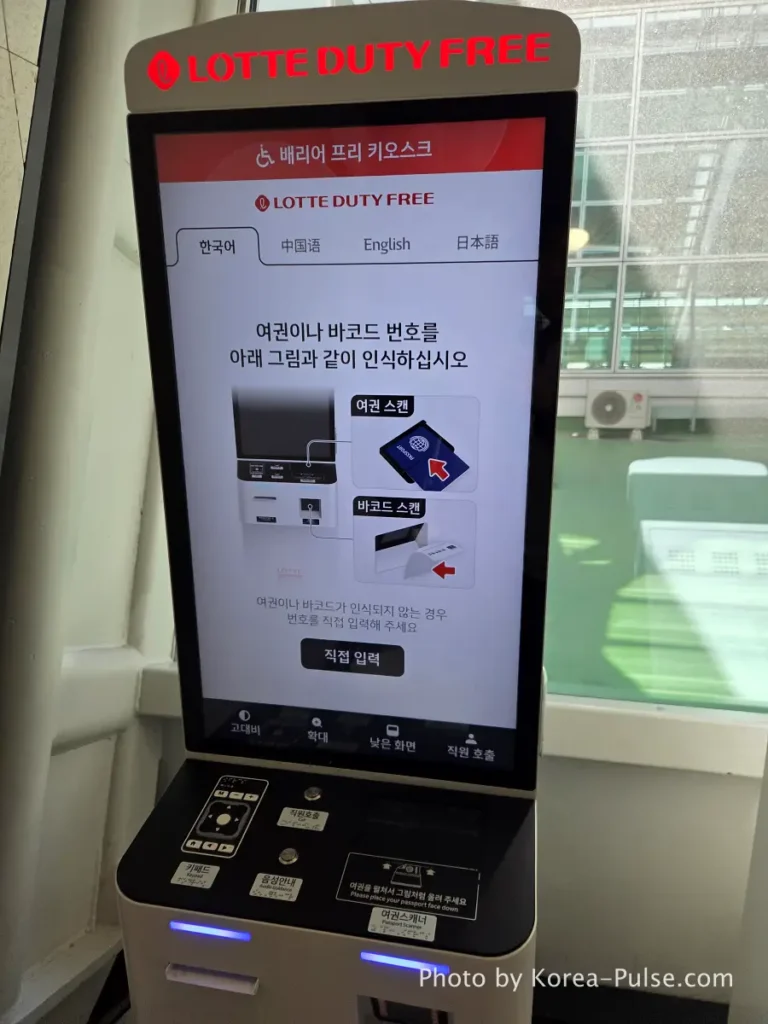
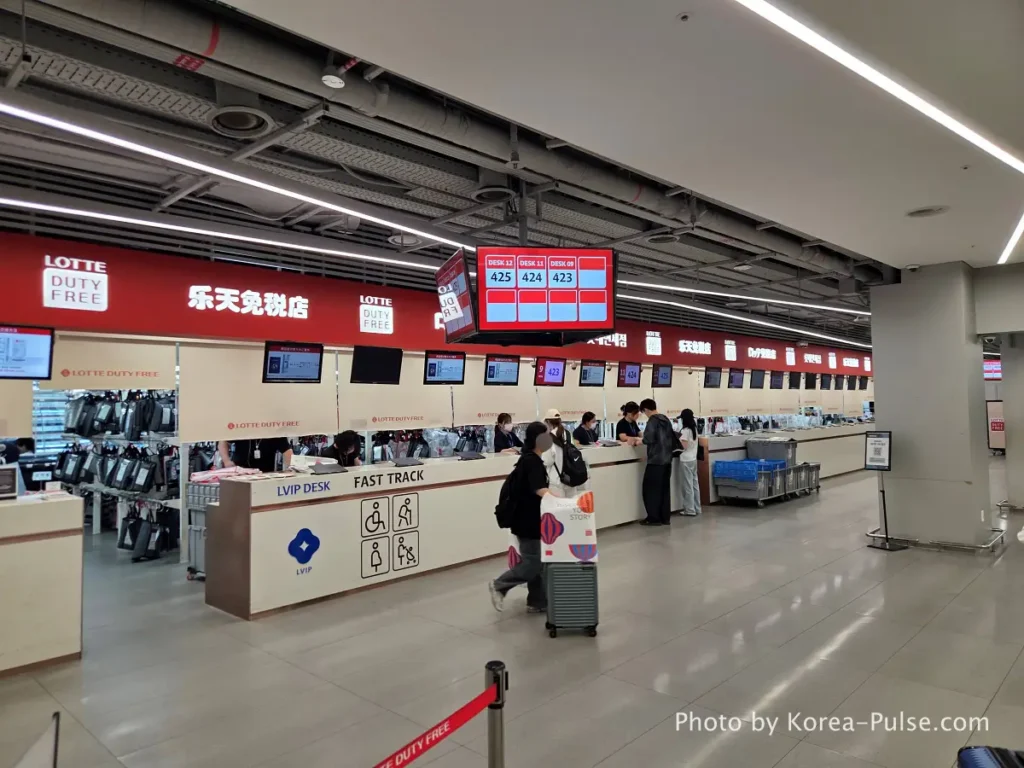
Because I’d taken an early flight, the counters weren’t overwhelmed. Number 425 came up almost immediately. Packages collected, bags re-shuffled, dignity maintained. On to the main event.
The Lounge Question: Which One, and How to Get In Free
With duty-free in hand and a solid hour before boarding, it was time for my favourite part of any departure: the lounge. At Incheon, you are not short of options.
Terminal 1 has five lounges total — two Matina Lounges (Gate 11 and Gate 43) and three SKYHUB Lounges (Gate 25, Gate 29, and Gate 115). Terminal 2 has four: SKYHUB (Gate 268 and Gate 247), Matina (Gate 252), and the premium Matina Gold (Gate 250). The screenshots below show the current layout for both terminals.
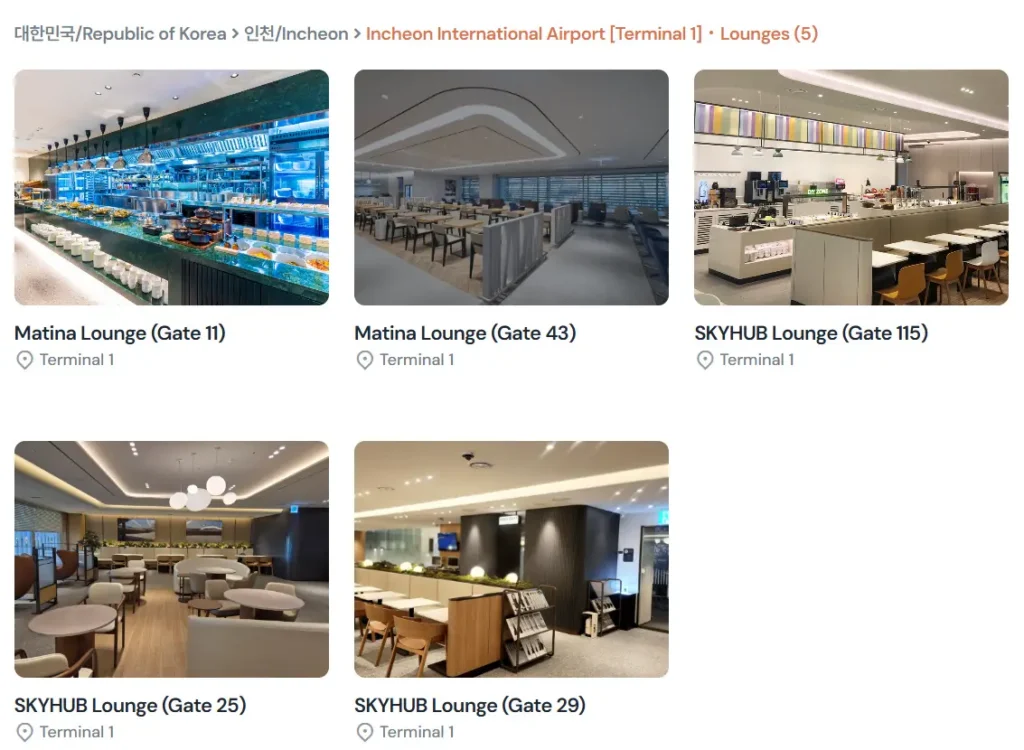
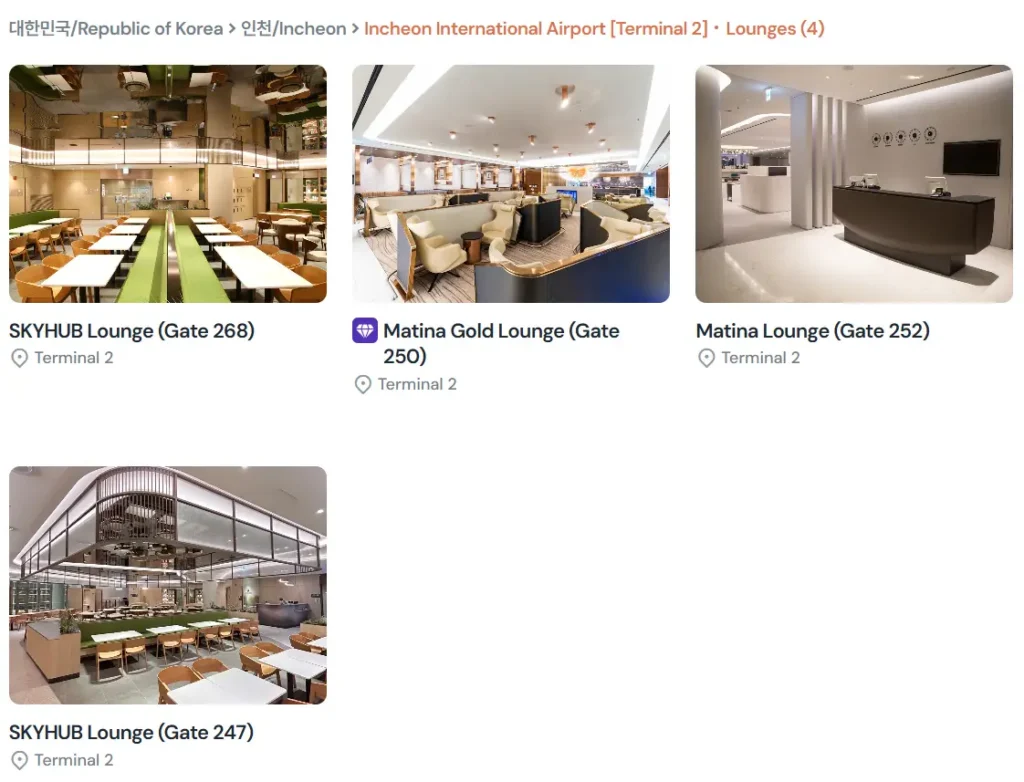
Walk-in rate: ~₩50,000 (approx. $37–40 USD). Almost nobody pays this. Here’s how people actually get in:
① Premium credit cards — Many Korean cards (Shinhan, Hyundai, Samsung, KB, Lotte) include complimentary lounge visits. Look for “공항 라운지 무료” in your card’s benefit page. Worth checking even for cards you’ve overlooked.
② The Lounge app (더 라운지) — Korea’s main lounge access platform. Register your eligible card in the app, generate a digital voucher, show it at the front desk. Most major Incheon lounges — Matina and SKYHUB — are listed. Some mid-tier travel cards qualify too.
③ Corporate benefit cards — Many Korean company employee ID cards (사원증 카드) include 2 complimentary lounge passes per year. Mine does. I used one here. If you haven’t checked with HR, now is the time.
④ Discounted vouchers — Card promotions often bring entry down to ₩30,000–₩35,000 (approx. $22–$25 USD). Not free, but meaningfully better than the door rate.
For the flagship lounge option: the Matina Lounge official page (Walkerhill) has full details on locations, hours, and facilities across both terminals.
My corporate card covered the entry, so I headed to the SKYHUB Lounge in T1. Three locations to choose from — Gates 25, 29, or 115 — depending on your gate assignment and energy levels. I picked the one nearest my departure gate. Zero regrets.
SKYHUB Lounge T1: Breakfast I Did Not Deserve
Presented my corporate card, waved through. The lounge isn’t enormous, but the food spread punches well above its weight for an airport buffet.
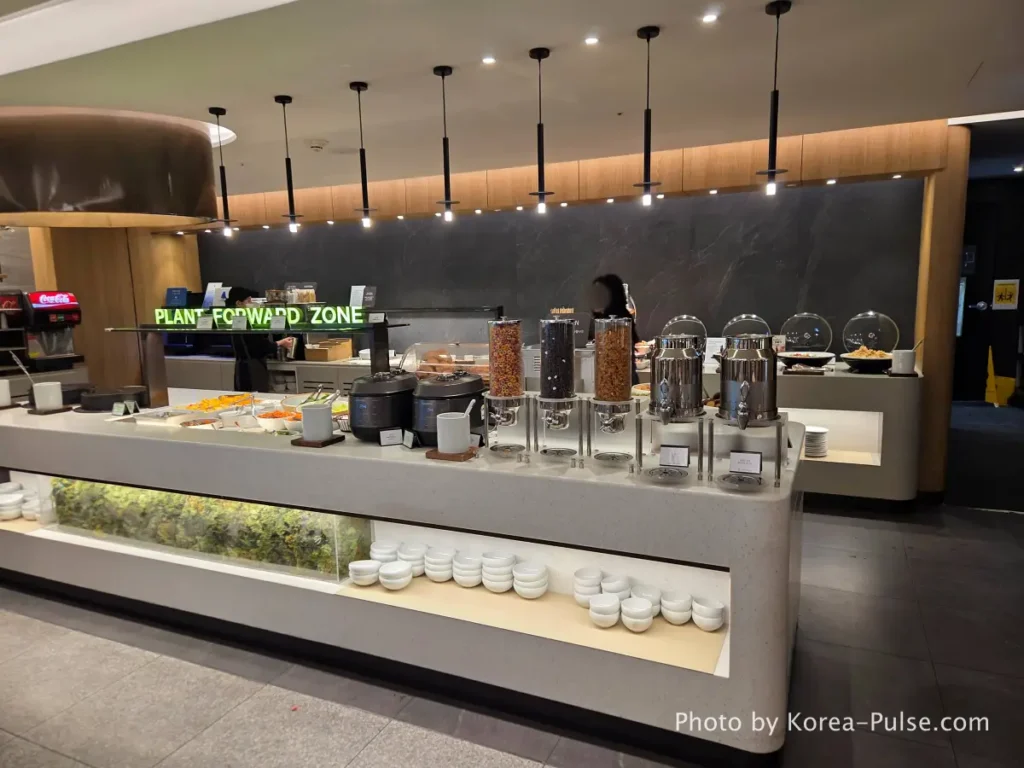
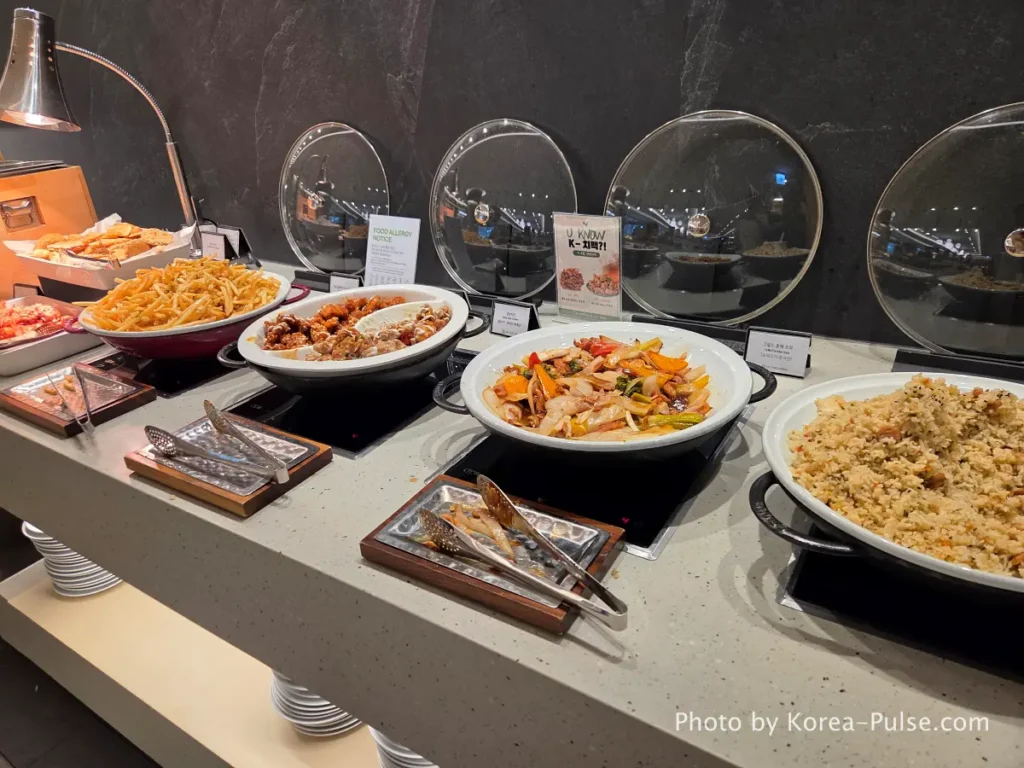
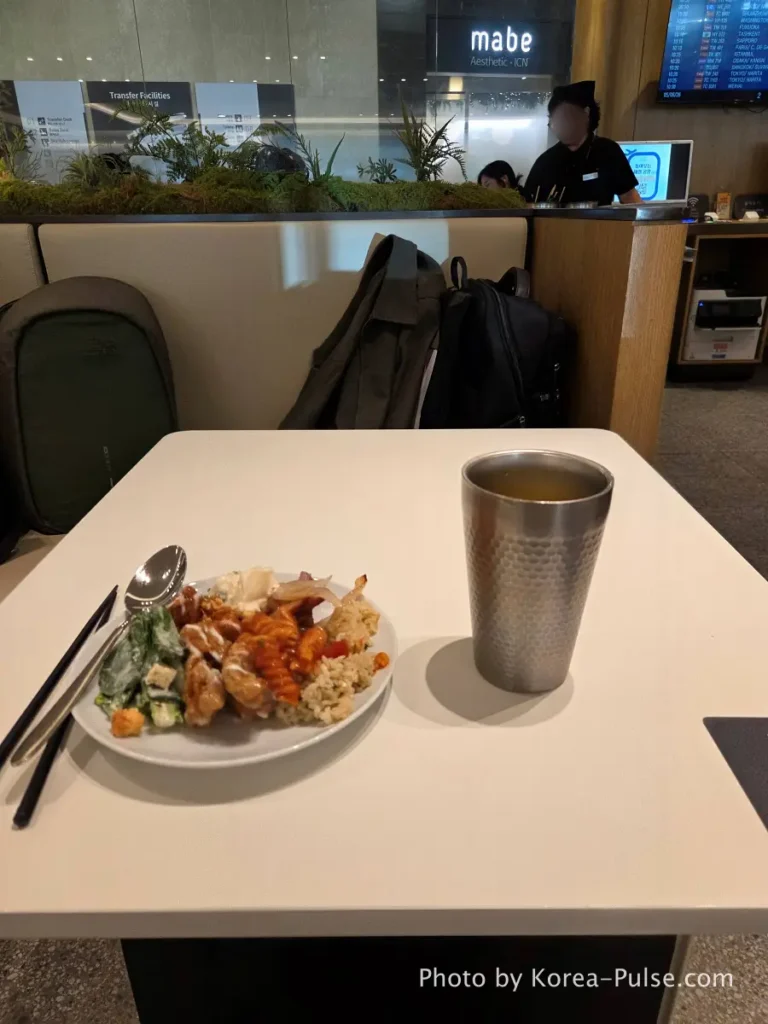
The spread: hot stir-fried rice, grilled smoked duck, crispy chicken, an array of side dishes, fresh fruits, cereals, Coca-Cola, and fresh juice. All included. I piled my plate, poured a tall glass of juice, and sat quietly for thirty-odd minutes watching the terminal hum below. If you have an early flight and 90 minutes before boarding, this is the move. The energy reset alone is worth the entry price — even if you paid for it.
If lounge access isn’t available for this trip, Incheon’s airside has a solid food court and plenty of cafes and snack shops directly on the route to the gates. You won’t go hungry — but you will be paying for it, and the queue for the good sandwich place can be surprisingly committed.
Gate 35 and the Flight: Bangkok, Here We Come
Boarding call. Packed up, thanked the lounge buffet silently, and headed toward Gate 35. The walk to the gates at Incheon always feels like a runway in itself — that long, sunlit corridor with the moving walkways doing most of the work is one of the better architectural experiences in international aviation.
Gate 35. The tarmac through the window showed a massive aircraft that wasn’t mine — but soon enough, the boarding announcement rang through. Stepping onto the Thai Airways flight, the airline’s iconic purple-and-gold palette, warm crew, and an in-flight meal that actually came with a snack for later made the transition feel complete.
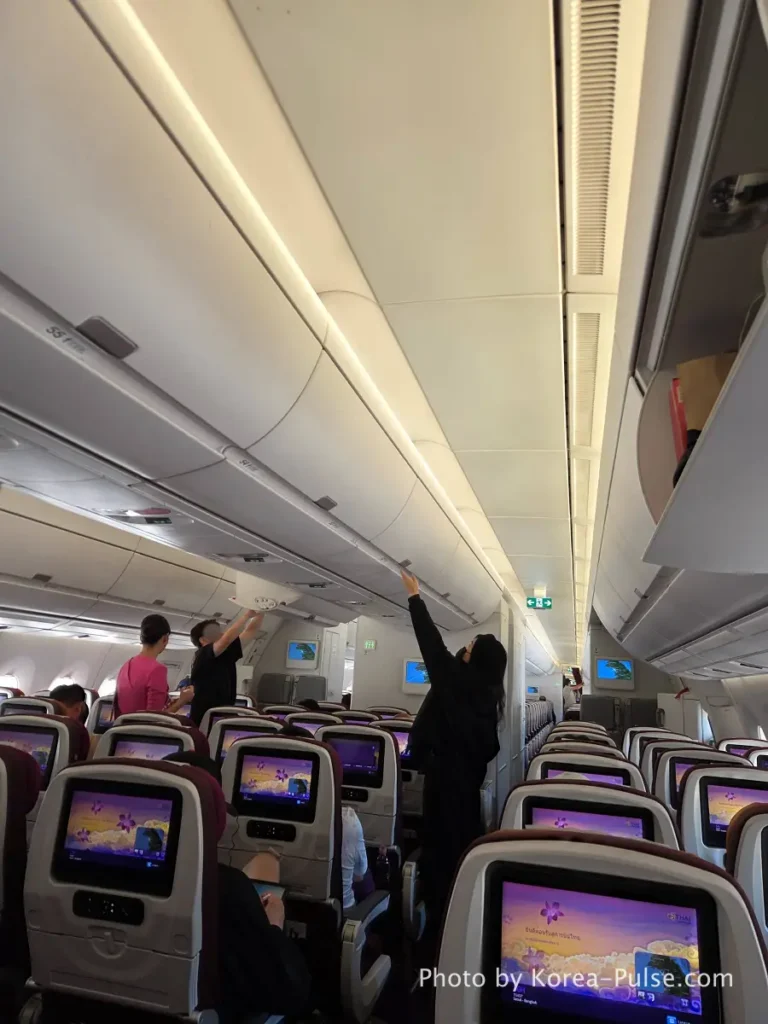
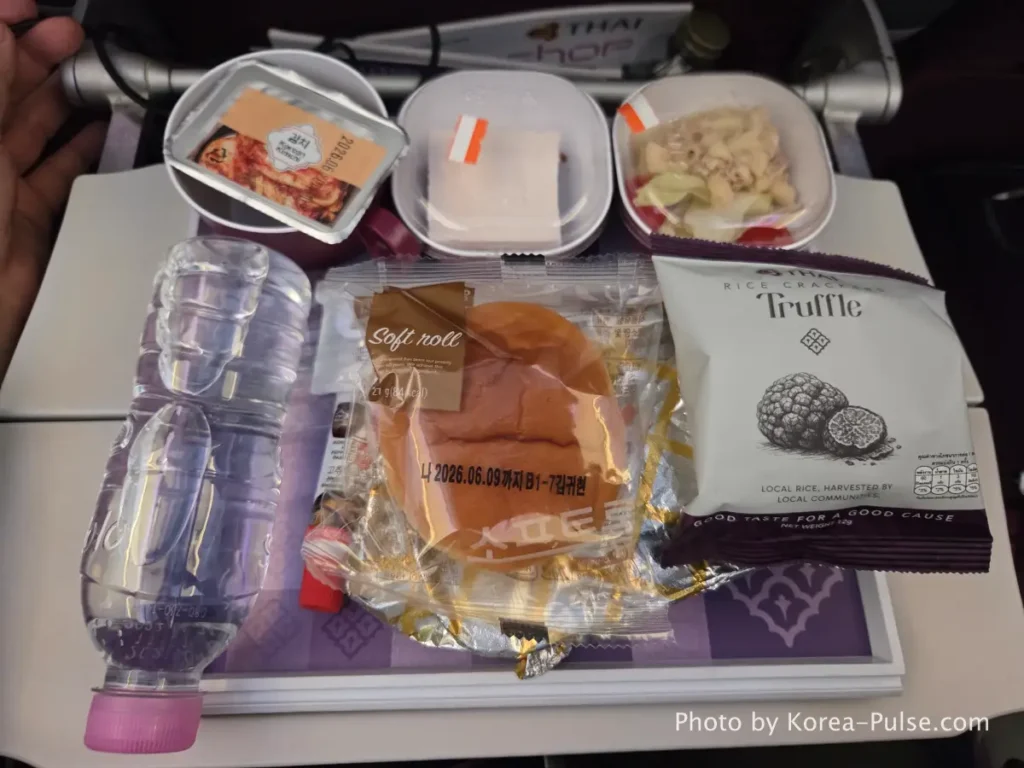
Korea faded behind the clouds. Bangkok was ahead. And the departure — from the Incheon Airport Smartpass gate to boarding — had been, genuinely, one of the smoothest I’ve experienced out of any major international hub.
“Five minutes of setup. A few seconds at the gate. A hot lounge breakfast before the flight. This is how you leave Korea.”
The Incheon Airport Smartpass is free, genuinely fast, and works exactly as advertised. Register the night before on the app, head straight to Gate 5 in T1 (or Gate 2D in T2), and ignore anyone who sends you somewhere else. Combine it with a lounge stop near Gate 43–45 and airport departure stops being a stress event — and starts being the actual beginning of your trip.
Quick Reference: Incheon Airport Smartpass Cheat Sheet
| Item | Detail |
|---|---|
| Registration | Incheon Airport app (iOS/Android) or on-site kiosk — free |
| Passport requirement | Biometric (NFC-chipped) passport required for registration |
| T1 Smartpass gates | Departure Gate 2 and Gate 5 (verify on the day) |
| T2 Smartpass gates | Gates 1D/1C and 2D/2C (verify on the day) |
| What it skips | Departure hall entry gate — security screening still applies |
| Duty-free pickup (T1) | 4F near Gate 43–45 — passport kiosk → number ticket |
| T1 Lounges | Matina (Gate 11, Gate 43) / SKYHUB (Gate 25, Gate 29, Gate 115) |
| T2 Lounges | SKYHUB (Gate 268, Gate 247) / Matina (Gate 252) / Matina Gold (Gate 250) |
| Lounge walk-in rate | ~₩50,000 ($37–40 USD) — use The Lounge app or card benefits |
| Official Smartpass page | airport.kr/ap_en/1416/subview.do |
| Matina Lounge info | walkerhill.com (Matina Lounge) |
FAQ: Incheon Airport Smartpass
The questions I get asked most — answered straight.
Yes — most foreign passport holders with a biometric (NFC-chipped) passport can register and use it. The system is designed for all international departure passengers, not just Korean nationals. A small number of passport types may not be supported; check the official page if you’re unsure about yours.
Yes — for the boarding gate and any airline check at the gate, you’ll still need your physical passport. Smartpass replaces the passport check at the departure hall entry gate only. Don’t leave it in your suitcase.
No — security screening (X-ray conveyor, metal detector) still applies after you enter through the Smartpass gate, same as everyone else. What Smartpass skips is the departure hall entry queue, where passports are checked before you reach security. In practice, the security screening area in the Smartpass lane tends to be much less congested, especially at peak times.
No — Incheon Airport Smartpass is for departures only. For arrivals, Incheon has a separate automated immigration system for eligible passport holders, but it’s a different process.
It happens occasionally — lighting, glasses, or minor registration issues can cause a no-match. A staff member is always stationed nearby to assist and verify manually. You won’t be stuck — it just becomes a slightly less dramatic entrance.